



Geometric growth is the kind of idea that feels small until it doesn’t.
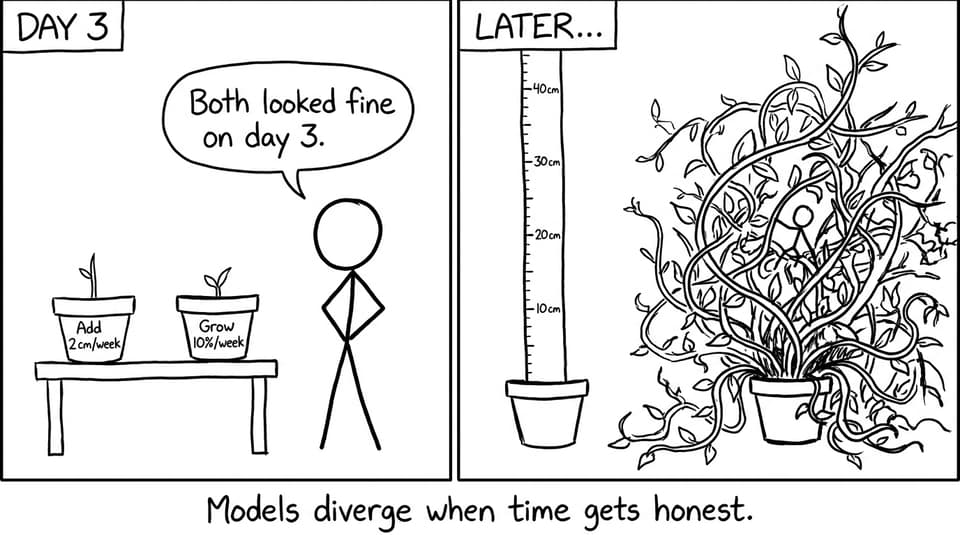
Picture two friends starting revision at the same time. One adds 20 minutes a day, every day. The other increases study time by 10% each week. In week one, they look almost identical. By week eight, one has a steady routine. The other has accidentally built a machine.
That’s the quiet reason IB Math leans on geometric sequences when questions touch finance, populations, depreciation, or “rate” language. Most real systems don’t change by adding the same amount. They change by multiplying what’s already there.
The 15-second decision rule (IB Math checklist)
When you’re under exam pressure, don’t ask “Which formula do I remember?” Ask “How is the system changing?”
Use this quick IB Math checklist:
-
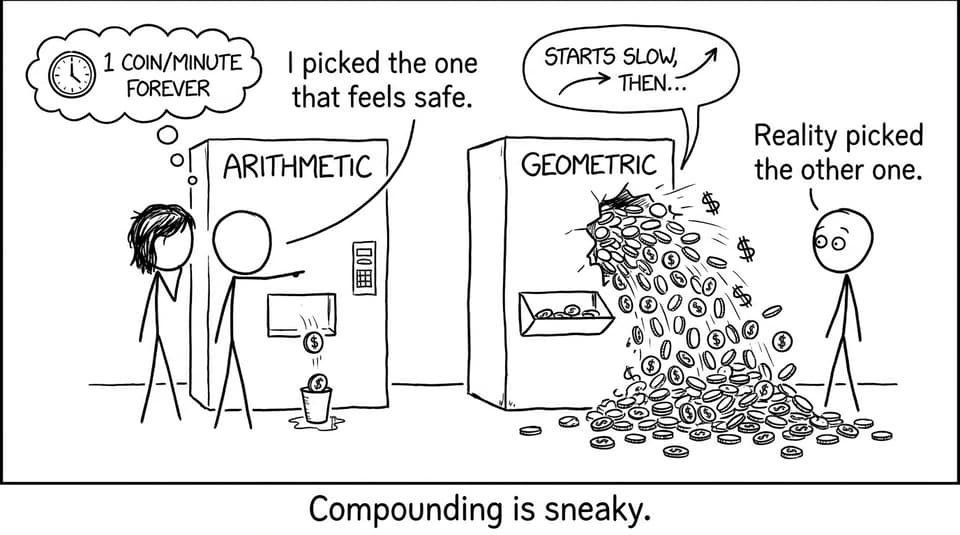
Arithmetic if the change is a fixed amount each step ("+50 per month")
-
Geometric if the change is a fixed rate/percentage/factor ("increases by 5%", "multiplies", "decays by 12%")
-
If the question says “per year” or “per month,” match your factor to the time unit
-
Sanity check: does the model ever predict negative values for something that can’t be negative?
If you want a fast refresher on the mechanics, keep these open while you practise:
What geometric sequences actually “mean”
An arithmetic sequence says: “Each step adds the same difference.” That’s linear change.
A geometric sequence says: “Each step applies the same multiplier.” That’s proportional change.
In IB Math, that proportional idea matters more than the formula. Because the world often pays attention to size.
A bank account doesn’t add $5 because you feel like you tried hard this month. It grows based on what’s already in it. A population doesn’t gain 200 people because the calendar flipped. It changes because births (and spread, and adoption, and decay) depend on how many exist right now.
Why reality usually multiplies instead of adds
Here’s the core story: in many systems, the “engine of change” is proportional to the current amount.
That’s why IB modelling tasks love contexts like:
-
Compound interest and inflation (growth factor like (1.05))
-
Depreciation (decay factor like (0.85))
-
Population growth/decline at a constant rate
-
Information spread when each person influences more people
If you want targeted syllabus-aligned practice in that modelling style, these hubs help:
Why arithmetic models “look fine” at first, then fail
Over short time windows, arithmetic and geometric models can mimic each other. That’s the trap.
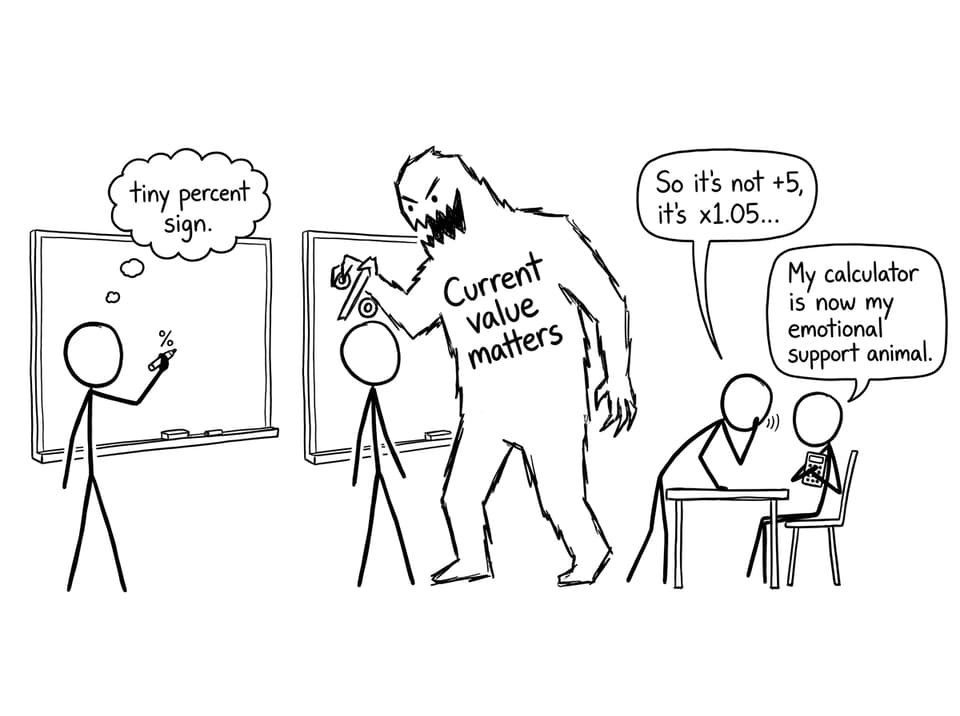
If a quantity grows from 100 to 105, both “+5” and “x1.05” feel plausible. But push time forward and they separate fast. Arithmetic growth stays steady. Geometric growth accelerates (or decays toward zero) because the amount of change grows with the value.
This is exactly what IB Math is testing when it asks you to interpret long-term behaviour. They’re not just checking that you can compute (u_{12}). They’re checking whether you can say, “This model is appropriate because the change is percentage-based, so the increments won’t be constant.”
For extra help with the sequence vs series wording that often trips students, see:
Common exam mistakes (and the fix)
Most errors are not algebra errors. They’re interpretation errors.
-
Mistake: using arithmetic for percentage change.
- Fix: translate language to a factor: “increase by 7%” means multiply by (1.07).
-
Mistake: mixing time units (monthly rate applied yearly).
- Fix: write “per month” beside (r) before you substitute.
-
Mistake: skipping justification.
- Fix: add one sentence: “Geometric is suitable because change is proportional to the current value.”
When you practise on RevisionDojo, you can build that habit deliberately: do one set in the Questionbank, then summarise your “model choice sentence” using Flashcards-style active recall.
The takeaway (and how to practise it fast)
Geometric sequences model reality better because reality often cares about scale: what happens next depends on what exists now. That’s why IB Math pushes you toward multipliers in modelling contexts, and why arithmetic models can quietly break when time stretches.
If you want to turn that understanding into marks, use RevisionDojo as your loop: start with the Mathematics Applications & Interpretation (AI) hub, review Study Notes, drill the Questionbank, reinforce with Flashcards, and finish with a short Mock Exam built from predicted-style practice. The goal isn’t to memorise sequences. It’s to recognise how the world changes; then let the math follow.