


Function transformations in IB Math can feel like the syllabus is playing a small prank on you.
You look at a perfectly normal parent function. You understand its shape. Then the question adds one innocent-looking thing, like
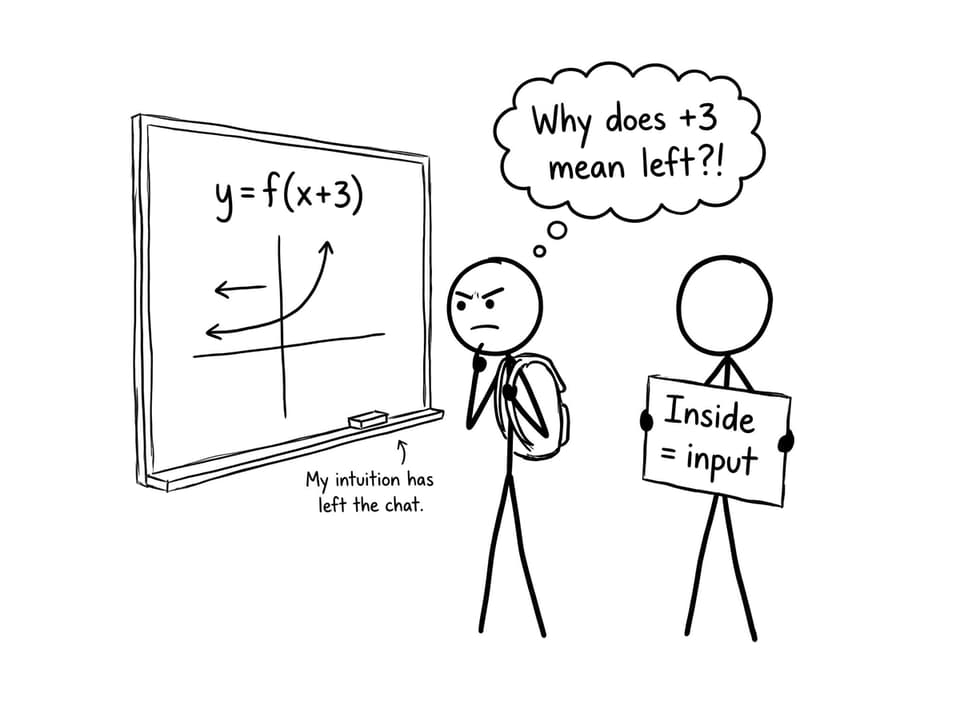
(y=f(x+3)), and suddenly your confidence disappears. Not because you’re “bad at graphs”, but because transformations test how you think about inputs and outputs, not how well you can copy rules.
In IB Math, that gap matters. Examiners love it.
A quick IB Math checklist for transformations
When transformations feel confusing, it usually means you’re doing too many steps in your head. Use a written checklist instead:
-
Identify the parent function (e.g., (x^2), (|x|), (\sin x)).
-
Separate changes inside (f(,\cdot,)) from changes outside (f(x)).
-
Handle transformations one at a time.
-
Write the transformation in words before sketching.
-
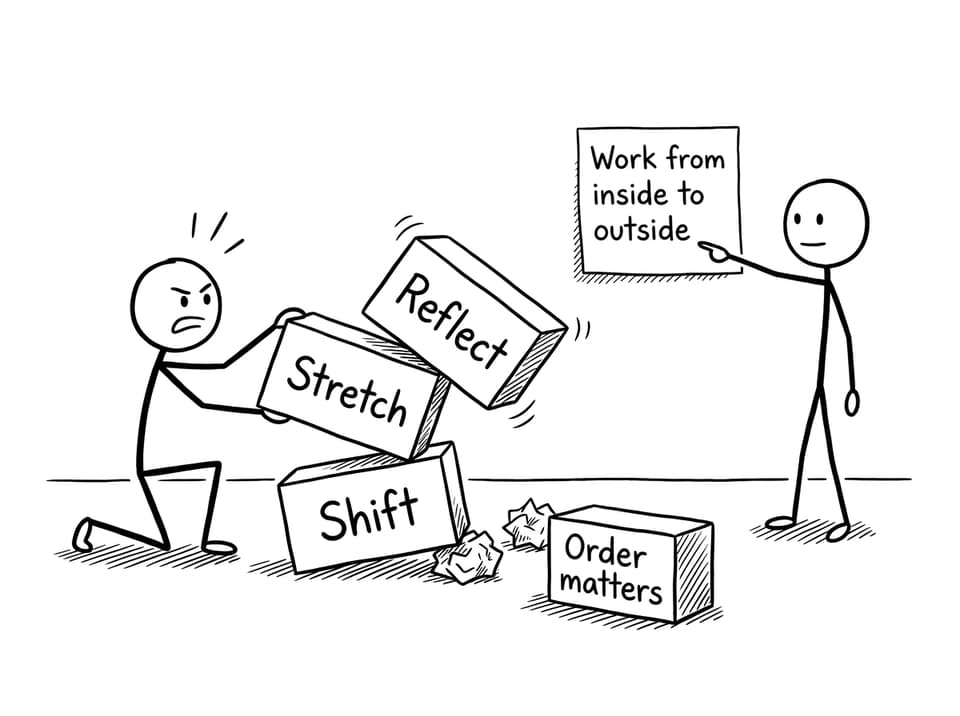
For combined transformations, work from inside to outside.
For structured practice on this exact skill, the syllabus-aligned hub for SL 2.11 Transformation of functions keeps everything in one place.
Why “inside vs outside” breaks your intuition in IB Math
Here’s the story most students live through.
Vertical changes feel natural:
-
(y=f(x)+2) goes up 2.
-
(y=3f(x)) stretches vertically by factor 3.
Those changes are outside the function. They affect the output, so your brain says, “Sure, that makes sense.”
Horizontal changes are where IB Math turns the steering wheel the other way. Anything inside the function changes the input:
-
(y=f(x-2)) shifts right 2.
-
(y=f(x+2)) shifts left 2.
It feels backwards because you’re not moving the graph directly; you’re changing which (x)-values produce the old outputs. Once you start reading (f(x+2)) as “the function gets the value two steps earlier,” the confusion drops.
If you want the deeper explanation with examples, RevisionDojo’s notes on transformation of functions are built exactly around this input/output mindset.
How IB Math exam questions make transformations harder on purpose
IB Math rarely rewards “rule dumping.” It rewards controlled reasoning. Transformation questions tend to ask you to:
-
sketch a transformed graph,
-
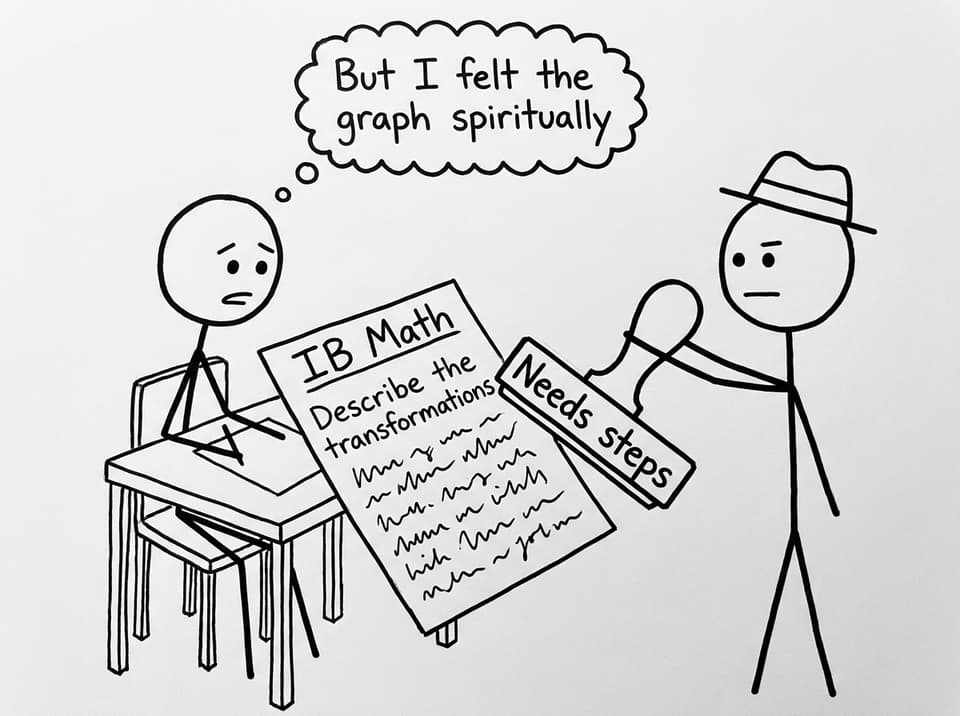
describe transformations in correct language,
-
match an equation to a graph (or a graph to an equation),
-
combine multiple transformations cleanly.
And the trap is predictable: students spot one transformation, apply it, and forget the second (or do them in a messy order). That’s why drilling with feedback matters. The SL 2.11 Questionbank on RevisionDojo is ideal here because you can practise the exact question styles that keep appearing.
The most common IB Math mistakes (and how to stop making them)
A few errors cause most of the lost marks:
Treating horizontal shifts like vertical shifts
Students see “+3” and move the graph right. In IB Math, inside changes are about inputs, so signs often feel reversed. Fix it by writing a quick mapping, like “new input = old input + 3.”
Mixing up horizontal vs vertical stretches
-
(y=2f(x)) is vertical stretch.
-
(y=f(2x)) is horizontal compression.
If it’s inside, it affects the (x)-scale.
Doing transformations in a random order
When there are multiple transformations, write them in layers and work inside to outside. If you feel unsure, read the strategy in How to master functions and transformations (Graphing Toolkit).
Why transformations matter later in IB Math
Function transformations aren’t a one-chapter problem. In IB Math they show up everywhere:
-
trigonometric graphs and phase shifts (see SL 3.7 Circular functions: graphs and transformations),
-
modelling and interpreting parameters,
-
calculus via the chain rule logic (you can preview this via the Calculus Questionbank),
-
even basic graph communication skills (RevisionDojo’s SL 2.3 Graphing notes help here).
Transformations are basically the grammar of functions. If the grammar is shaky, every future sentence feels harder than it should.
A calmer way to master IB Math transformations
If function transformations feel confusing in IB Math, treat that as feedback: you need a clearer process, not more panic.
RevisionDojo makes that process practical: learn the idea in Study Notes, lock it in with Flashcards, test it in the Questionbank, and use AI Chat and Grading tools to diagnose the exact step where your thinking flips. When you’re ready, Mock Exams and Predicted Papers help you practise the same transformation logic under time pressure, with Tutors available when you want a human walkthrough.
Start with SL 2.11 Transformation of functions and build the kind of certainty that survives exam day.