



Financial models in IB Math have a special talent: the moment you want a neat, comforting answer, they produce something like 12,347.83 and then stare at you like it’s your job to make peace with it.
That discomfort is the point. In IB Math, especially Applications & Interpretation, financial modelling is less about worshipping the output and more about understanding the story underneath it: what you assumed, what you ignored, and what could break the model tomorrow morning.

Quick checklist: what examiners want after you calculate (IB Math)
When a financial model in IB Math gives a “non-perfect” answer, run this quick check before you write your final line:
-
Did I state the key assumptions (rates, timing, regularity)?
-
Did I mention at least one realistic limitation (changes, shocks, behaviour)?
-
Did I interpret the number in context (what it means for the person/business)?
-
Did I use cautious language (may, likely, suggests) rather than certainty?
If you want targeted practice on these exact contexts, start at the IB Mathematics Applications & Interpretation hub and filter straight into financial topics.
A financial model is a map, not the territory
A financial model in IB Math is a representation: a simplified structure that makes a messy situation calculable. It’s like drawing a subway map. The map is useful because it leaves things out.
Most IB-style models quietly rely on assumptions such as:
-
constant interest or inflation rates
-
payments made regularly (monthly, yearly)
-
stable income patterns
-
no unexpected events changing behaviour
RevisionDojo’s financial applications topic page is a good reminder that the core skills are simple, but the interpretation is where marks usually live.
Why real financial behaviour refuses to be tidy
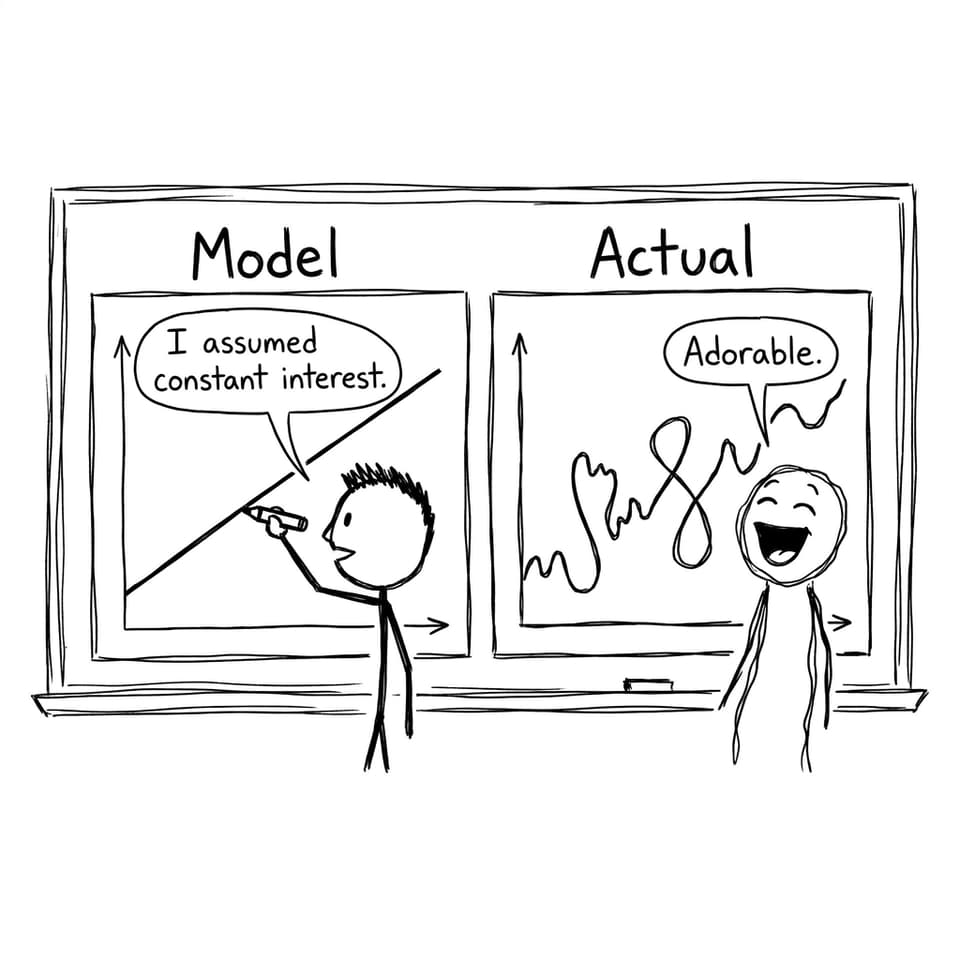
The world doesn’t compound politely. Rates change, jobs change, prices move, and people behave inconsistently (including the person in the question).
That’s why IB Math modelling questions often feel “unfair” if you’re expecting earlier-school mathematics where everything is designed to land on a clean integer. In finance, precision can be fake confidence. A model can be correct and still be fragile.
If you want a deeper dive into one common destabiliser, pair this with When should inflation be included in IB financial modelling questions. Inflation is a classic reason an answer looks “reasonable” but the conclusion is wrong.
Why IB asks for limitations (and rewards them)
In IB Math, Applications & Interpretation is built to test judgement. Examiners want to see that you can:
-
identify assumptions you made to set up the maths
-
explain why those assumptions might not hold
-
avoid overconfident conclusions
-
communicate what the result suggests rather than what it guarantees
This is why questions sometimes avoid handing you a formula. The course is training decision-making. See Why do IB Maths questions avoid giving financial formulas directly for the logic behind that design.
Where “imperfect models” show up most in IB Math exams
You’ll see the realism conversation in:
-
compound interest and depreciation over long time horizons
-
annuities and payment timing
-
loans and amortisation decisions
-
salary projections with raises, caps, or bonuses
-
regression-based predictions treated like forecasts
Annuities are especially good at creating confusion because timing assumptions matter as much as the button presses. Read Why is annuity modelling harder than simple interest in IB Maths when your answers feel “off by a little” for no obvious reason.
Common mistakes students make (and how to fix them)
Most lost marks come from tone, not algebra.
-
Treating a model as reality: write one sentence separating “model” from “real world.”
-
Forgetting assumptions: mention rate stability, regular payments, and no shocks.
-
Overstating: swap “will” for “may.”
-
Ignoring context: explain what the number means for affordability, profit, or feasibility.
For practice that trains this habit, RevisionDojo’s Questionbank strategy guide shows how to drill modelling questions and get feedback fast. The platform also supports you with Study Notes, Flashcards, AI Chat, and Grading tools that push you toward examiner-style wording.

Conclusion: in IB Math, “imperfect” is often the real skill
Financial models don’t behave perfectly in IB Math because the course is trying to make you fluent in reality, not just formulas. Your job is to calculate, then explain what your model assumes, where it could fail, and what the answer means.
If you want to get calm with messy outputs, RevisionDojo is built for this: practise with the Questionbank, learn the language with Study Notes and Flashcards, ask AI Chat to help you phrase limitations, and use Mock Exams and Predicted Papers to rehearse under time pressure. In IB Math, the cleanest marks often come from the least “clean” numbers.