


Exponential functions have a way of embarrassing confident students.
You sketch a curve that seems reasonable, plug in one extra value, and suddenly your graph rockets upward like it has somewhere better to be. In IB Math, that moment isn’t a trick. It’s the point. Exponentials behave differently because their “speed” depends on where they already are, and IB questions quietly test whether you see that.
A quick IB Math checklist for exponentials
Before you do any algebra, run this mental checklist:
-
Is the variable in the exponent (like (a^x) or (ke^{rx}))?
-
Is this growth (base (>1) or (r>0)) or decay (base between 0 and 1, or (r<0))?
-
What happens as (x\to \infty) and (x\to -\infty)?
-
Is there a horizontal asymptote (often a (+c) shift)?
-
In context, what do the parameters mean (initial value, rate, long-term value)?
When you practice, the fastest way to internalise these is to pair concept + exam-style repetition in the SL 2.9 Exponential and logarithmic functions Questionbank and check your reasoning with RevisionDojo’s AI Chat.
The core reason exponentials feel “alien” in IB Math
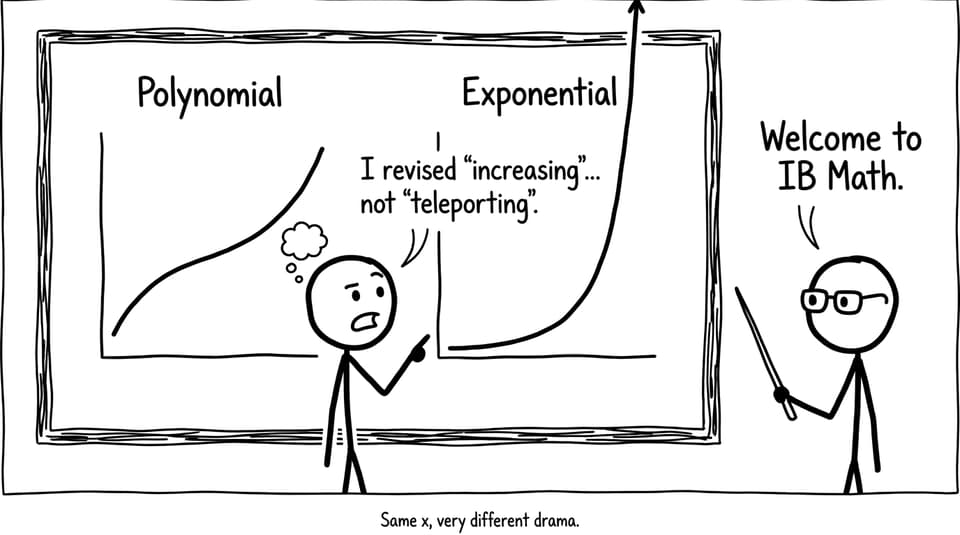
Polynomials change additively. Exponentials change multiplicatively.
A polynomial (even a steep one) has a rate of change that grows in a comparatively predictable way. But an exponential function grows by a constant factor each step. That means the change you get tomorrow depends on the size you reached today.
In IB Math, this shows up as graphs that look almost flat for a while and then suddenly become extremely steep. Students often misread that “flat” part as “not important,” but IB examiners love the slow start because it reveals whether you understand long-term behaviour.
If you want a clean, concrete example, the story-style walkthrough in IB Math exponential growth example (explained simply) is the kind of model IB repeatedly returns to.

Growth vs decay: the tiny sign that flips everything
One of the most common IB Math mistakes is treating growth and decay like “mirror images” you can eyeball later.
Instead, decide immediately from structure:
-
(f(x)=a^x) with (a>1) grows.
-
(f(x)=a^x) with (0<a<1) decays.
-
(f(x)=ke^{rx}) grows if (r>0), decays if (r<0).
In modelling questions, that decision controls everything: your sketch, your interpretation, and whether your final sentence makes sense.
For the algebra foundations behind those patterns, revisit Laws of exponents explained for IB Maths (AA SL & HL) and drill the matching note section in SL 1.7 Laws of exponents and logs (notes).
Why asymptotes matter more than you think
Exponentials often come with a quiet promise: they approach a value without ever reaching it.
That’s what a horizontal asymptote captures. In IB Math, the asymptote isn’t just a sketching detail. It’s an interpretation tool:
-
(f(x)=a^x) has horizontal asymptote (y=0).
-
(f(x)=ka^x+c) has horizontal asymptote (y=c).
Students who draw the curve crossing the asymptote usually aren’t “bad at graphs”; they’re missing the long-term story. If you want a broader refresher on reading features correctly, Understanding functions in IB Math AA: a beginner’s walkthrough pairs well with the syllabus hub at IB Mathematics Analysis and Approaches resources.
Why IB Math uses exponentials in real contexts
IB loves exponentials because they model processes where proportional change is natural:
-
population and bacteria growth
-
radioactive decay and half-life
-
compound interest
-
cooling/heating models (in more advanced contexts)
The marks often disappear in the interpretation, not the solving. That’s why RevisionDojo’s Study Notes and Coursework Library emphasise parameter meaning, and why practicing timed sets in the Questionbank (or full Mock Exams and Predicted Papers) helps you write conclusions that match the context.
Exam-day moves that actually help
A good IB Math exponential solution is usually calm and structured:
-
State growth/decay early.
-
Identify the asymptote and intercepts (if relevant).
-
If solving for the exponent, switch to logs confidently (and check your log rules).
-
If a calculator is used, explain what the value represents.
For log confidence, keep Laws of logarithms explained for IB Maths (AA SL & HL) and Change of base formula explained for IB Maths close during revision.
Bring exponentials back under your control
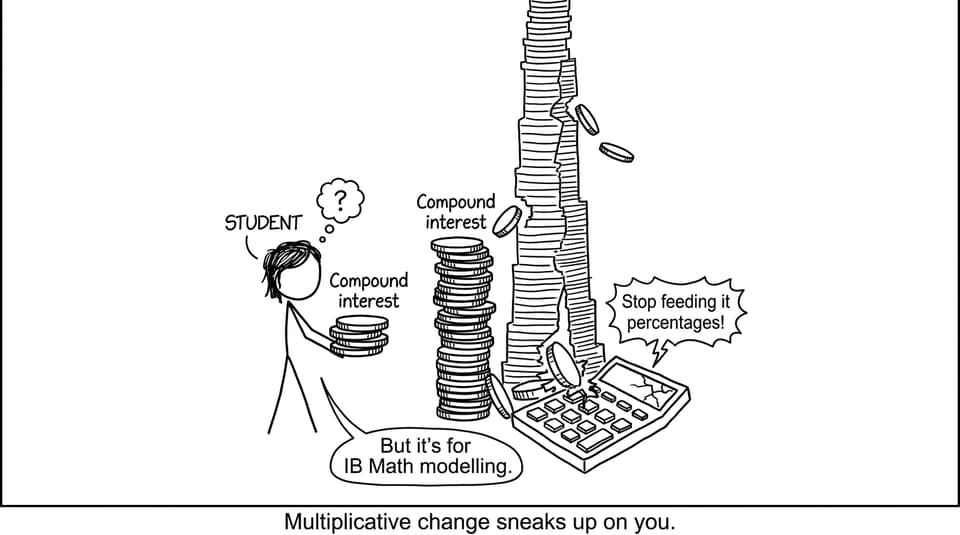
Exponentials feel different in IB Math because they are different: they multiply reality forward rather than adding to it. Once you start treating them as stories about proportional change, the graphs stop looking like surprises and start looking inevitable.
If you want that “inevitable” feeling on exam day, build a simple loop on RevisionDojo: read the Study Notes, drill the Questionbank, review with Flashcards, then test yourself with Mock Exams and Predicted Papers. When something still feels strange, ask AI Chat to explain it in mark-scheme language, and keep going until the steep part of the curve stops being scary.