



Why differential equations suddenly feel like a different subject
There’s a moment in IB Math when calculus stops feeling like a set of moves and starts feeling like a riddle.
You’ve practiced derivatives: take a function, follow rules, get an answer. You’ve practiced integrals: take an expression, reverse the derivative, simplify. Then differential equations arrive and calmly ask you to do something that feels backwards: find the function itself when all you’re given is how it changes.
That’s the real reason differential equations feel abstract in IB Math. The algebra is usually manageable. The mindset shift is not.
Quick checklist: what IB wants you to notice first
Before you write anything, run this short checklist (it saves marks):
-
What is changing? Identify the dependent variable (often (y), (T), (P)).
-
With respect to what? Usually (x) or (t) (time).
-
Are variables separable? Can you get all (y)’s on one side and all (x)’s on the other?
-
Do you need a general solution or a particular solution? Look for an initial condition.
-
What should the answer “mean”? IB loves interpretation, not just manipulation.
If you want a clean refresher on the calculus tools behind this, keep IB Mathematics Analysis and Approaches Calculus Notes open while you practice.
What a differential equation is actually saying
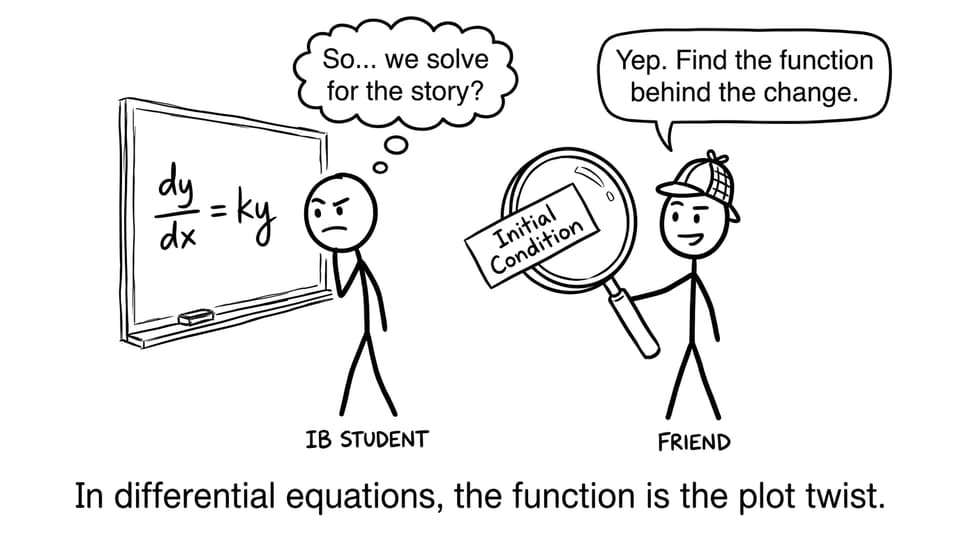
A differential equation is just a relationship between a function and its derivative(s). In normal IB Math problems, the function is the “main character” and the derivative is a description.
Differential equations flip that.
Instead of: “Here is (y). Find (\frac{dy}{dx}).”
You get: “Here is (\frac{dy}{dx}). Find (y).”
That reversal makes students feel like they’re guessing, because it’s less concrete. But you’re not guessing. You’re reconstructing.
For a deeper walkthrough of common IB styles, practice alongside IB Math AA HL: How to Approach Differential Equations Like a Pro.
Why the constant of integration feels “too open-ended”
A big source of abstraction in IB Math differential equations is the idea that one derivative can belong to infinitely many functions.
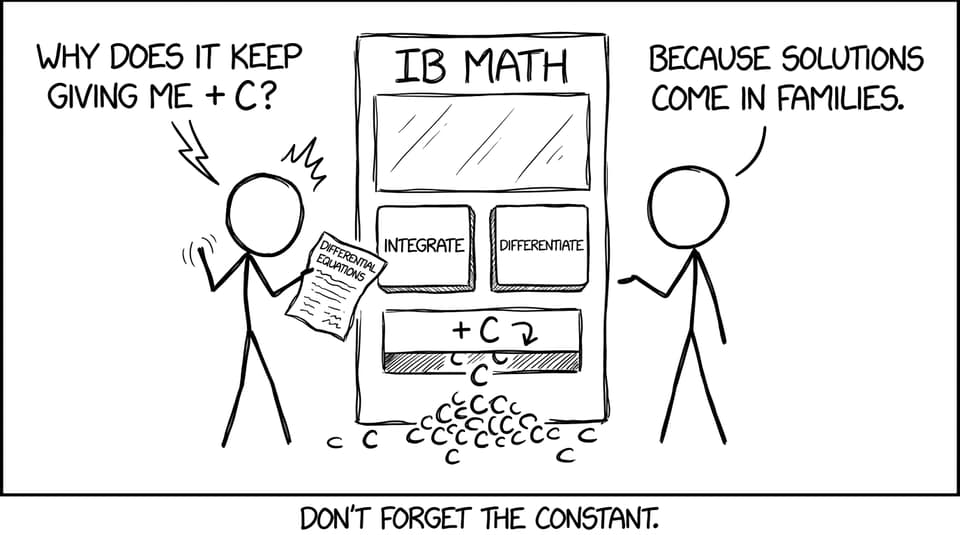
If (\frac{dy}{dx} = 3x^2), then (y = x^3 + C). That (+C) isn’t a technicality. It’s the honest admission that you don’t yet know which member of the family you’re describing.
And that’s why IB often gives an initial condition: a single fact that pins the family down to one person.
To drill the “family of solutions” idea with feedback, use targeted sets in the Math AA Calculus Questionbank.
Why initial conditions matter so much (and why they’re easy to forget)
Without an initial condition, your solution is usually general. With an initial condition, your solution becomes unique. In exam terms: forgetting to apply the condition often turns a full-mark response into a method mark plus a missing final step.
A good habit in IB Math is to treat the initial condition like a lock and key:
-
Solve to get the general form (with (C)).
-
Substitute the given values.
-
Solve for (C).
-
Write the particular solution clearly.
If you’re building speed, the 15-minute topic loop in How to Review Each IB Math Topic in 15 Minutes works surprisingly well for differential equations.
How IB tends to test differential equations
In IB Math, differential equations usually reward structure more than cleverness. Common patterns include:
-
Separable differential equations (rearrange, integrate, apply condition)
-
First-order modelling language (growth/decay style statements)
-
Interpretation: what does the solution imply about change?
-
Clear communication: correct constants, domains, and final form
RevisionDojo is built for this exam feel: the Study Notes keep methods tidy, the Flashcards keep triggers memorable, and the Questionbank turns weak spots into repeatable drills.
A short exam plan that makes the topic feel concrete again
When differential equations feel foggy, use a routine that forces clarity:
-
Learn the method once from notes: start at IB Mathematics Analysis and Approaches Resources.
-
Do 10 focused questions and log your mistakes: Math AA Calculus Questionbank.
-
Simulate timing so it stops feeling abstract under pressure: How to Use RevisionDojo's Mock Exam Builder to Simulate IB Conditions.
-
Add one “why” question after every solution: ask RevisionDojo’s AI Chat what the solution means in words.
If you’re ramping up toward exams, a full-paper rehearsal using Mathematics Analysis and Approaches Predicted Papers helps you see where differential equations fit in the bigger IB Math rhythm.
Closing: turn abstraction into a repeatable method
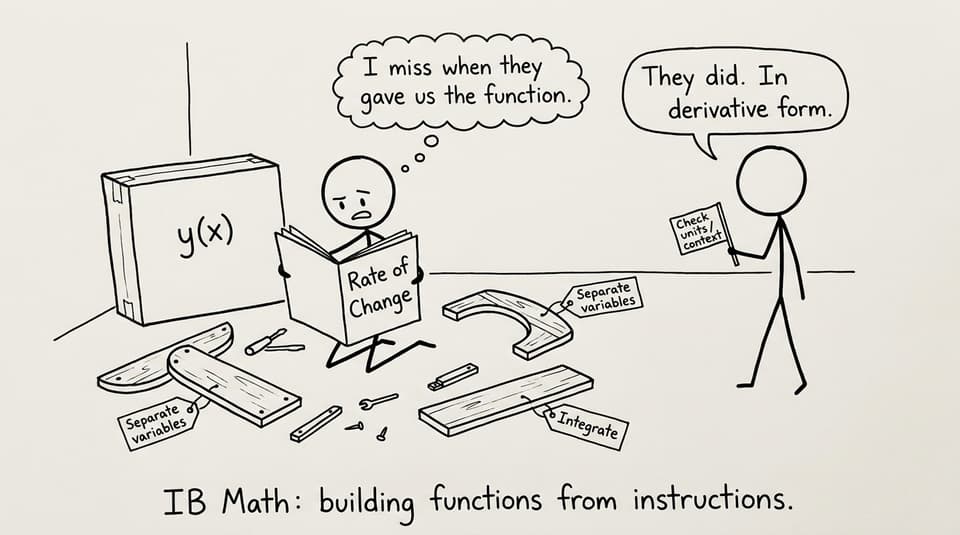
Differential equations feel abstract in IB Math because they ask you to think in reverse: you’re not analysing a function, you’re rebuilding one from change. But the exam doesn’t reward mystery. It rewards a calm structure: separate, integrate, add (+C), apply the initial condition, interpret.
If you want that structure to become automatic, use RevisionDojo as your training ground: the Questionbank for repetition, Study Notes for clarity, AI Chat for meaning, Grading tools for fast feedback, and Predicted Papers plus Mock Exams when you’re ready to perform under real conditions.