

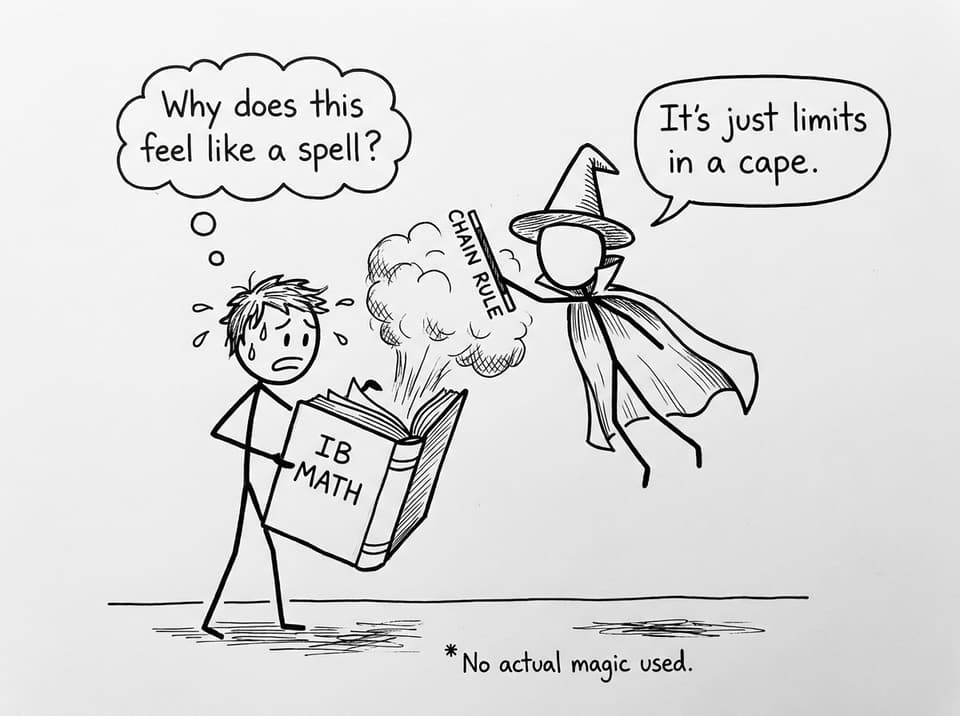
Derivative rules can feel like magic the first time you meet them in IB Math.
One week you are wrestling with limits, inching toward an answer like you are crossing a frozen lake. The next, someone hands you a clean set of “rules” and says, “Just do this.” It’s fast. It’s reliable. It’s also unsettling, because it feels like you skipped the part where mathematics explains itself.
The good news: in IB Math, differentiation rules aren’t tricks. They’re compressed logic. When you see what they’re compressing, the “magic” fades into something better: confidence.
A quick IB Math checklist to demystify derivatives
Before you differentiate anything in IB Math, pause and run this mental checklist:
-
What does the derivative mean here (rate of change, tangent gradient, velocity)?
-
Is the function a sum, product, or composition?
-
Which rule matches the structure (power, product, chain, quotient)?
-
After differentiating, does the result look reasonable?
If you want a structured home base for the calculus syllabus, start with IB Mathematics Analysis and Approaches Resources.
Where derivative rules come from in IB Math
Every differentiation rule you use in IB Math is a shortcut built from the limit definition of the derivative. That definition is slow on purpose. It forces you to look at what happens when an input changes by a tiny amount, and it measures the response.
When you repeat that reasoning on common function types, patterns show up.
-
Powers change in a predictable way.
-
Sums change term-by-term.
-
Constants don’t change at all.
So the rules don’t appear “out of nowhere.” They’re what you get when you do honest work many times and then write the results on a small card so you can keep solving real problems.
If differentiation still feels mechanical, this companion read helps: Why Does Differentiation Feel So Mechanical at First in IB Maths.
Why IB Math derivative rules work so reliably
A useful way to think about IB Math derivative rules is this: they are descriptions of behavior.
They work because common function “shapes” react consistently to small changes. That’s why exam questions can push you into unfamiliar contexts (optimization, modeling, kinematics) and the same rules still hold.
But the examiners also care about when a rule applies. A rule used on the wrong structure is a perfect-looking wrong answer.
RevisionDojo’s Study Notes and Flashcards help here because they train pattern recognition: you stop seeing “a messy expression” and start seeing “a product of two functions” or “a composition with an inner function.”
Why the chain rule and product rule feel like traps in IB Math
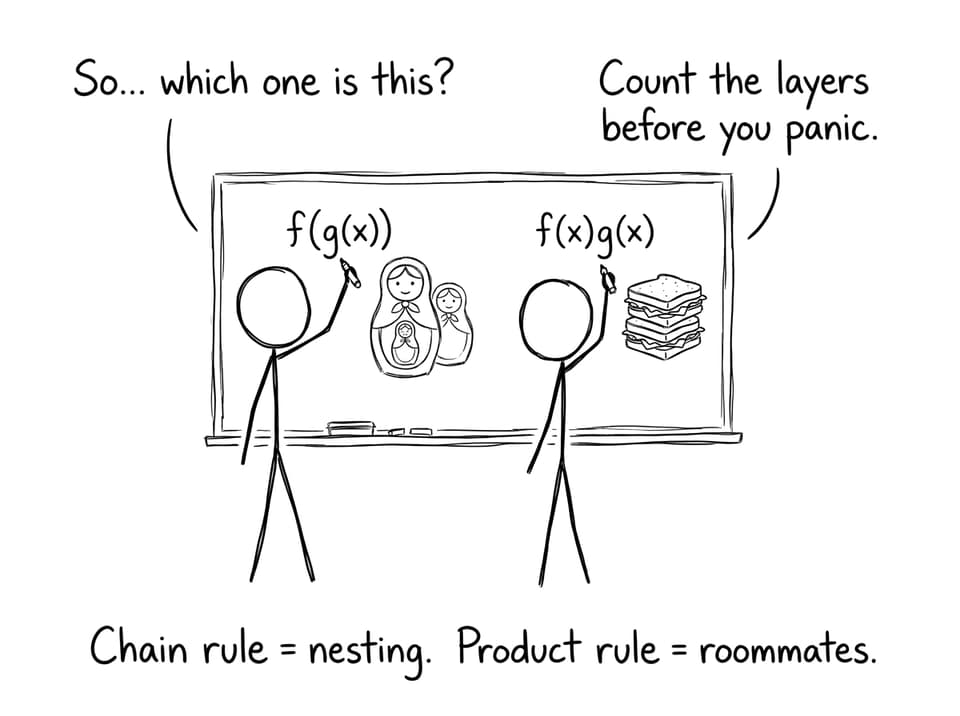
In IB Math, the chain rule and product rule cause trouble for one reason: they test structure, not speed.
A product is two functions multiplied.
A composition is one function sitting inside another.
If you rush, both can look like “two things next to each other.” And then you choose the wrong tool.
For targeted practice, RevisionDojo has focused support on both the ideas and the exam style:
-
Why Is the Chain Rule So Easy to Apply Incorrectly in IB Maths
-
SL 5.6 Differentiating Polynomials (Chain, Product, Quotient)
The real exam skill: meaning, not just method
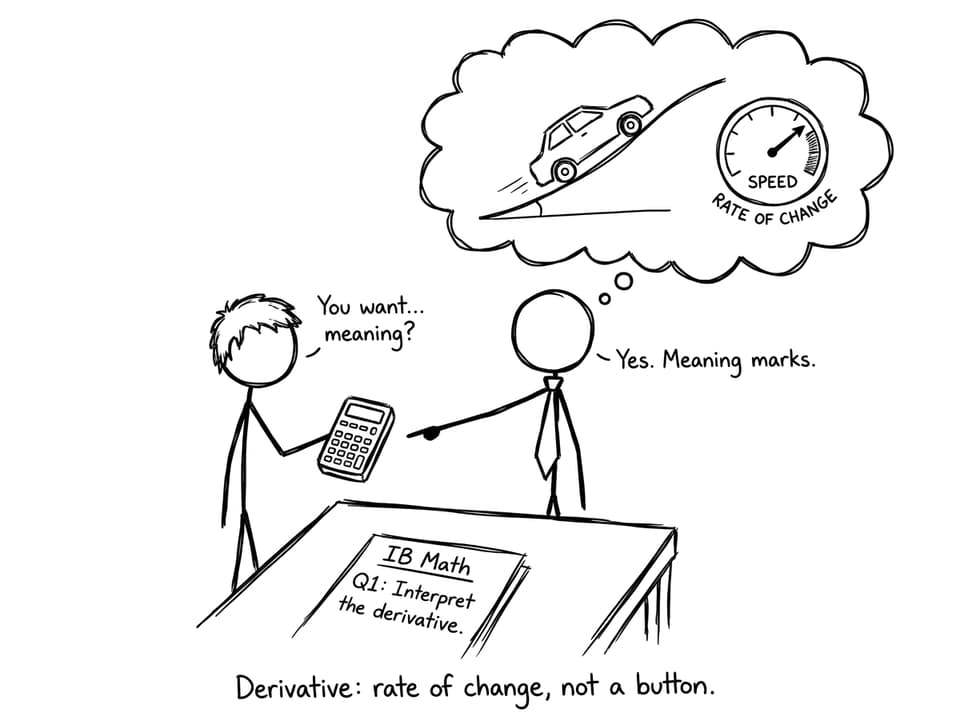
A quiet truth about IB Math is that marks often hide in interpretation.
You can differentiate perfectly and still lose points if you don’t explain what the derivative represents in context. This shows up heavily in applied prompts like motion. If kinematics has ever made you feel like your calculus vanished under pressure, read Why Does Kinematics with Calculus Feel So Confusing in IB Maths.
This is also where RevisionDojo becomes more than notes: the Questionbank, AI Chat, and Grading tools are built for feedback loops. You try an exam-style question, get corrections that match markscheme logic, and tighten the reasoning that earns method and accuracy marks.
Conclusion: make IB Math feel like logic again
Derivative rules feel like magic when they arrive as finished spells. In IB Math, they become logical when you treat them as summaries of change, and when you train yourself to spot structure before you calculate.
If you want that shift to happen quickly, build a routine: use RevisionDojo Study Notes to learn the idea, drill structure with the Flashcards, and then validate your choices with exam-style questions in the Questionbank. When differentiation stops being “a trick,” it becomes one of the most predictable sources of marks in IB Math.