


Definite integrals are the moment many IB Math students stop feeling like they’re “doing calculus” and start feeling like calculus is doing something to them.
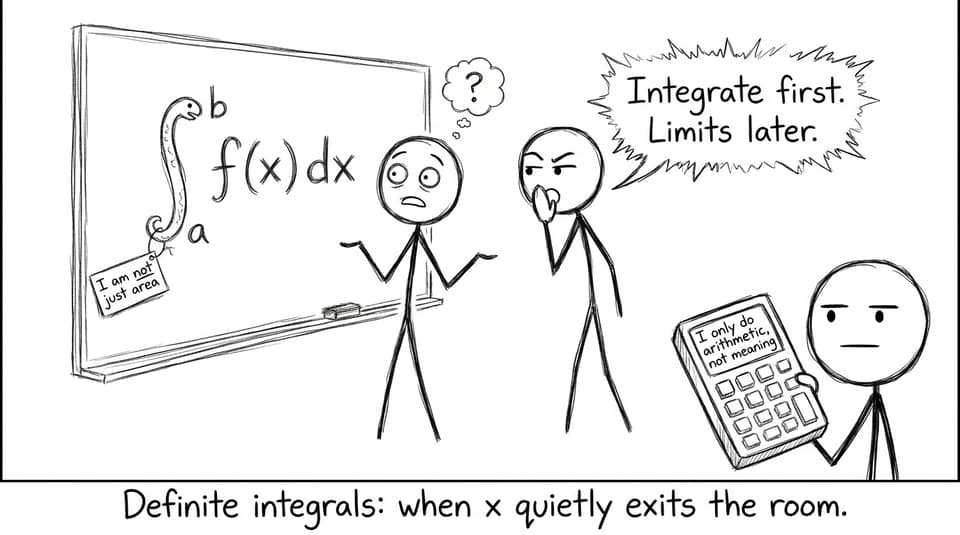
You’re happily finding antiderivatives, the steps feel predictable, and then suddenly the question adds two numbers at the top and bottom of the integral sign. The variable seems to vanish. The answer is a single number that can even be negative. And the markscheme starts rewarding interpretation, not just technique.
That shift is exactly why definite integrals confuse so many IB Math students: you’re not just manipulating symbols anymore. You’re measuring something.
A quick checklist for definite integrals in IB Math
Before you calculate anything, run this fast mental checklist (it saves marks):
-
What is the integral measuring here: area, accumulation, displacement, probability?
-
Are you being asked for net area or total area?
-
Does the graph cross the x-axis (meaning signs will matter)?
-
Are you integrating first and substituting limits second?
-
Can you sketch a 10-second graph to sanity-check your answer?
If you want targeted practice right on this syllabus point, use RevisionDojo’s IB Math topic resources for SL 5.11 definite integrals and the matching SL 5.11 Questionbank.
What a definite integral is actually measuring
A definite integral measures net accumulation across an interval. In graph language, it’s the signed area between the curve and the x-axis from (a) to (b).
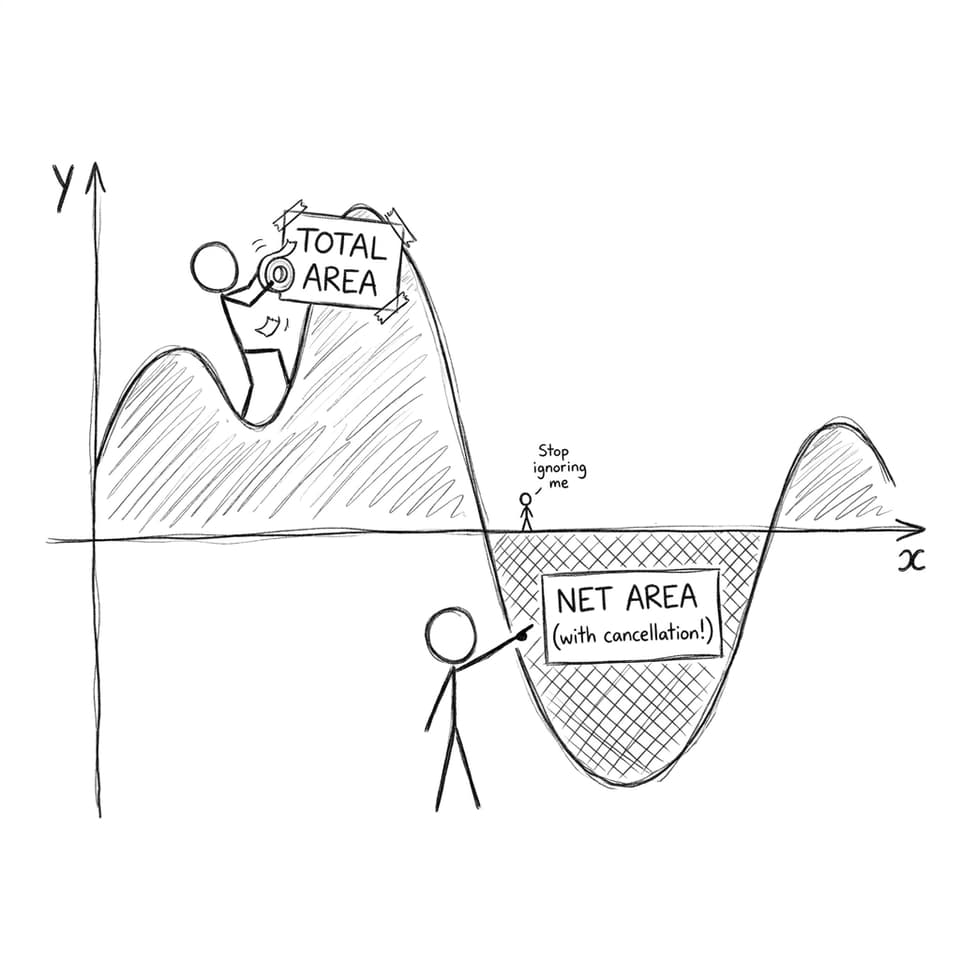
That word “signed” is where IB Math students often lose certainty. Area above the axis counts positive. Area below counts negative. The integral is not promising “the size of the region” unless the question explicitly asks for total area.
When you treat a definite integral like a fancier antiderivative, you can still get the arithmetic right and lose interpretation marks. IB cares about what your number means.
Why the limits of integration feel so weird
In IB Math, the limits change the job of (x). In an indefinite integral, (x) stays a variable and you get a family of functions. In a definite integral, (x) is more like a placeholder name on a form that gets shredded at the end.
That’s why “substitute the limits too early” is such a common mistake. The correct rhythm is:
-
Integrate to get an antiderivative (F(x))
-
Evaluate (F(b)-F(a))
-
Interpret the sign and units in context
If integration methods themselves feel shaky, pair this article with IB Math HL: Tips for Tackling Integration Problems with Confidence and then drill weak spots using the AA Calculus Questionbank.
Net area vs total area: the silent mark trap
A definite integral gives net area, which means positive and negative regions can cancel. But many exam questions want total area (a physical size) or total distance (no direction).
In those cases, you usually have to split the integral at the x-intercepts and take absolute values. This is less about clever calculus and more about reading the situation like an examiner.
RevisionDojo helps here because you can jump between concept explanations and exam-style practice inside the Study Notes, Flashcards, and Questionbank workflow. If you like building your own understanding step-by-step, see Digital IB Study Notes: Access Anywhere, Anytime.
Where definite integrals show up across IB Math
Definite integrals are a repeating theme, not a one-off chapter. Expect them in:
-
Area under curves and area between curves
-
Kinematics (displacement vs distance)
-
Accumulation models in applied problems
-
Probability density functions
That’s why IB uses them: they test whether you can connect procedure to meaning. For the wider structure of the course, bookmark IB Mathematics Analysis and Approaches Resources.

Bringing it home (and making it easier)
Definite integrals stop being confusing when you stop treating them like a trick and start treating them like a measurement. The limits tell you where you measure. The sign tells you direction. The context tells you what the number represents.
When you’re ready to turn understanding into marks, RevisionDojo is built for IB Math exam prep: use the Questionbank for examiner-style practice, Study Notes and Flashcards for recall, AI Chat for “why did my sign flip?” moments, plus Mock Exams, Predicted Papers, and grading tools when you want full exam realism. Start with the definite integrals topic page, then practise until the meaning feels automatic.