


Cumulative distribution functions have a special talent: they make confident IB Math students second-guess themselves.
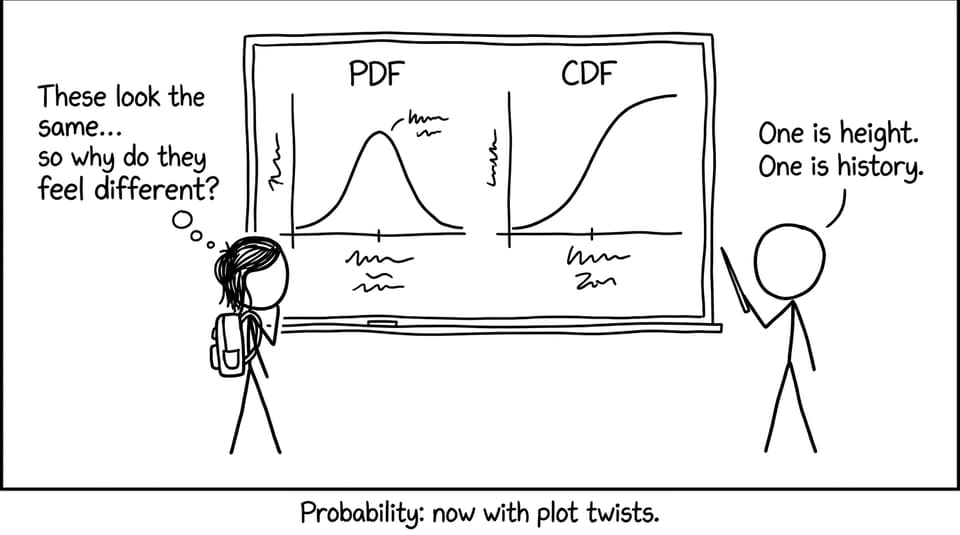
You look at a CDF graph and it resembles the probability graphs you already know. Your brain tries to read it the old way. And that’s the trap. A CDF is not asking, “How likely is this exact value?” It’s asking, “How much probability has already piled up by the time we reach this value?” Same axes, different story.
In IB Math, that tiny shift in meaning is why CDFs feel abstract, slippery, and weirdly easy to misread under time pressure.
The one-sentence definition that actually helps in IB Math
A cumulative distribution function is:
F(x) = P(X \le x)
That’s it. But the helpful part is the mental picture: a CDF is a running total. Like a progress bar that starts at 0, creeps upward, and can’t go backward.
If you want a home base for this topic, keep a probability overview open while you practice, like RevisionDojo’s Statistics & Probability hub. CDF questions become far less intimidating when you keep returning to “running total” as the meaning.
Quick CDF checklist (the exam-proof version)
Before you do any calculation, force these checks:
-
The CDF value is a probability, so it must stay between 0 and 1.
-
The graph never decreases (it can flatten, but it can’t drop).
-
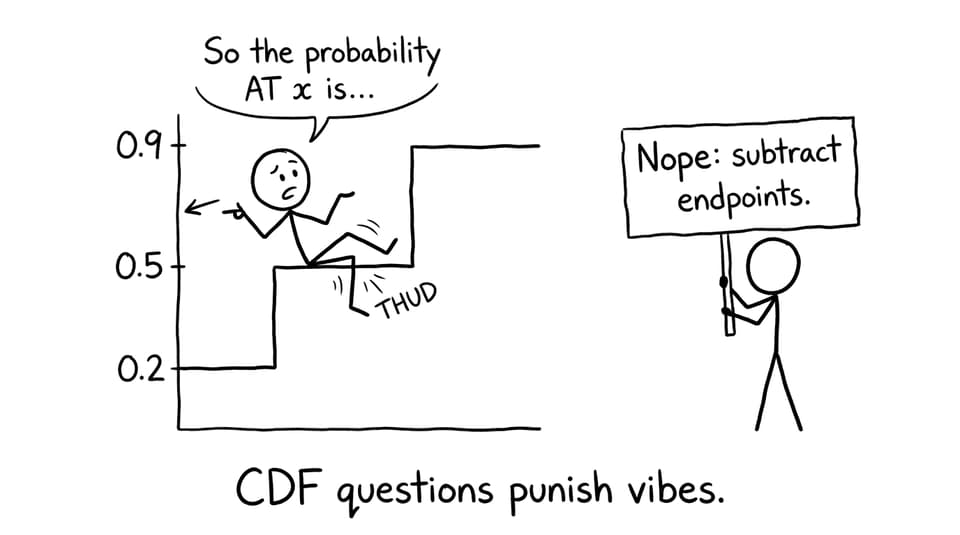
Probabilities between two values come from subtraction:
P(a < X \le b) = F(b) - F(a)
This checklist saves marks in IB Math because most lost marks come from interpretation, not algebra.
Why CDFs get confused with PDFs (and why IB likes that)
A PDF trains you to treat “height” like “how likely.” Then a CDF arrives with a similar-looking curve and dares you to do the same.
But in a CDF, the y-value is not “likelihood at x.” It’s “probability up to x.” That difference explains most classic IB Math errors:
-
Reading F(2) as “probability at 2” instead of “probability up to 2.”
-
Forgetting that the probability for an interval is a difference of two CDF values.
-
Sketching something that decreases because you’re thinking “shape of distribution” instead of “accumulation of probability.”
IB asks CDF questions because they reveal whether you understand what probability means rather than whether you can copy a method. If interpretation is a weak spot for you, the article Why interpreting probability distributions is harder than creating them is a great mindset reset.
The calculus connection: CDFs are where chapters collide
In IB Math AA especially, CDFs sit right on the seam between probability and calculus:
-
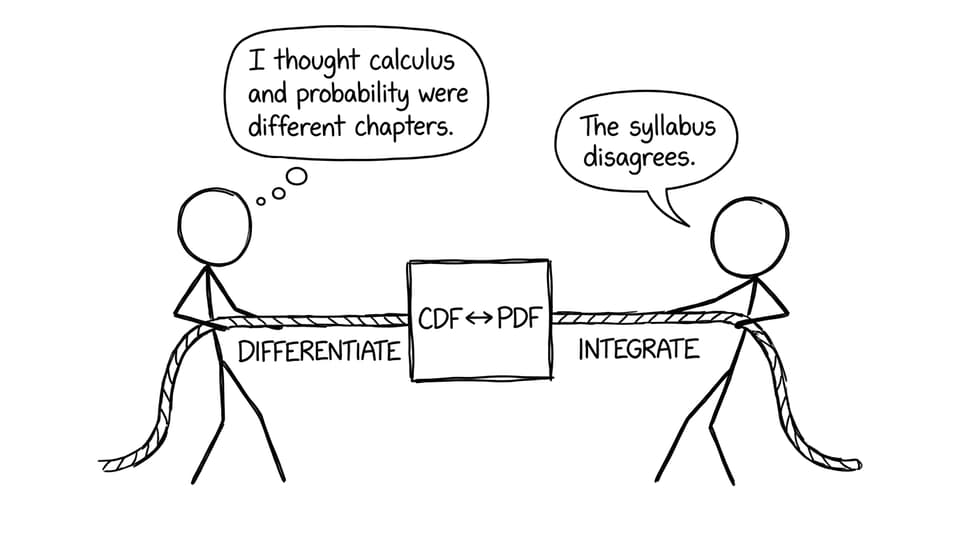
CDF is the integral of the PDF (accumulating area).
-
PDF is the derivative of the CDF (rate of accumulation).
That’s why both differentiation and integration show up in the same question. Students often feel thrown because they learned these skills in different units, with different instincts.
To practice that seam deliberately, it helps to drill both sides: calculus fluency from the AA Calculus Questionbank and probability habits from the step-by-step guide How to Solve IB Math Probability Problems Step-by-Step.
How IB Math actually tests CDF understanding
CDF questions in IB Math tend to repeat a few “tells.” If you can name them, you can prepare for them:
-
“Find P(a < X \le b)” (translation: subtract endpoints).
-
“Sketch the CDF given the PDF” (translation: think area added as x increases).
-
“Find k” in a distribution definition (translation: enforce total probability = 1).
-
“Explain” why a graph cannot be a CDF (translation: use monotonic and 0-to-1 properties).
If you keep making small probability-structure mistakes, the short read Why students forget probabilities must sum to one plugs a surprisingly common leak.
The calm way to make CDFs click (and score the marks)
CDFs feel confusing in IB Math because they look familiar while demanding a different instinct: not height, but history. Once you treat them as accumulation graphs, most questions collapse into the same few moves: check 0-to-1, check non-decreasing, subtract endpoints, connect derivative/integral when needed.
If you want this to become muscle memory, RevisionDojo is built for it: use the Study Notes for definitions, Flashcards for quick recall, the Questionbank for exam-style repetition, AI Chat when a step feels foggy, and Grading tools to see exactly where method marks disappear. When you’re close to exams, add Mock Exams, Predicted Papers, and targeted support from Tutors to turn “I kind of get CDFs” into confident IB Math marks on the page.