



The moment composite functions stop feeling “normal”
Most IB Math students can handle functions right up until the day a teacher writes something like (f\circ g) on the board and the room gets quieter. Not because the algebra suddenly got harder, but because your brain is being asked to hold a new idea: a function can be an input.
That’s the real shift. Up to this point, functions mostly acted on numbers. Composite functions ask you to picture processes acting on processes. Under exam pressure, the notation becomes a blur, and the intuitive part of your mind tries to “simplify the symbols” instead of tracking what happens first.
If composite functions feel unintuitive in IB Math, it’s not a sign you’re bad at functions. It’s a sign you’re thinking like a calculator when the course wants you to think like a translator.
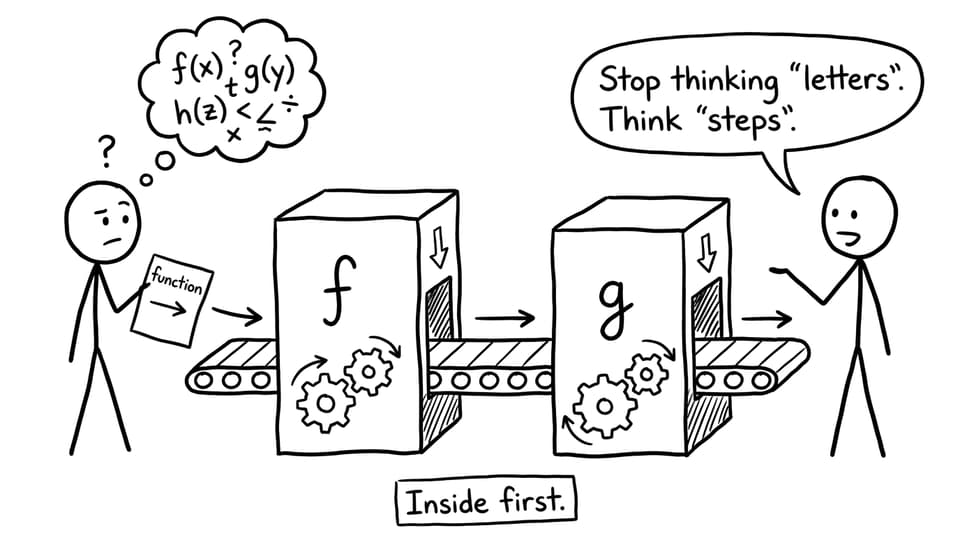
A quick composite function checklist (use this every time)
When composite functions show up in IB Math, run this mini-checklist before you do any algebra:
-
Identify the inside function (the one applied first)
-
Write the inside output in brackets, then apply the outside function
-
Simplify only after the structure is correct
-
State domain restrictions explicitly (don’t assume)
-
If a question asks for evaluation, substitute at the end (not too early)
For targeted practice, use RevisionDojo’s Composite Functions Questionbank: SL 2.5 Composite functions, identity, finding inverse (Questionbank).
Why composite functions feel unintuitive in IB Math
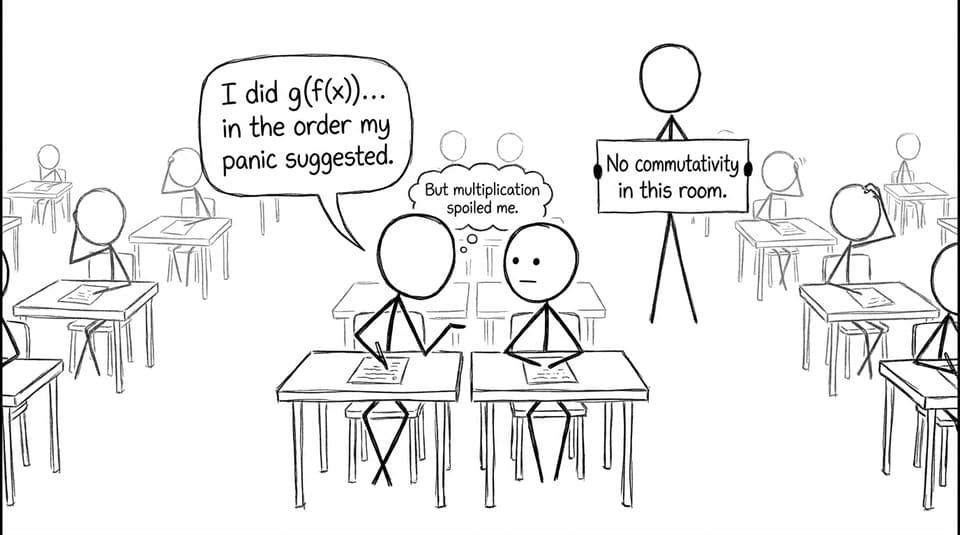
Your instincts expect commutativity
A quiet trap in IB Math is how much early algebra trains you to believe order “usually doesn’t matter.” Addition and multiplication are commutative, so your brain builds a habit: swap terms, keep the result.
Composite functions break that habit.
In general, (f(g(x))\neq g(f(x))). They’re not interchangeable because they’re not just objects. They’re ordered actions.
That’s why composite function questions can feel emotionally unfair: you do all the correct-looking steps, but the first step was in the wrong order, so the whole solution collapses.
The notation is backwards from how we read
Another reason composite functions feel unintuitive in IB Math is that the notation fights your reading habits. You read left to right, but you apply (f(g(x))) right to left.
A useful mental model is: don’t read it like a sentence. Read it like instructions stacked on top of each other:
-
Start with (x)
-
Do (g) first
-
Take that result and do (f)
If you want a clean conceptual reset, RevisionDojo’s functions hub keeps everything connected (notes, practice, videos, flashcards): IB Math AA Functions.
The domain problem: where most marks quietly disappear
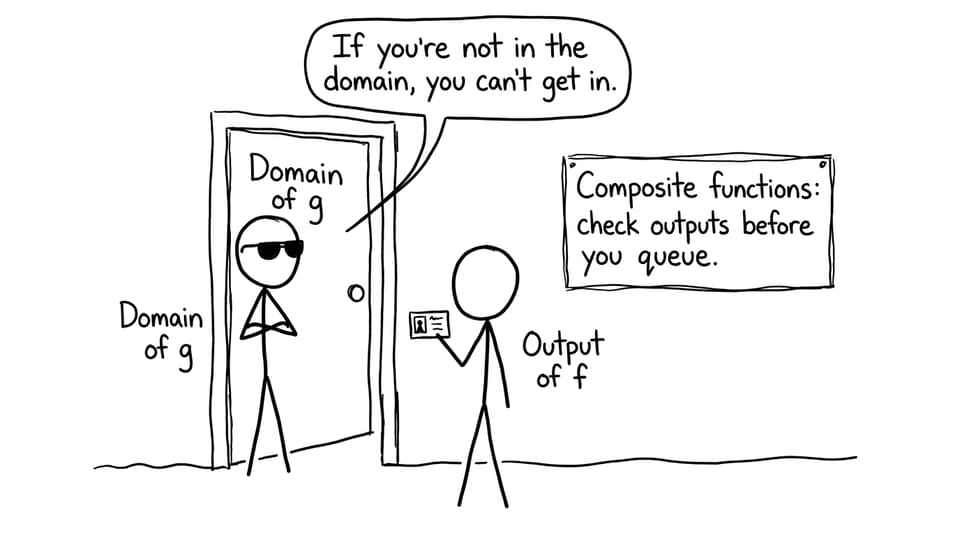
In IB Math, domain is where composite functions become less about algebra and more about judgement.
Even if (f) is valid for many inputs, (g) might accept fewer. And with composites, the output of the inside function must land inside the allowed inputs of the outside function.
This is why you can get a perfectly simplified expression and still lose marks: the composite function might not be defined everywhere you assumed.
A strong companion read is: Why Is Finding the Domain of a Function So Tricky in IB Maths. For the foundations, use: SL 2.2 Functions: notation, domain, range and inverse (Notes).
How composite functions are tested in IB Math (and how to train)
Composite functions in IB Math usually appear as:
-
“Find (f\circ g) and state its domain”
-
“Evaluate (f(g(a)))”
-
“Solve an equation involving (f(g(x)))”
-
“Use a given composite to deduce information about (f) or (g)”
The best training isn’t reading more theory. It’s doing small, repeated sets until order and domain checks become automatic.
RevisionDojo is built for that loop:
-
Study Notes to get a clean explanation fast
-
Flashcards to make “inside first” and domain rules stick
-
AI Chat when you can’t see why your order is wrong
-
Questionbank to drill exam-style composites by difficulty
-
Mock Exams and Predicted Papers to practise under time
-
Grading tools to check if your working matches markscheme logic
-
Tutors when the same mistake keeps returning
-
Coursework Library for broader math literacy that helps modelling questions
A practical workflow is outlined here: How to Use the Questionbank for Targeted Math Revision.
Bringing it all together (and making it feel natural)
Composite functions feel unintuitive in IB Math for the same reason good stories feel inevitable only after you’ve read them: order matters, and you don’t see the structure until you slow down.
If you want composite functions to click reliably before exams, build a simple routine: learn the process with RevisionDojo Study Notes, lock the rules with Flashcards, ask AI Chat to diagnose your exact error pattern, then drill composites in the Questionbank until “inside first” becomes reflex. When you’re ready, pressure-test it using Mock Exams and Predicted Papers, and use Grading tools (or Tutors) to turn feedback into higher marks.
Start here for a solid foundation: Understanding Functions in IB Math AA: A Beginner’s Walkthrough.