


Composite functions in IB Math have a strange talent: they look like routine algebra right up until they quietly delete your method marks.
Most students don’t fail composite-function questions because they can’t do functions. They fail because composition forces you to think like the examiner thinks: a function isn’t a formula, it’s a process. The moment you forget that, you start moving symbols around instead of moving inputs through steps.
A quick composite-functions checklist (use it every time)
Before you simplify anything in IB Math, run this mental checklist:
-
Name the inner function (the one applied first).
-
Name the outer function (the one applied second).
-
Write an “in-between” line (the intermediate output).
-
Check domain compatibility (can the outer function accept the inner output?).
-
Only then simplify.
If you want targeted practice on exactly these moves, the Composite functions questionbank (AA SL 2.5) is built around exam-style traps and the working the markschemes reward.
What a composite function is actually testing in IB Math
A composite function is simple in definition: the output of one function becomes the input of another. But in IB Math, the point isn’t the definition. The point is whether you can keep track of a chain of actions.
Students who do well tend to narrate it to themselves:
-
“First I run (x) through (g).”
-
“That result becomes the input to (f).”
This is why composition shows up across the functions unit, and why it links naturally to inverses, transformations, and calculus. If you’re revising foundations, the Functions topic hub (AA) and the Functions videos are a calm way to rebuild the “function as process” mindset.
Why order feels like a trick (but isn’t)
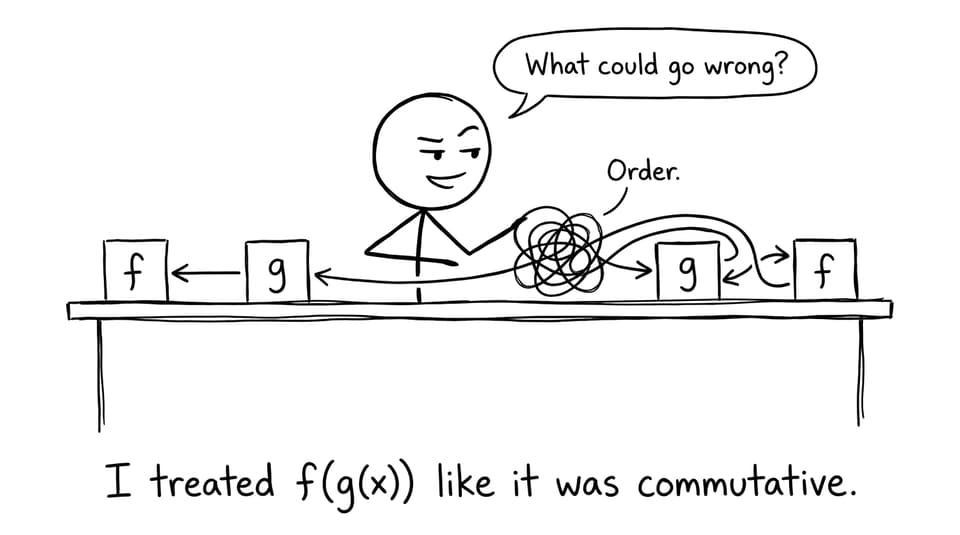
The most expensive mistake in IB Math composite functions is treating composition like multiplication: assuming (f(g(x))) and (g(f(x))) are basically the same.
They’re not. Composition is not commutative, because each function changes the input in its own way. Switch the order and you change the story.
A good habit: write “inside first, outside second” beside your working. Even better: write a temporary placeholder like (u=g(x)), then compute (f(u)). It slows you down just enough to stay honest.
The notation problem: compact symbols, hidden steps
Composite notation is dense: (f(g(x))) compresses two actions into one line. Under exam pressure, many students read it as a single object rather than a sequence.
This is the same reason function equations feel harder than they “should.” The symbols look familiar, but the meaning is layered. If that’s been happening to you, read Why function equations are harder than normal equations; it’s the same structural issue wearing a different costume.
Domain restrictions: where perfect algebra still loses marks
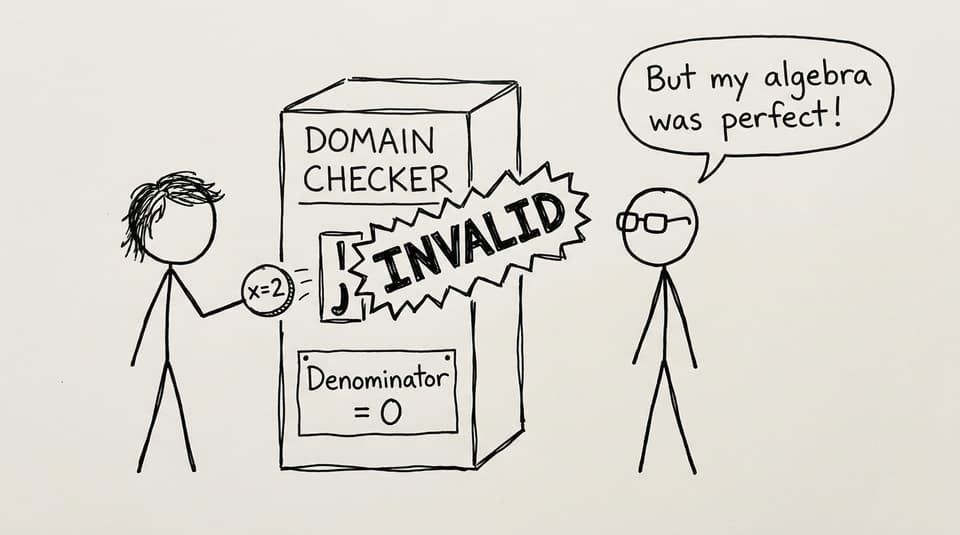
In IB Math, the algebra can be flawless and the answer can still be wrong if the composition isn’t defined.
When you form (f\circ g), the output of (g) must live inside the domain of (f). This is where students skip a step because nothing looks “dangerous” yet.
If domain logic is a weak spot, Why finding the domain is tricky in IB Maths is worth a focused read, and the Functions notation and domain notes (AA SL 2.2) give clear examples you can mirror in your own solutions.
Why composite functions show up everywhere (especially calculus)
Composite thinking is the bridge skill. In IB Math, it appears in:
-
inverse functions and domain restriction (you’re reversing a process),
-
transformations (a function applied to a changed input),
-
and differentiation via the chain rule.
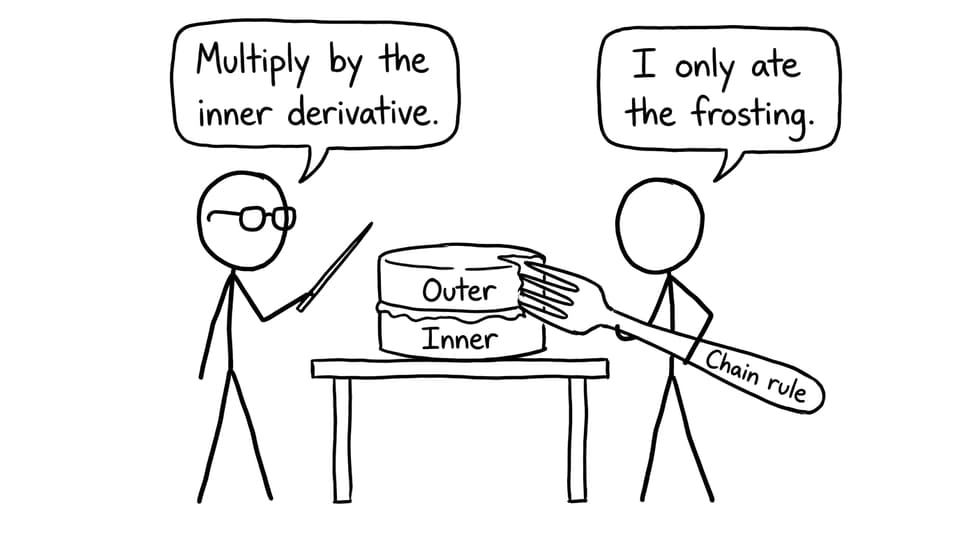
The chain rule is basically composition turned into calculus marks: “outer derivative times inner derivative.” If you want to connect those dots, read Why the chain rule causes mistakes in IB Maths and practise with Applying chain rule on more complex composite functions.
Bringing it home: make IB Math composition predictable
Composite functions cause errors in IB Math because they force you to respect order, unpack notation, and check domains, three skills that disappear when you rush.
If you want composition to feel boring (in the best way), build a repeatable workflow with RevisionDojo: practise exam-style composites in the Questionbank, lock in notation with Study Notes and Flashcards, ask AI Chat to diagnose your exact step where the structure breaks, and verify your reasoning with Grading tools. Add Mock Exams and Predicted Papers once the basics feel steady, and dip into the Coursework Library and Tutors when you want personalised feedback.
Composite functions don’t need more talent. They need a calmer process, and that’s exactly what RevisionDojo is designed to train.