


When you first learn sequences, arithmetic ones feel like the friend who always shows up on time.
Term to term, everything behaves. Add the same number. Repeat. Predict. It’s comforting.
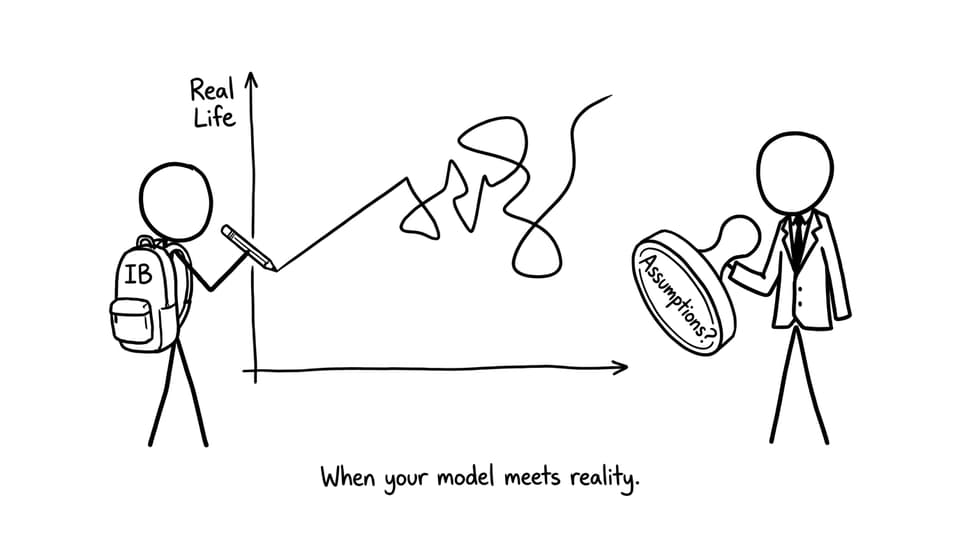
Then you try to use that comfort in IB Math modelling and something quietly goes wrong. Your numbers keep marching in a straight line while the real world curves, compounds, saturates, and occasionally flips the table. And in exams, that mismatch is exactly where marks disappear.
The quick checklist: should IB Math use an arithmetic sequence here?
Use this as a fast modelling filter before you commit to an arithmetic sequence in IB Math:
-
Is the change a fixed amount each step (like +3 units every week)?
-
Or is it a percentage / proportion of the current value (like +5% each year)?
-
Will your model be used for many steps into the future (where errors amplify)?
-
Could the model produce something impossible (negative people, negative money, infinite resources)?
-
Can you clearly explain the assumption: constant additive change?
If you can’t justify that last bullet, the arithmetic sequence is probably a trap.
What arithmetic sequences actually model well (in IB Math terms)
Arithmetic sequences are honest about what they are: linear change.
That makes them great in IB Math for short, controlled contexts where “each step adds the same amount” is genuinely true. Think of scenarios like fixed weekly savings deposits (not including interest), equal spacing patterns, or controlled production increases with a strict quota.
If you need a refresher on the mechanics, RevisionDojo’s explanation is clean and exam-aligned: IB Math Arithmetic Sequences (AA SL & HL) Explained.
But modelling is not mechanics. Modelling is judgment.
Why arithmetic sequences fail in real-life modelling
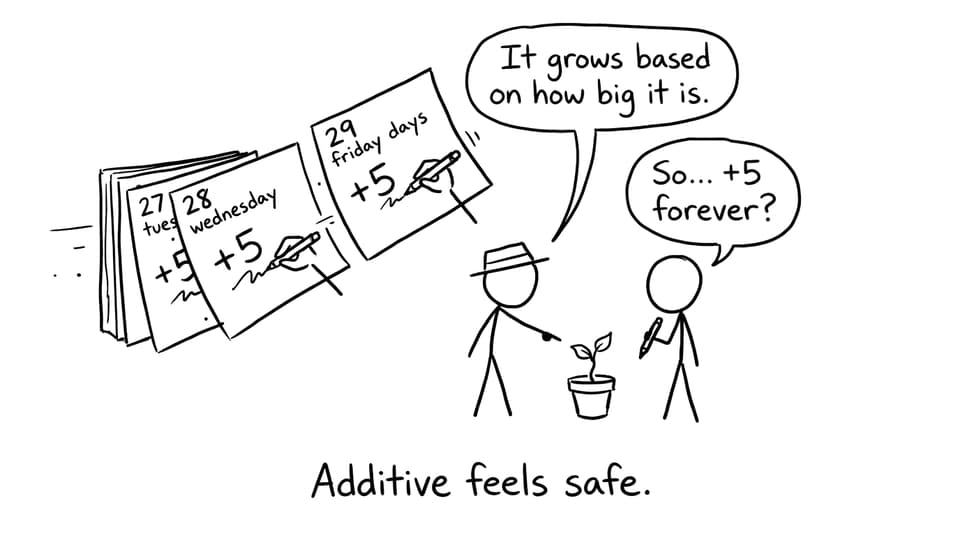
In real systems, change usually depends on what’s already there.
Money earns interest based on your balance. Populations grow based on current population. Depreciation often happens as a percentage of current value. Even social trends spread faster when more people already participate.
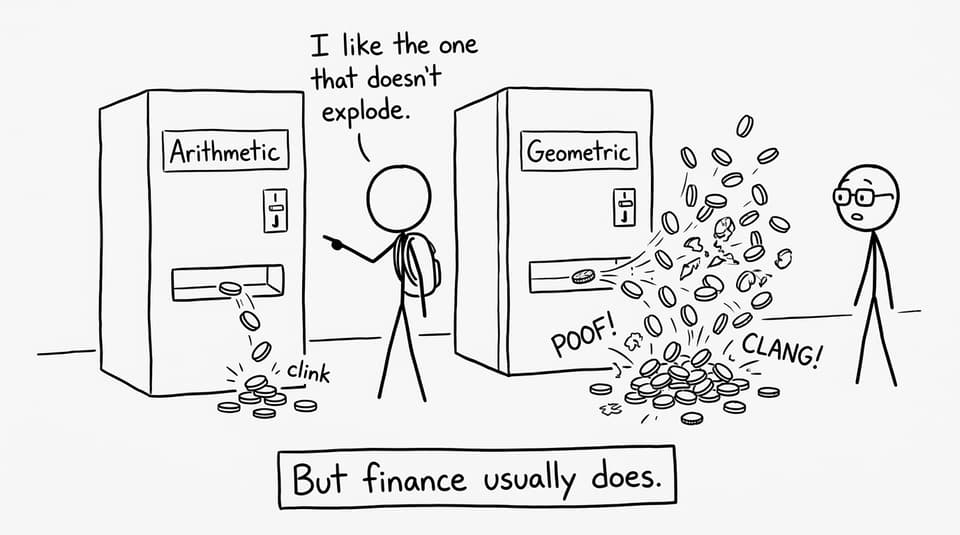
An arithmetic sequence can’t “see” the current size. It adds the same amount no matter what. That’s the core reason arithmetic sequences fail in real-life modelling for IB Math: they assume the world is linear when it’s usually multiplicative.
A good companion read is: Why Do Geometric Sequences Model Reality Better Than Arithmetic Ones.
The hidden exam reason: IB Math tests your assumptions, not your formulas
IB Math (especially Applications & Interpretation) is designed to reward students who pause and ask, “What kind of change is this?”
Examiners aren’t only checking whether you can write (u_n = a + (n-1)d). They’re checking whether your model matches the story the question is telling.
That’s why RevisionDojo’s AI track is built around modelling decisions, not just answers: IB Mathematics Applications & Interpretation Resources and the targeted syllabus point SL 1.2 Sequences and Sigma Notation.
Why students default to arithmetic sequences (and how to stop)
Most students choose arithmetic sequences in IB Math for a simple reason: they feel safer.
Arithmetic sequences avoid compounding, keep numbers tidy, and resemble earlier-school pattern questions. In time pressure, “tidy” feels like “correct.”
A better habit is to force yourself to write one sentence before you calculate:
“This situation changes by a constant amount / constant percentage, so an arithmetic / geometric model is appropriate.”
That one sentence often decides whether you earn the method marks.
For broader strategy, keep this toolkit open: How to Approach Sequences and Series Effectively.
When linear models break: the slow drift into nonsense
Arithmetic models usually don’t look wrong on step 1 or step 2. They fail quietly.
Over many steps, a linear model can predict impossible outcomes: negative quantities, unlimited growth in limited environments, or constant increases that ignore scale. In IB Math, you’re expected to notice that and comment on it.
This connects to why exam questions sometimes allow estimation: Why Do IB Exam Questions Allow Approximation in Sequences. Approximation is often a hint that interpretation matters more than exactness.
Closing: turn “sequences” into modelling judgment
Arithmetic sequences fail in real-life modelling because the world rarely changes by a fixed amount for long. IB Math isn’t trying to trick you with sequences; it’s training you to choose assumptions carefully, defend them clearly, and notice when a tidy line turns into an unrealistic prediction.
If you want that judgement to become automatic under exam pressure, build it with RevisionDojo: use the Questionbank for exam-style modelling, Study Notes for quick clarity, Flashcards for formulas, AI Chat when you get stuck mid-solution, and Mock Exams plus Predicted Papers to rehearse decision-making at speed. Add the Coursework Library and Tutors when you want feedback that feels like an examiner’s eyes.
Arithmetic sequences are simple. Choosing them wisely in IB Math is the real skill.