




Why IB Math applications of integration can feel weirdly abstract
You can be the person who integrates confidently in IB Math. You know the rules. You can grind through an antiderivative and even remember the "+ C" without being reminded.
Then the question changes tone:
“Find the area enclosed…”
“Determine the volume formed by rotation…”
“Interpret the value in context…”
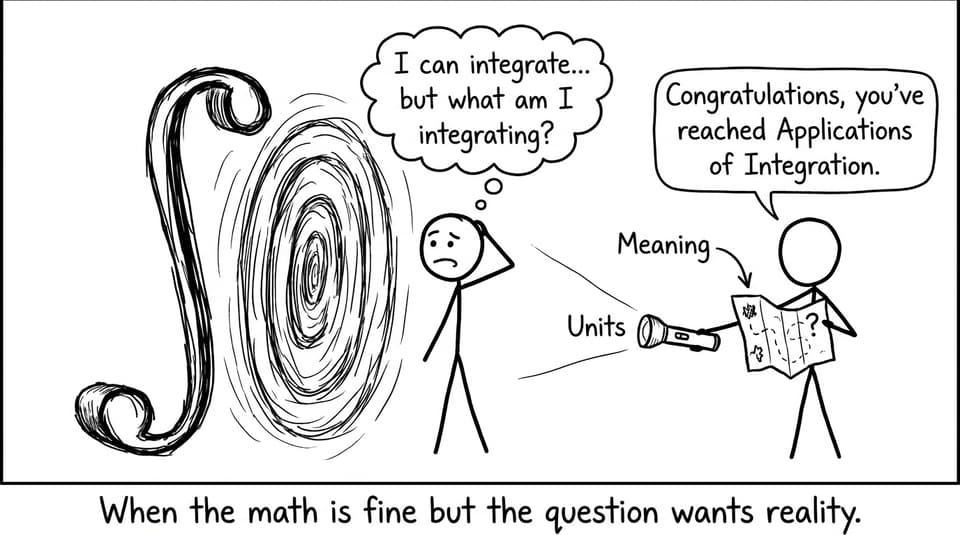
Suddenly, the calculus you trusted feels like it drifted away from shore.
That’s not a sign you’re bad at IB Math. It’s a sign that applications of integration ask for a different skill: not computing, but deciding what the computation means. In exams, that decision-making is where a lot of marks live.
A quick checklist: what IB Math is really testing
When applications of integration feel abstract, it’s usually because one of these five steps is fuzzy:
-
Quantity: What real thing is accumulating (area, distance, work, probability, etc.)?
-
Rate: What function represents the rate or density?
-
Bounds: Where does accumulation start and stop?
-
Geometry: What does the diagram/region/solid actually look like?
-
Communication: What units and interpretation sentence finish the job?
If you want targeted practice on exactly these steps, the IB Math AA calculus questionbank is designed to drill the exam thinking, not just the algebra.
The real reason applications feel abstract: integrals stop being “a method”
In early calculus, the integral behaves like a procedure: simplify, integrate, substitute. In applications, the integral becomes a container for meaning. In IB Math, that switch is deliberate.
A definite integral is not just “find the value.” It’s “measure a total.” Your job is to explain what total is being measured.
That’s why many students find it helpful to first stabilize the core interpretation with short, syllabus-aligned notes. Start with the AI SL 5.5 Introduction to Integration topic hub or, for broader navigation, the IB Mathematics AA resources page.
Why area between curves feels harder than it should in IB Math
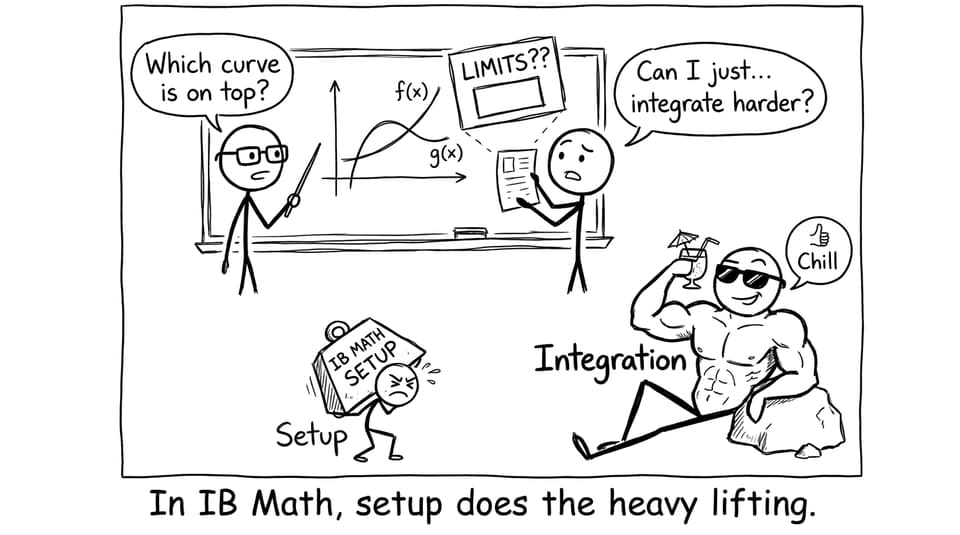
Most “area” questions aren’t hard because the integration is hard. They’re hard because the setup is easy to get subtly wrong.
In IB Math, you’re expected to decide:
-
Which curve is on top (or right)
-
Where the intersections are
-
Whether you want net area or total area
-
What your limits should be
If any of those choices is off, you can integrate perfectly and still be wrong.
A practical habit: write one sentence before you integrate, like “Area = integral of (top minus bottom) from x=a to x=b.” Examiners reward that clarity.
If definite integrals themselves still feel slippery, read Why Do Definite Integrals Confuse So Many IB Maths Students and then test yourself right away with the RevisionDojo Questionbank and instant feedback.
Why volumes of revolution feel like imagination homework
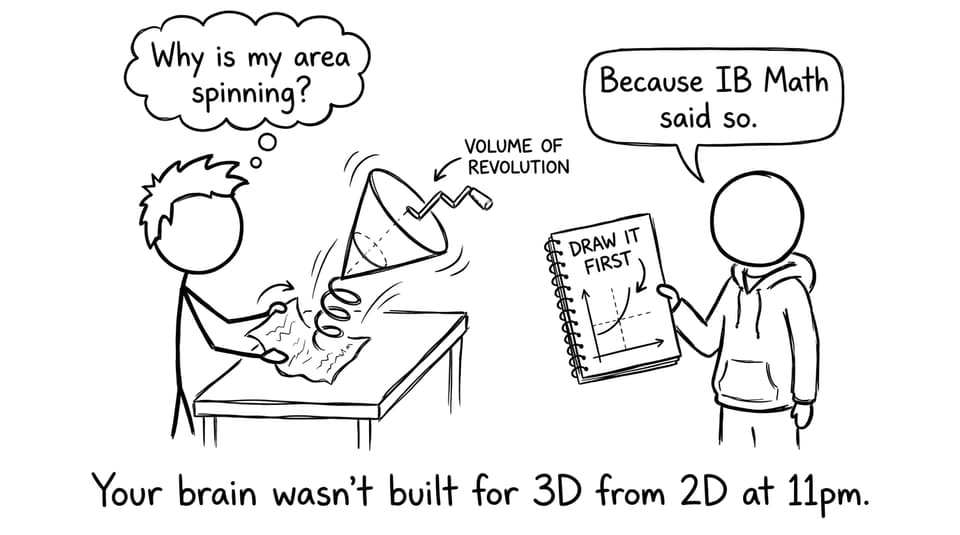
Volume questions often feel abstract because they demand 3D thinking from a 2D sketch, under time pressure.
In IB Math, the exam expects you to:
-
Visualize the region
-
Identify the axis of rotation
-
Choose a method (disk/washer in AA contexts)
-
Match the radius to the correct function
A simple fix is also the most ignored: sketch the region and draw the axis. Even a messy sketch reduces cognitive load and prevents you from rotating the wrong curve.
To build confidence with integration more broadly (including the techniques that show up around these questions), use IB Math HL: Tips for Tackling Integration Problems with Confidence.
Why units suddenly matter (and why that costs marks)
Pure integration practice trains you to output a number. Applications of integration in IB Math train you to output a measured quantity.
So units stop being decoration. They become part of the meaning:
-
If the integrand is in m/s, the integral over time becomes m.
-
If the integrand is in N, integrating over m becomes J (work).
This is where RevisionDojo’s AI Chat is useful: paste your final line and ask, “What does this answer represent, and what should the units be?” Then lock it in with Flashcards so you stop losing easy communication marks.
How to make applications of integration feel concrete fast
Use a repeatable loop (this is what top scorers do in IB Math):
-
Study Notes: Patch one sub-skill (like limits, net vs total area).
-
Questionbank: Do a short targeted set until you see patterns.
-
AI Chat: Ask one precise “why” question on your mistake.
-
Grading tools: Check whether your explanation and units would earn method marks.
-
Mock Exams + Predicted Papers: Rehearse the skill under time so it stops feeling abstract.
For structure, How to Use the Questionbank for Targeted Math Revision pairs well with Custom IB Mock Exams: Build Practice Tests by Topic and the IB Predicted Papers hub.
Closing: make IB Math feel real again
Applications of integration feel abstract when the meaning disappears behind symbols. But in IB Math, the symbols are the shortcut to reality: area, accumulation, volume, and total change.
If you want that reality to feel automatic under exam conditions, build one calm system: RevisionDojo Study Notes for clarity, Flashcards for recall, a Questionbank for exam-style patterns, AI Chat when you’re stuck, Grading tools to secure method/communication marks, and Mock Exams plus Predicted Papers to make the pressure familiar.
Start with one topic, one setup habit, and a short practice set today. Your future self will feel the difference when the next IB Math integral shows up wearing a story problem disguise.