


Why amortisation feels like “calculator maths” in IB Math
The first time you meet an amortisation question in IB Math, it can feel strangely unfair. You’re not asked to “solve for x.” You’re asked to build a schedule, read a table, and explain what a payment means. It’s the kind of moment where a student stares at their graphing calculator like it owes them an apology.
That discomfort is the point.
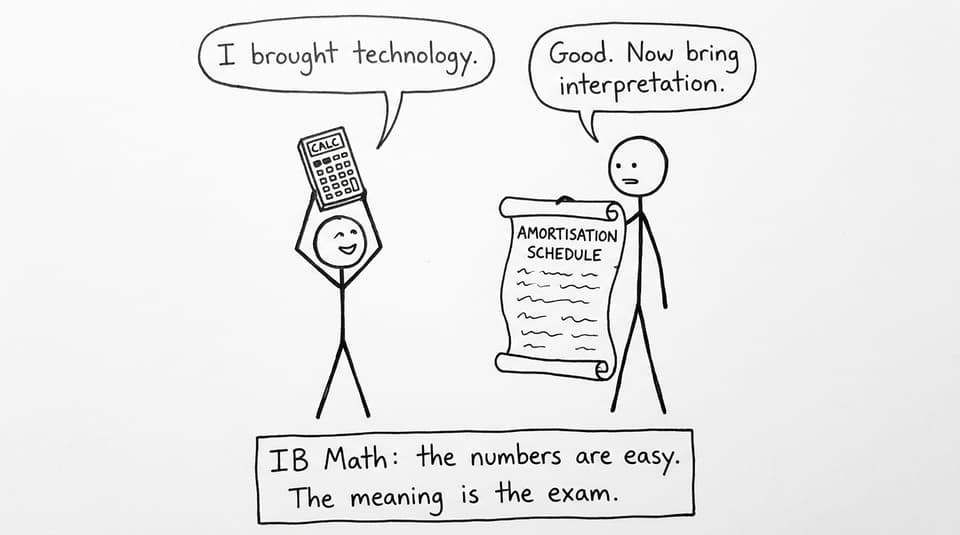
Amortisation questions rely so heavily on technology in IB Math because the course (especially Applications & Interpretation) is testing something closer to real financial modelling than to hand-calculation stamina. In other words: the calculator is not a shortcut. It is part of the task.
Quick checklist: what IB Math is actually assessing
Before you dive into buttons and tables, anchor yourself with a simple checklist. In IB Math, strong amortisation responses usually show:
-
A clear statement of the time period (monthly? annually?)
-
Correct matching of interest rate to the payment frequency
-
Correct use of technology to create an amortisation schedule
-
Interpretation: what the balance, interest portion, and principal portion represent
-
A reasonableness check (does the balance decrease? do interest payments shrink over time?)
If you want practice that mirrors this exact marking style, RevisionDojo’s Loan Repayments and Amortization topic is built around tech setup and explanation.
What amortisation is modelling (and why tech belongs in the model)
Amortisation is a story told in repeated steps: a loan balance accrues interest, you make a payment, the balance drops, and the cycle repeats. Each payment is split into two parts:
-
Interest on what you still owe
-
Principal repayment (the part that actually reduces the loan)
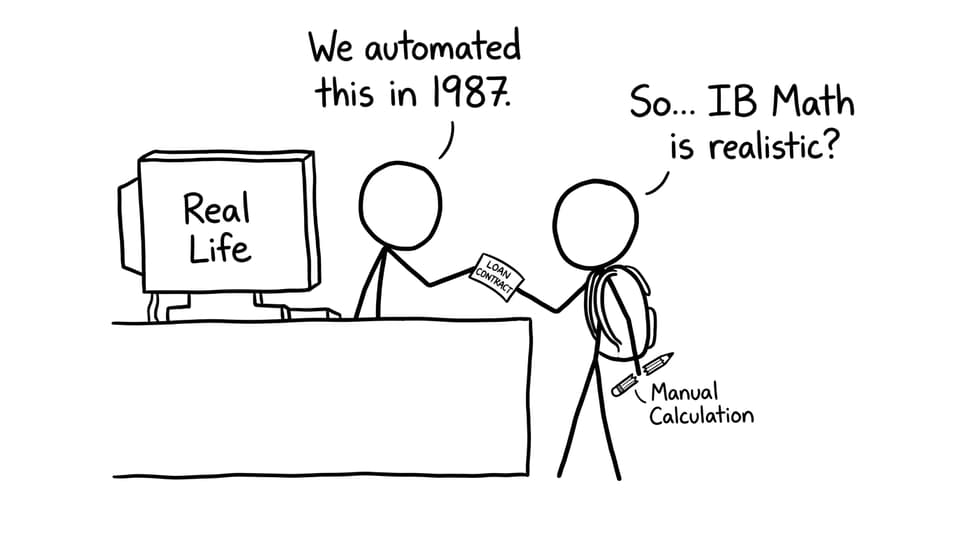
In real life, nobody writes 36 lines of arithmetic to do this. Banks use software. Spreadsheets handle it. Financial calculators automate it. IB Math mirrors that reality because the underlying goal is financial literacy: can you model a long-term commitment and explain its consequences?
RevisionDojo’s amortisation notes are especially useful here because they focus on the structure of the schedule, not just the final numbers.
Why manual calculation misses the point in IB Math
Manual amortisation is repetitive. That repetition doesn’t test deeper understanding, it tests patience. So IB Math shifts the difficulty away from arithmetic and toward decisions:
-
What rate should I use per period?
-
Is this an ordinary annuity assumption (payments at the end of each period)?
-
Which row of the table answers the question being asked?
-
What conclusion should I draw from the trend?
This same philosophy shows up across calculator papers. If Paper 2 feels “easier,” it’s often because the calculations are faster, not because the thinking is lighter. RevisionDojo’s guide on how to prepare for IB Math Paper 2 explains why technology marks are really interpretation marks in disguise.

Why students lose marks even with perfect tables
A correct table can still earn a disappointing score in IB Math. Examiners regularly see students:
-
Copy values without stating what they represent
-
Read the wrong row (off-by-one period errors are common)
-
Use an annual rate with monthly payments without converting
-
Forget to connect the output back to the context (loan, mortgage, term)
Technology produces numbers automatically. But IB Math awards marks for meaning. If you want a bigger-picture explanation of this pattern, see why over-reliance on technology loses marks in AI Maths.
The quiet killer: mismatched time units
If amortisation questions have one hidden trap, it’s time.
Students might enter a 6% interest rate as if it applies every month, then wonder why the balance behaves oddly. Or they might keep the rate annual but treat the number of payments as months. In IB Math, that mismatch signals that the model is not understood, so it’s penalised heavily.
Technology doesn’t fix this. It accelerates it.
To reinforce this skill across finance topics, RevisionDojo’s post on financial mathematics in IB Maths helps you build the habit of translating context into the right variables.
How to use technology the way examiners want
In IB Math, technology earns marks when it is clearly controlled. A simple pattern works well:
-
State your period and converted rate.
-
Generate the amortisation schedule.
-
Quote only the values needed.
-
Explain them in one or two precise sentences.
-
Add a short reasonableness check.
If you’re unsure what “controlled” looks like, RevisionDojo’s guide on how to use graphing calculators during IB Math exams breaks down tech habits that prevent avoidable errors.
Bringing it home: technology is the language of this topic
Amortisation questions lean on technology in IB Math for the same reason real finance does: the hard part is not the arithmetic, it’s building a model you trust and explaining what it implies.
If you want to get genuinely consistent at these questions, use RevisionDojo the way top students do: practice with the Questionbank, tighten concepts with Study Notes and Flashcards, stress-test your explanations with AI Chat and Grading tools, and simulate timing with Predicted Papers and Mock Exams. When amortisation stops being “calculator work” and becomes “interpreting a financial story,” your marks usually rise with it.