



Discrete random variables are the moment many IB Math students feel probability turn from “real life” into “pure symbols.” One week you are shading regions and counting outcomes. The next, you are told that a letter like (X) “takes values,” and a tidy table is supposed to represent an entire situation. Nothing got harder overnight. But the feeling changes.
A quick checklist to make discrete random variables feel real
When discrete random variables start to feel foggy in IB Math, run this quick reset:
-
Say what (X) means in one sentence (not what it “is”).
-
List the possible values of (X) like normal outcomes.
-
Check the probabilities add to 1.
-
Translate one table entry into English: “(P(X=2)=0.3) means…”.
-
Only then compute (E(X)) or other measures.
For targeted practice on the exact syllabus skill, open Discrete Random Variables (AA SL 4.7) or use the Math AI SL 4.7 Questionbank.
Why discrete random variables feel abstract at first
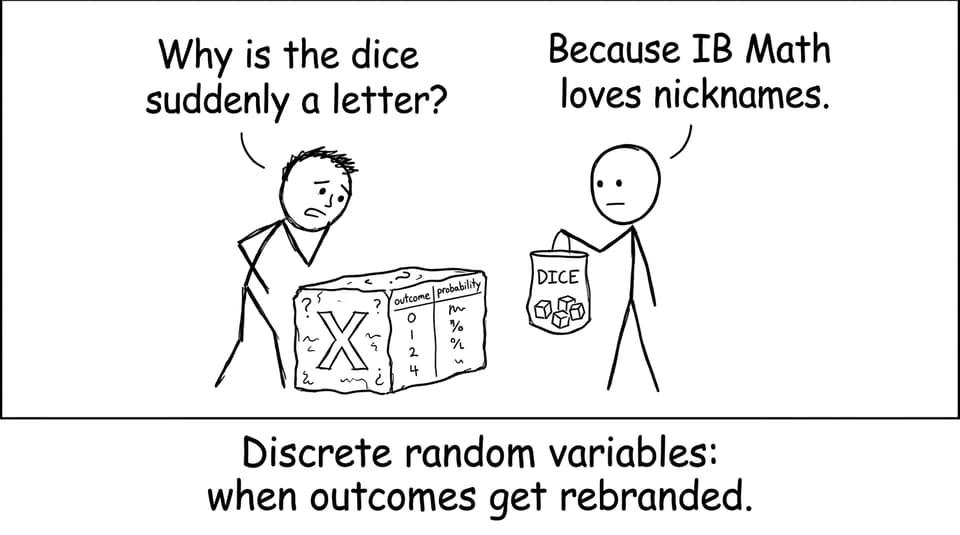
The “nickname problem”: notation replaces objects
In early probability, the objects stay visible: coins, cards, spinners. With discrete random variables, IB Math asks you to name the outcome with a symbol and work at a distance.
(X) is not trying to be fancy. It is just a shortcut for “the number of successes,” “the amount you win,” or “the number of emails received.” But until you anchor (X) back to context every time, it can feel like the question is talking about nothing.
If you want a clean home base for the broader topic, keep Statistics and Probability (AA) bookmarked.
Two ideas at once: values and probabilities must live together
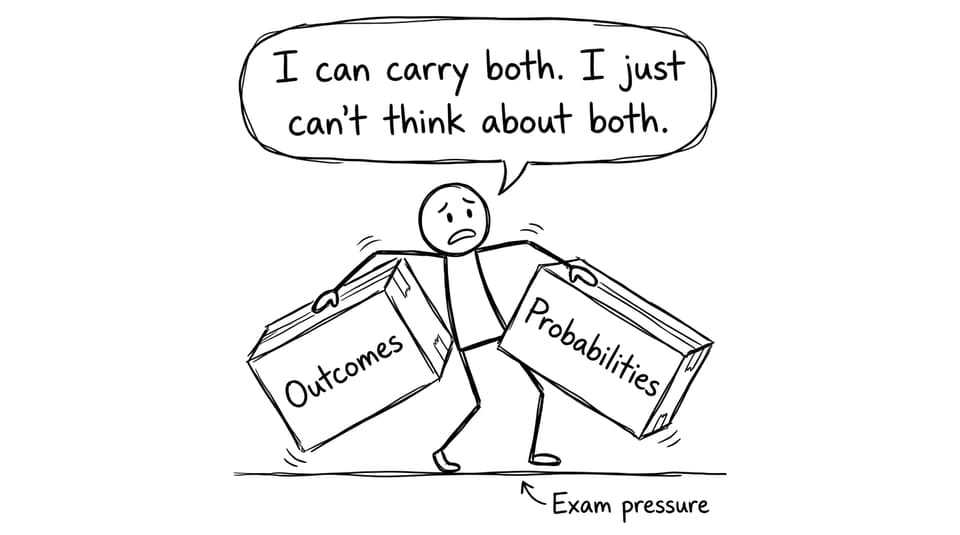
A discrete random variable is really two lists glued together:
-
the values (X) can take
-
the probabilities attached to each value
That “dual tracking” is why it feels abstract in IB Math under time pressure. You are not just finding one probability; you are describing a whole system.
A practical fix: rewrite the distribution as a sentence once. For example, “There’s a 0.2 chance of 0, a 0.5 chance of 1…” It slows you down for 20 seconds and saves you from losing method marks later.
To train that “system thinking,” use Why Students Forget Probabilities Must Sum to One and then drill similar questions in RevisionDojo’s Questionbank.
Neat tables create a false sense that the thinking is done
Distributions often look polished: a complete table, a named distribution, a clean set of values. That can trick you into treating the question as reading instead of interpreting.
But many IB Math marks here are earned by explaining what a value represents, what a probability implies, or what assumptions the model is making. If you want to see how IB tends to reward explanation, read Why IB Questions Focus More on Interpretation Than Calculation for DRVs.
Expected value feels like an answer that never happens
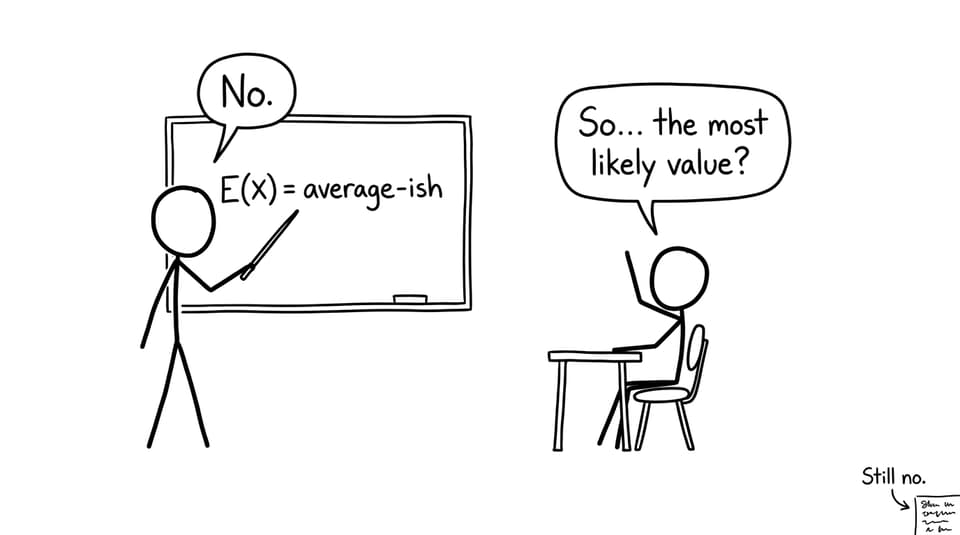
Soon after discrete random variables, (E(X)) appears. Students expect an “answer” to match an actual outcome. Then expected value shows up as an average that might not occur at all.
That is not a bug. It is the point: IB Math is testing whether you can separate single outcomes from long-run patterns. Once you accept that expected value is a decision tool (not a prediction), the topic becomes calmer.
How RevisionDojo helps you turn abstraction into marks
The fastest path from “abstract” to “structured” is a loop:
-
Learn the meaning with Statistics and Probability Notes (AA) or the Math AI Statistics and Probability hub.
-
Practice in the Questionbank with instant solutions.
-
Use Flashcards to lock in definitions like “discrete,” “distribution,” and “expected value.”
-
Ask AI Chat the one-sentence meaning of a symbol when you feel stuck.
-
Use Grading tools to check whether your interpretation lines would score.
-
Pressure-test with Predicted Papers and Mock Exams (try IB Predicted Papers).
If you need a bigger study structure around IB Math, these guides help: Best Study Schedule for IB Math Exams and How to Score 7 in IB Math AI SL.
Closing: make the symbol point back to the story
Discrete random variables feel abstract in IB Math for a simple reason: the course asks you to think in representations, not just outcomes. But once you train yourself to translate (X) back into a sentence, and the distribution back into a story, the topic becomes structured instead of theoretical.
If you want that structure every time you revise, use RevisionDojo as your loop: Study Notes for clarity, Flashcards for recall, Questionbank for repetition, AI Chat for quick explanations, Grading tools for feedback, and Predicted Papers plus Mock Exams for exam realism. That is how “abstract” becomes “predictable,” and predictable becomes marks.