



If you have ever stared at a cumulative frequency curve and thought, “Okay… so where is the peak?” you are not alone. In IB Math, these graphs can feel strangely polished: a smooth line, a neat rise, a sense that the data is telling you everything. But that smoothness is exactly the trap. A cumulative frequency graph is designed to answer one kind of question very well, and to hide another kind almost completely.
The quick IB Math checklist: what a cumulative frequency graph is for
Before you interpret anything in IB Math, ask what the graph is built to show.
-
It shows accumulation: how many values are at or below a point.
-
It is strong for median, quartiles, percentiles, and comparisons of position.
-
It is weak for distribution shape: skewness, modality, clustering, and gaps.
If you want a step-by-step confidence boost on reading these curves, pair this with Why Cumulative Frequency Graphs Feel Hard to Read.
Why cumulative frequency graphs hide distribution shape in IB Math
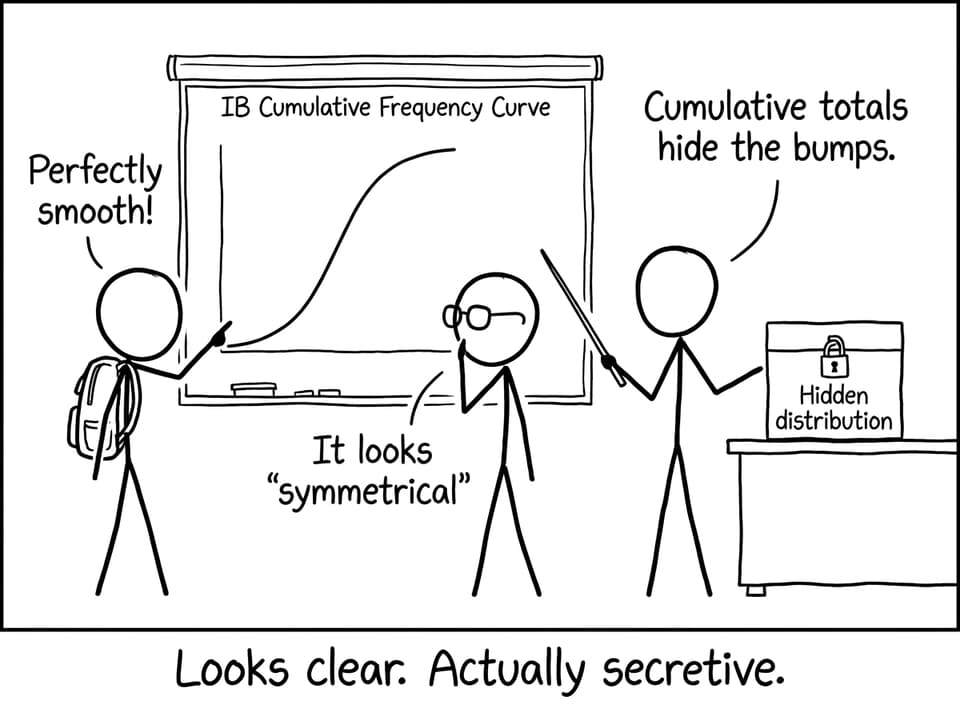
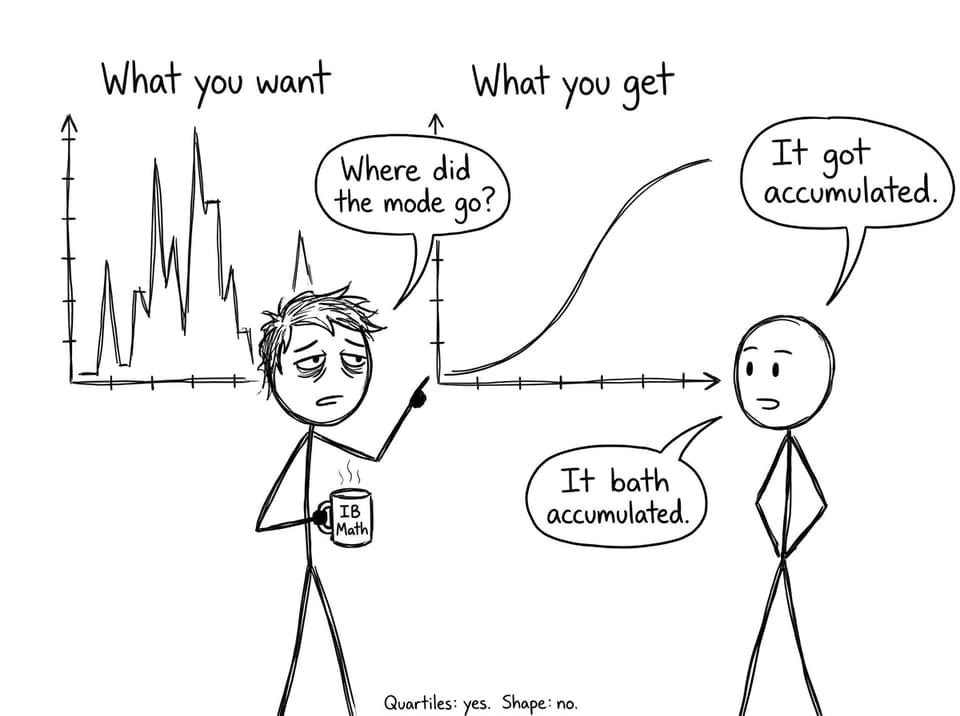
The reason is simple but easy to forget under exam pressure: cumulative frequency graphs don’t plot frequency. They plot total so far.
Imagine a histogram with a dramatic spike in one interval and almost nothing elsewhere. In a histogram, that spike shouts “most values live here.” In a cumulative frequency curve, that same spike becomes just a steeper segment inside one continuously increasing line. The peak is not visible as a peak anymore; it has been absorbed into the running total.
That is why students in IB Math get tempted to comment on symmetry or skewness from the curve’s overall look. A curve can look nicely balanced (even S-shaped) while the underlying data is lopsided. The curve is telling you about how fast the total increases, not what the distribution “looks like.”
For IB-style reasoning and what examiners actually test, see Why IB Questions Prefer Cumulative Frequency Over Raw Tables.
What you can say confidently instead (and score marks)
In IB Math, you are rewarded for making claims the graph truly supports.
Talk position, not shape
A cumulative frequency graph is built for positional statements:
-
“About 75% of values are below …”
-
“The median is approximately …”
-
“Group A has a higher upper quartile than Group B”
If quartiles are where you tend to slip, Why Students Misread Quartiles on Cumulative Frequency Curves is worth five focused minutes.
Use it to estimate, then justify
IB expects sensible estimates, with clear construction lines and cautious language. Practise the mechanics directly with Histograms and Cumulative Frequency (IB Math AI) and the companion practice page Constructing Cumulative Frequency Graphs (Bootcamps).
The common IB Math mistake that loses easy marks
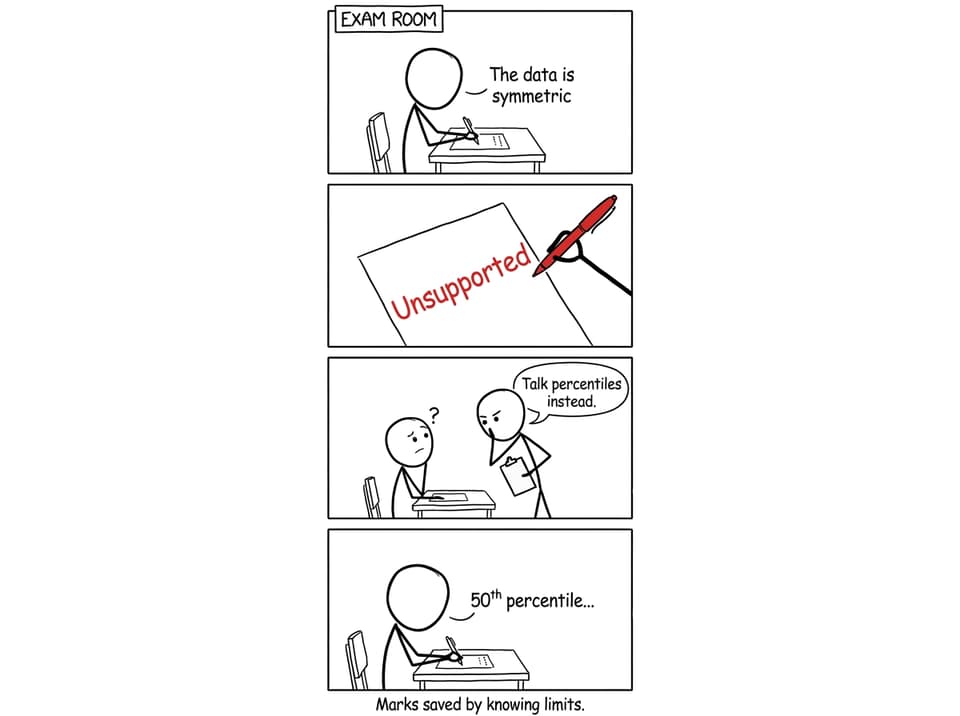
Students often write: “The distribution is symmetric” or “It is skewed right,” because the curve feels like a distribution plot.
But in IB Math, those are high-risk claims unless you have a histogram, a box plot, or a frequency table that actually shows concentration. Examiners like restrained interpretation. Precision is not the goal; appropriate inference is.
If you want to build that examiner-style voice across statistics questions, start from the IB Mathematics Applications & Interpretation Resources hub and the wider IB Math posts.
Bring it home with RevisionDojo
In IB Math, cumulative frequency graphs are a lesson in restraint: the curve looks complete, but it is quietly hiding the distribution shape. Once you stop trying to “see the mode” in an accumulated total, your interpretations become calmer, sharper, and more mark-efficient.
If you want to turn that understanding into exam performance, RevisionDojo is built for it: drill graph interpretation in the Questionbank, learn the workflow in Study Notes, lock in phrasing with Flashcards, and sanity-check conclusions with AI Chat. Then pressure-test the skill with Mock Exams and Predicted Papers, and use the Grading tools to see exactly where your explanation got too confident. If you are stuck, the Tutors and Coursework Library help you rebuild the skill from first principles, the way IB expects you to think.