

You know the feeling: you’re fine with a histogram, you can talk about skew and spread, and then a cumulative frequency curve shows up and suddenly your brain goes quiet. In IB Math, this is one of those topics that isn’t “hard” in the usual way. It’s hard because it asks you to read information indirectly, like listening to a story from the final chapter backwards.
Why IB Math cumulative frequency graphs feel confusing
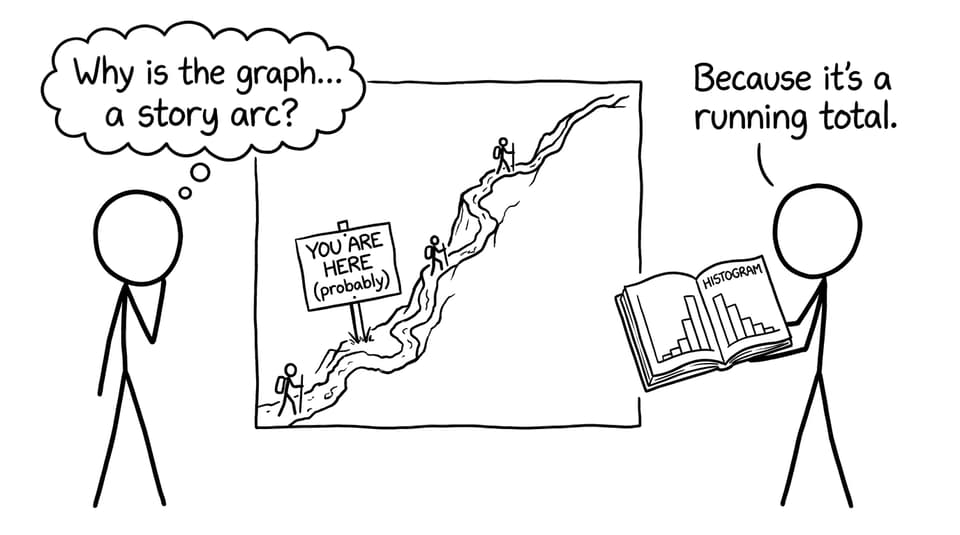
A cumulative frequency graph doesn’t show you the data points or even the frequencies in each class. It shows a running total. That design choice is the whole reason it feels slippery.
You’re forced to think “backwards”
With bar charts and histograms, the y-value tells you “how many.” With a cumulative frequency curve, the y-value tells you “how many up to here.” So every time you want the frequency in an interval, your brain has to subtract two totals. In IB Math, that extra step can feel like doing mental gymnastics while also trying to stay calm.
The curve invites estimation, not exactness
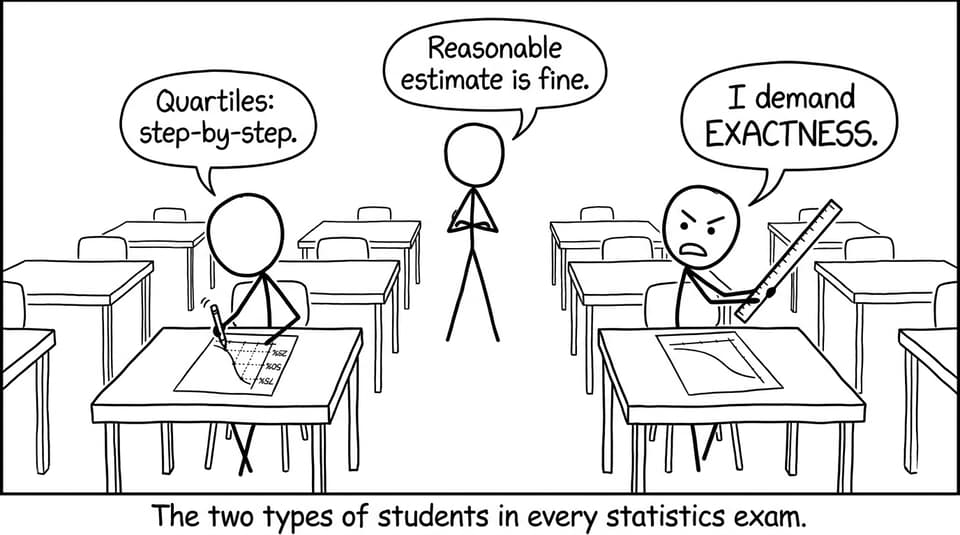
Most cumulative frequency graphs are smooth curves. That means you often read values between grid lines and between plotted points. The answer can be correct while still looking “messy,” which is emotionally uncomfortable under exam pressure.
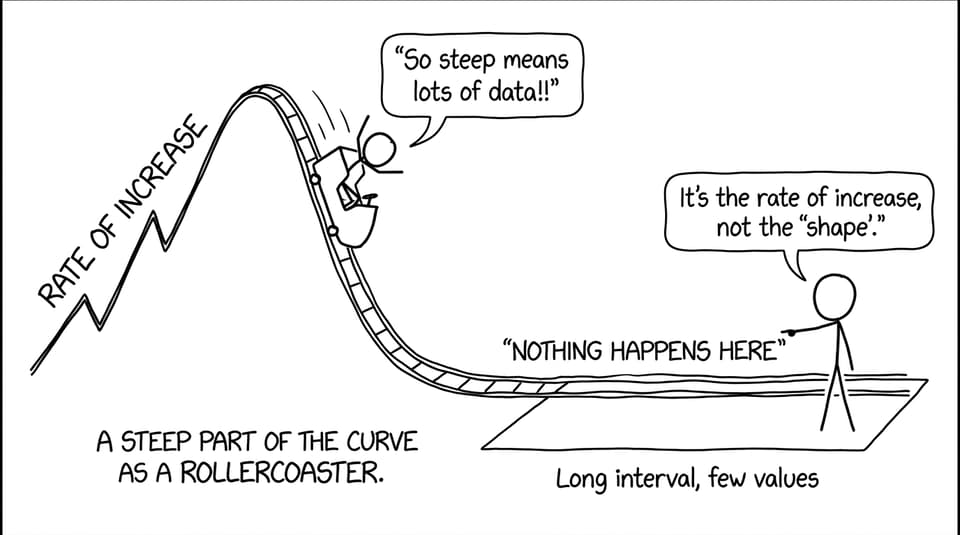
The shape means rate of increase, not clustering
This is the biggest conceptual trap. On a histogram, a tall bar screams “many values here.” On a cumulative frequency graph, a steep section means the same thing, but it’s encoded as speed: how fast the total is increasing. Once you internalise that, the graph stops feeling mysterious.
A quick checklist for reading cumulative frequency graphs (exam-ready)
Use this every time. In IB Math, consistency beats cleverness.
-
Find the total frequency (the final y-value).
-
Convert the target percentile to a cumulative frequency (e.g., 0.25n, 0.5n, 0.75n).
-
Move from that y-value horizontally to the curve.
-
Drop vertically to the x-axis to read the data value.
-
Draw light construction lines so the examiner can see your method.
If you want structured practice on this exact workflow, use the IB Mathematics Applications & Interpretation Resources hub, then drill questions in the Statistics and Probability topic.
The hidden reason mistakes happen in IB Math exams
Most errors are not conceptual. They’re directional.
Students rush and:
-
read quartile values off the y-axis instead of projecting to the x-axis,
-
forget to compute 25%, 50%, 75% of the total frequency,
-
skip construction lines because they “look messy.”
That’s why resources that train interpretation matter. RevisionDojo’s Questionbank forces you to practice the same reading moves repeatedly, while AI Chat helps you diagnose why a reading went wrong (axis, rounding, or method). If you’re building a bigger revision system, the How to Score 7 in IB Math AI SL guide pairs well with this topic.
Where RevisionDojo fits into cumulative frequency confidence
Cumulative frequency graphs get easier when you see patterns in your own mistakes. RevisionDojo is built for that loop:
-
Study Notes to learn the method once, cleanly.
-
Flashcards to lock in “percentile to cumulative frequency” habits.
-
Grading tools to understand method marks vs final answers.
-
Mock Exams and Predicted Papers to practise under time pressure.
-
Tutors when you need one specific block cleared up fast.
For extra support, explore Question Type 2: Histograms and cumulative frequency, plus these deeper reads: Why Students Misread Quartiles on Cumulative Frequency Curves and Why Medians Are Easier Than Means on Cumulative Frequency Graphs.
Conclusion: make the curve predictable
A cumulative frequency graph feels hard because it’s a different kind of reading: totals first, values second. But in IB Math, once you commit to the same steps every time, the curve stops being intimidating and starts being useful.
If you want this to become automatic, practise with RevisionDojo’s Study Notes, Questionbank, and timed Mock Exams so you build the calm, repeatable habits that show up on exam day. Start at the IB Math tag hub and turn this one “confusing graph” into an easy source of marks.