
If DNA were a long zipper you had to trust with every important instruction in your life, you’d want two things: it should stay closed when it matters, and it should open smoothly when you need access.
That balancing act is exactly why complementary base pairing is such a big deal in IB Biology. It’s not just a memorisation rule (A with T, C with G). It’s a stability system that keeps DNA the same width, makes the double helix energetically favourable, and lets cells copy information with high fidelity.
Quick checklist: what stabilises DNA?
For exam answers in IB Biology, aim to hit these points clearly:
-
Specific hydrogen bonding between bases holds the strands together.
-
Purine-pyrimidine pairing keeps the helix width consistent.
-
Many weak interactions together create strong overall stability.
-
Mismatch distortion helps repair enzymes find errors.
-
Base pairing supports accurate replication and reliable gene expression.
If you want the wider context of the molecule itself, pair this with Structure of DNA Explained: Double Helix, Bases, and Genetic Function.
Complementary base pairing keeps the helix the “right” shape
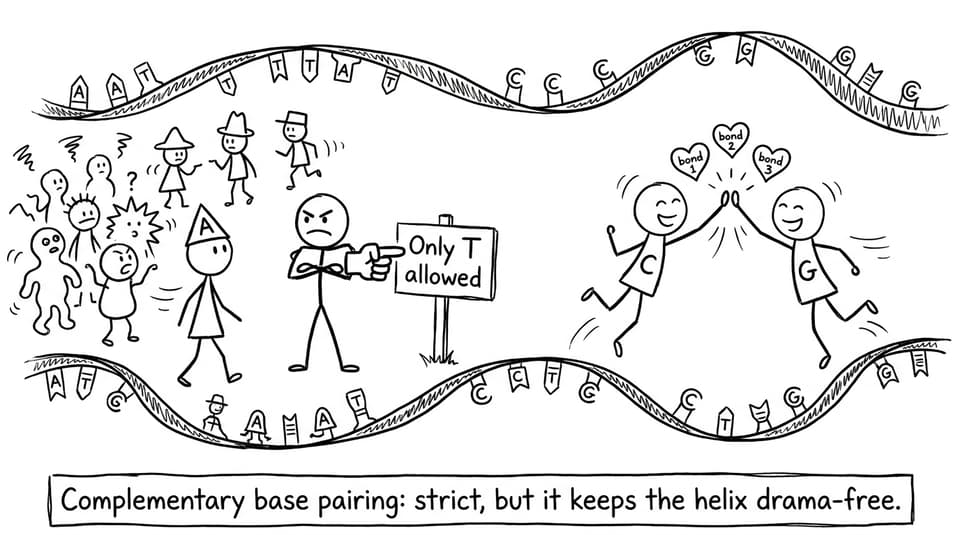
Adenine and guanine are purines (two-ring structures). Cytosine and thymine are pyrimidines (one-ring structures). In IB Biology, this pairing geometry matters because:
-
Purine + pyrimidine creates a consistent distance between strands.
-
That consistent spacing supports the smooth spiral of the double helix.
-
Odd pairings (like purine-purine) would bulge; pyrimidine-pyrimidine would pinch.
So the stability is partly mechanical: complementary base pairing prevents a DNA helix with random bumps and dents.
To connect this to bonding language, review Role of Hydrogen Bonding and Complementary Base Pairing (Notes).
Hydrogen bonds: weak individually, strong together
A pairs with T using two hydrogen bonds. C pairs with G using three hydrogen bonds. Students sometimes get stuck thinking “hydrogen bonds are weak, so how can they stabilise anything?”
Here’s the calm answer you can use in IB Biology: a single hydrogen bond is weak, but DNA contains millions of base pairs. Stability comes from lots of weak interactions acting together, which makes the double helix stable overall but still reversible when the cell needs to unzip it.

If you want an extra-clear refresher on what hydrogen bonding actually is, read What Is Hydrogen Bonding?.
Complementary base pairing makes replication accurate (and repair possible)
The elegance of base pairing is that each strand contains the instructions for rebuilding its partner. During replication, each original strand acts as a template, and DNA polymerase adds the nucleotide that fits.
This supports stability in a deeper sense: not just “DNA stays together,” but “DNA stays the same across generations of cells.” That’s a major theme in IB Biology.
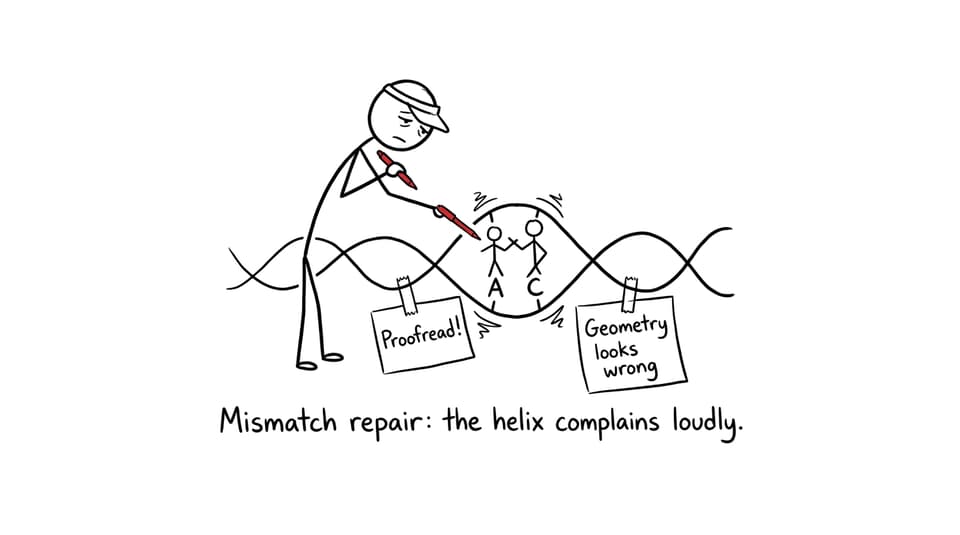
Even better, when a wrong nucleotide slips in, the mismatch usually:
-
forms fewer or incorrect hydrogen bonds, and
-
distorts the helix shape.
That distortion is useful. Repair enzymes can detect “something looks off” and fix the error.
For a syllabus-aligned pathway through this topic, use IB Biology Topic D1.1: DNA Replication and the focused note Semi-conservative Nature of DNA Replication (Notes).
If you want to go one layer deeper into accuracy, link base pairing to proofreading and correction using DNA Proofreading Notes (HL) or the explainer How DNA Polymerases Maintain Replication Accuracy.
The “unzips and rezips” advantage
A final stability point that exam questions love: DNA must be stable but also workable.
During replication and transcription, enzymes temporarily break hydrogen bonds to separate strands. That’s why weak-but-many bonds are perfect: separation is possible, but random drifting is limited because complementary sequences naturally realign and re-form the same pairings.
To connect base pairing with strand separation at the replication fork, see Roles of Helicase and Topoisomerase in Replication.
Bring it home: practise the way examiners think
In IB Biology, complementary base pairing is one of those concepts that looks simple until it appears in a longer explanation question about replication fidelity, gene expression, or mutation.
RevisionDojo helps you turn the idea into marks: use the Study Notes for clean wording, drill it with the Questionbank, lock terms with Flashcards, and clarify confusions quickly with AI Chat. When you’re ready to simulate exam pressure, add Mock Exams, Predicted Papers, and Grading tools to tighten your phrasing. And if you want guided structure, the Tutors and Coursework Library keep the bigger picture steady.
Start with the full hub of IB Biology Resources and build from there, because the best stability, in DNA and revision, comes from the right pairings repeated consistently.