



If you have ever walked out of an IB Math exam thinking, “I knew how to do that, so why did it go sideways?”, you are not alone. Long-response questions don’t just test whether you can calculate. They test whether an examiner can see your thinking quickly. In IB Math, clarity is not decoration; it is part of the assessment.
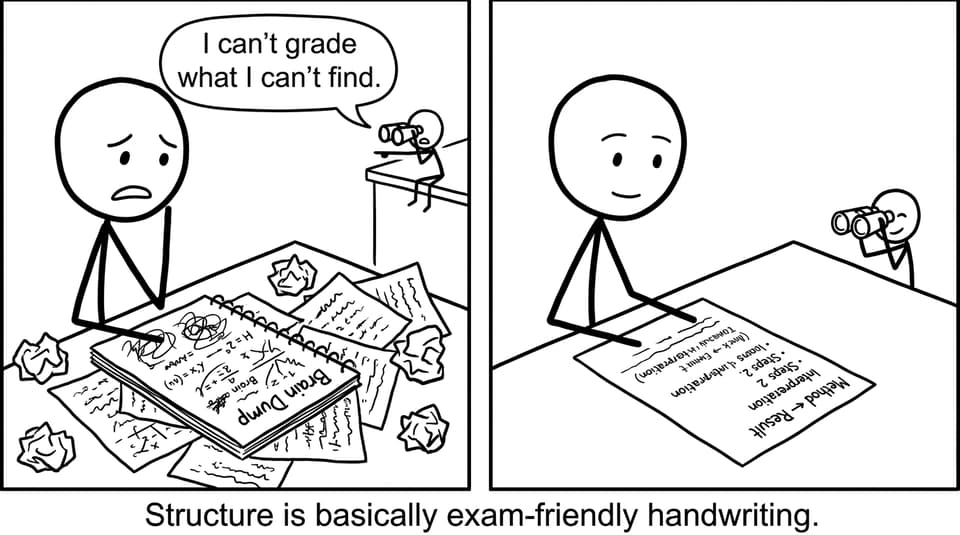
The fast checklist (use this every time in IB Math)
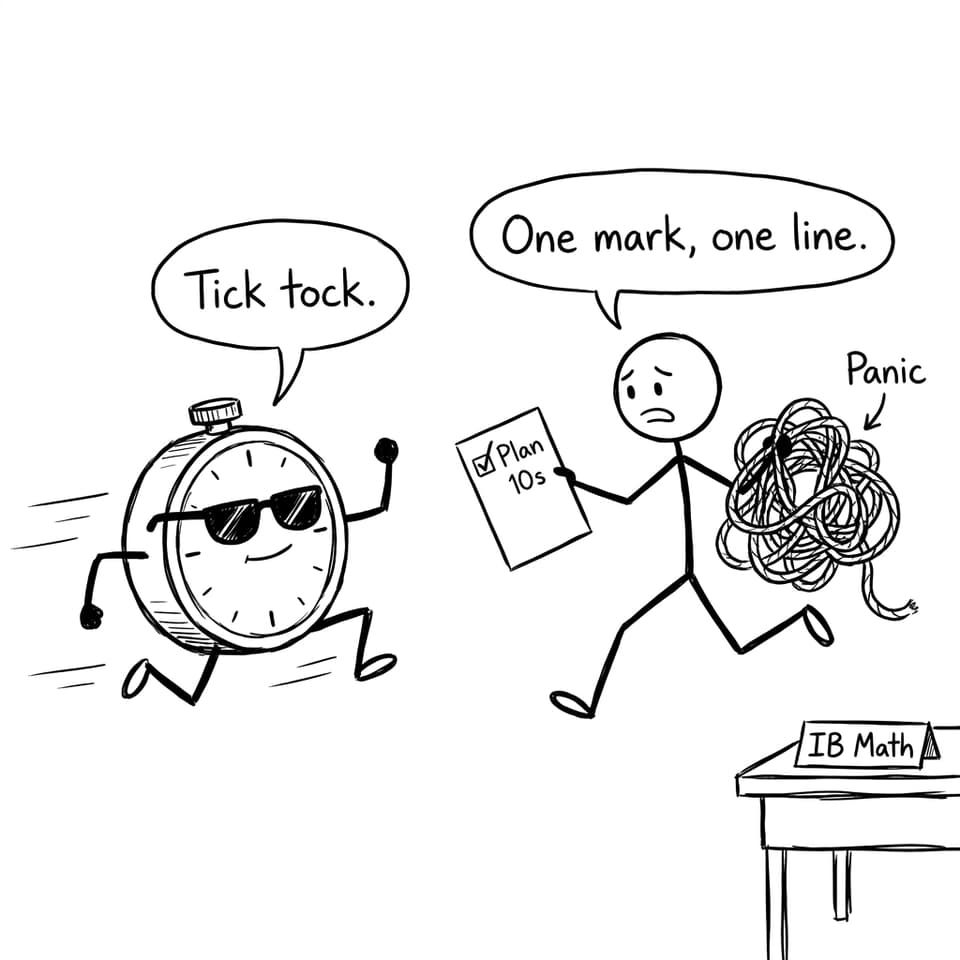
Before you write anything substantial, take 10 seconds and run this micro-plan:
-
Identify what the question is asking for (final quantity, statement, or decision)
-
Match your answer to the mark allocation (roughly one clear step per mark)
-
Use a consistent flow: Method -> Result -> Interpretation -> Evaluation/limitation
-
Box or underline your final result (so it can’t be missed)
If you want a broader structure system that works across subjects, borrow ideas from Structure IB Answers to Maximize Marks.
Why structure earns marks (even when your math is right)
In IB Math, long-response items often bundle multiple skills: calculation, reasoning, interpretation in context, and sometimes evaluation. The markscheme is usually modular. That means the examiner is scanning for recognizable “mark moments” more than admiring your elegant stream of consciousness.
When your work is scattered, three bad things happen:
-
Method marks vanish because the method is hard to locate
-
Reasoning marks vanish because your justification is implied, not stated
-
Follow-through marks shrink because later logic can’t be separated from earlier errors
Structure is how you make your understanding gradeable.
The safest structure for IB Math long responses
A reliable template for IB Math long-response questions is:
Working first, not conclusions first
Start with clean working: define variables, write the relevant formula, show substitutions, and keep steps on separate lines. If you jump to the conclusion, you often lose the “how” marks even if your “what” is correct.
To train this under exam conditions, do targeted practice in RevisionDojo’s IB Math AA Resources and build the habit of writing one step per line.
Result second (make it obvious)
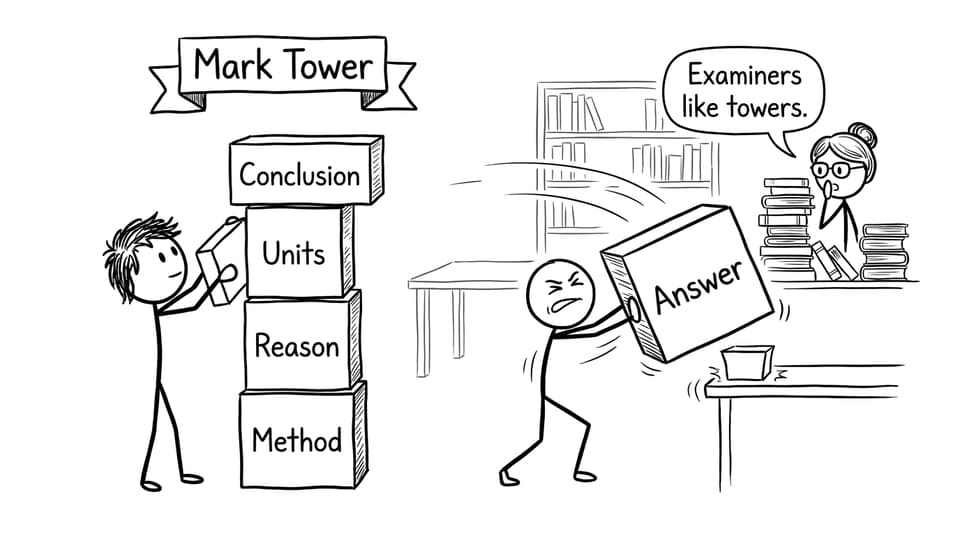
Write the numerical result or algebraic expression clearly, with units where relevant. Box it. Label it. Make it impossible to miss.
If you’re practicing calculus-heavy questions, use a focused set like the IB Math AA Calculus Questionbank to repeat the same “method -> result” rhythm until it becomes automatic.
Interpretation third (say what it means)
This is where many students silently lose marks in IB Math. Interpretation is not “I got 3.2”. It is “3.2 means the model predicts… in this context.” Write one or two complete sentences. Even in math, communication is assessed.
A good support resource here is the Notes for Functions (IB Math AI), because it models how to move from calculation to meaning.
Evaluation or limitation last (protect marks)
If a question asks for reliability, assumptions, limitations, or “comment”, treat that as a separate mini-section. State at least one limitation cleanly. This protects marks because the examiner can award evaluation independently.
For more help building calm routines around this, see The Ultimate IB Math Study Routine for Busy Students.
How RevisionDojo helps you build structure fast
Structure is a skill, which means it improves with feedback loops, not wishful thinking. RevisionDojo is built for exactly that:
-
Questionbank to drill long-response patterns by topic and difficulty
-
Study Notes to rebuild the concept quickly when you miss a step
-
Flashcards to lock in recurring “structure rules” (like “interpret in one sentence”)
-
AI Chat to ask, “Where did my structure break down?” and get targeted suggestions
-
Grading tools to check whether your reasoning is visible and complete
-
Mock Exams to practice structure under timing pressure
-
Predicted Papers to rehearse exam-like phrasing and multi-skill prompts (used strategically)
-
Coursework Library and Tutors when you need guided, human correction of habits
If you’re in AI, start from IB Math AI Resources. If you’re trying to climb from a low grade, 3 in IB Math: How to Get Back to a 4+ is a practical reset.
Conclusion: In IB Math, structure is part of the math
Long-response questions feel intimidating when they look like a wall of words. But in IB Math, the wall comes down once you treat structure as a scoring tool: show the method, make the result obvious, interpret in context, then evaluate when asked.
If you want to turn that structure into automatic exam behavior, practice it inside RevisionDojo using the Questionbank, reinforce it with Flashcards, and test it under pressure with Mock Exams and Predicted Papers. Your goal is simple: make every mark easy to find.