



Biased samples don’t announce themselves. They whisper.
You run the calculations perfectly, your correlation looks strong, your regression line is clean, and your conclusion sounds confident. Then the examiner reads one sentence about how the data was collected and your whole argument collapses. This is a classic IB Math moment: the mathematics can be flawless, but the conclusion can still be unreliable.
In IB Math, sampling is not a minor detail. It is the foundation. And when the foundation is biased, every number above it is standing on air.
What “biased sample” really means in IB Math
A sample is biased when some members of the population are systematically more likely to be included than others. The key word is systematically, not random bad luck, but a built-in tilt.
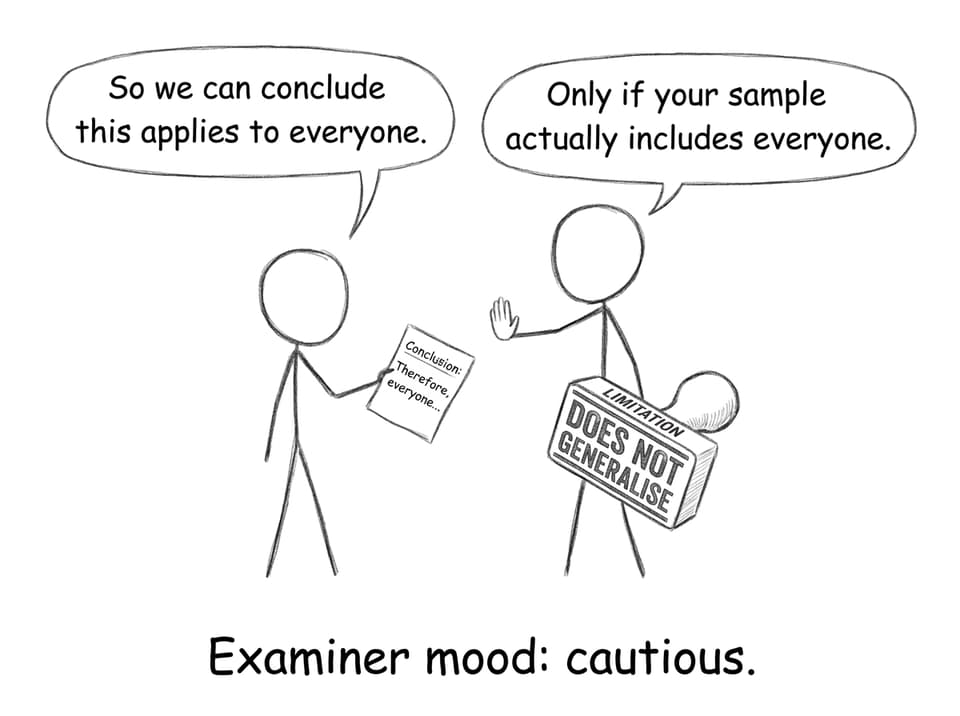
In IB Math, this matters because a biased sample is not representative, so results don’t generalise. Your statistics may describe your sample accurately, but they may fail to describe the population you claim to be studying.
If you’re revising the full stats strand, the Math AI Statistics and Probability hub is a strong place to anchor definitions, methods, and exam-style practice.
Quick exam checklist: spotting bias in 20 seconds
Before you interpret any result in IB Math, run this quick checklist:
-
Who was easier to reach? (convenience sampling)
-
Who chose to respond? (voluntary response bias)
-
Who was excluded by the method? (online-only, school-only, time-of-day)
-
Is one group overrepresented? (age, gender, location, ability)
-
Does the context create pressure to answer a certain way? (response bias)
A good habit is to pair your interpretation with a limitation sentence. RevisionDojo trains this well through targeted practice in the Questionbank, where feedback pushes you to write like an examiner.
Why biased samples break statistical conclusions
Biased samples don’t just add “a bit of error.” They can reverse the story.
Bias creates false confidence
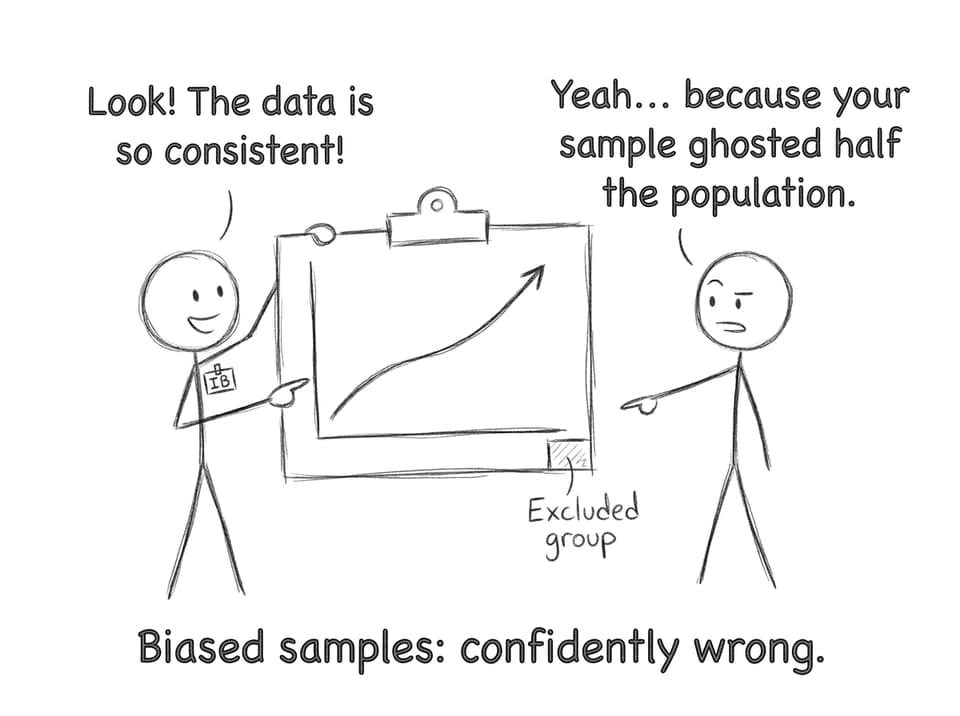
Biased data often looks neatly consistent. That’s the trap. The consistency may come from excluding the messy part of reality, not from discovering a real pattern.
In IB Math, you get rewarded for cautious, evidence-based interpretation. So if your sample is biased, the right move is to limit your claim: “This may not generalise to the whole population.” That single line can protect a lot of marks.
Bias cannot be fixed by better analysis
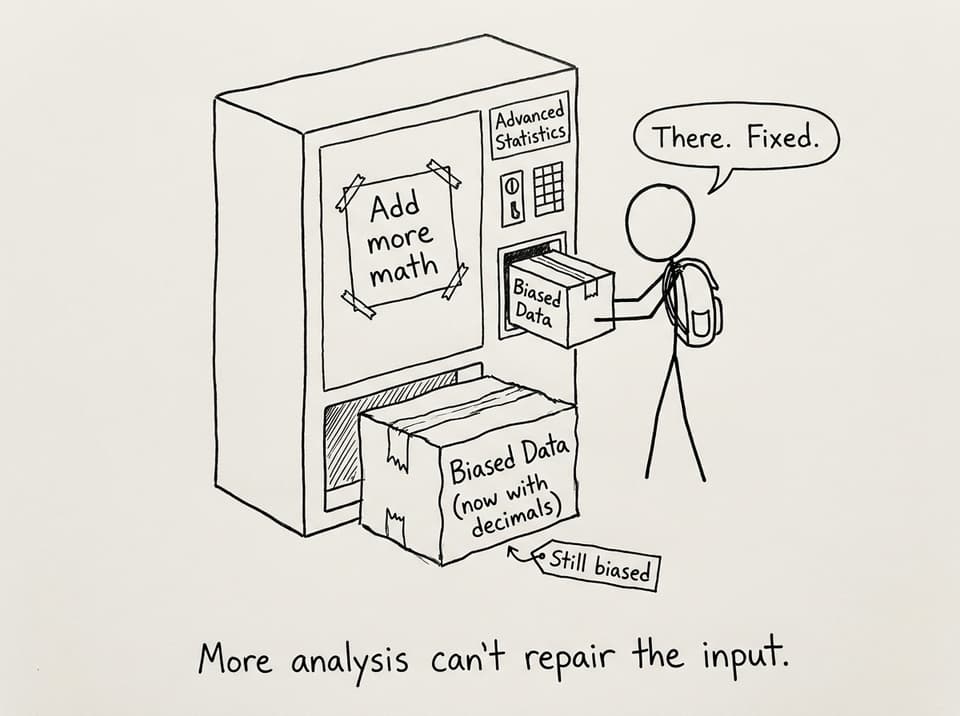
Students sometimes assume that more advanced techniques will rescue weak data: better graphs, stronger models, more calculator output. But bias happens before the maths.
You can’t “calculate your way out” of a flawed sample.
This idea connects to a bigger theme in IB Math: interpretation is often graded more than computation. If you want that mindset clearly explained, see IB Math: Why Interpretation Beats Calculation in Statistics.
Bias ruins comparisons
Comparison questions are where bias quietly steals marks. If two groups were sampled differently (different locations, different times, different incentives), then observed differences may reflect sampling method, not the underlying populations.
This is why IB Math questions often want you to comment on validity, not just differences in means or regression parameters.
How to write examiner-ready conclusions (even with imperfect data)
In IB Math, strong conclusions sound like a thoughtful scientist, not a headline.
Try this structure:
-
State the pattern (in context).
-
Support it (with a statistic or feature).
-
Limit it (bias, sample size, outliers, measurement).
RevisionDojo’s guide to interpreting data using technology is useful here because it shows how to blend calculator results with responsible evaluation.
Also remember: bias is different from outliers, but both can distort meaning. If outliers confuse your interpretations, read Why Do Outliers Matter So Much in IB Math AI?.
Conclusion: in IB Math, the data is the argument
A biased sample doesn’t just weaken your conclusion in IB Math, it changes what you’re allowed to conclude at all. The best students don’t just compute; they interrogate the data source, write with caution, and earn marks where others sound overconfident.
If you want to get faster at spotting bias and writing examiner-ready limitations, build the habit with RevisionDojo: practise in the Questionbank, tighten definitions with Study Notes, drill key phrases with Flashcards, sanity-check reasoning with AI Chat, and sharpen evaluation with grading tools, Mock Exams, Predicted Papers, and support from Tutors when you need it. In IB Math, good statistics begins before the calculator ever turns on.