


Muscles look effortless until you zoom in.
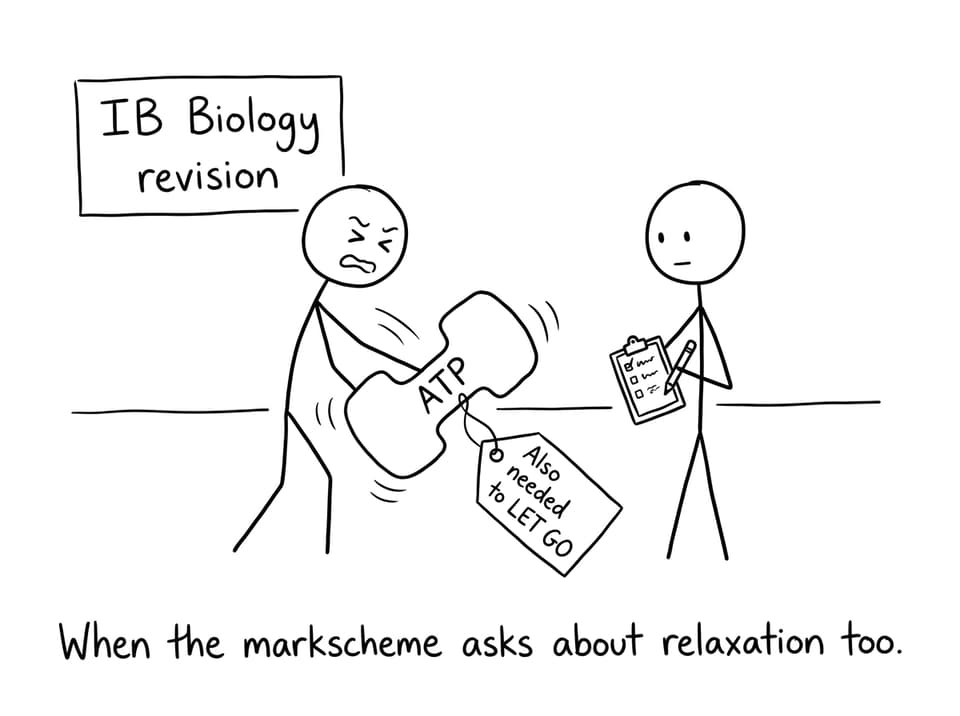
A sprinter explodes off the blocks, then instantly loosens their stride on the bend. That smooth switch between force and release feels automatic. But in IB Biology, it’s a clue: muscle fibers can only contract and relax because they keep spending ATP in both directions. ATP isn’t just the “go” button. It’s also the “let go” button.
Quick exam checklist for IB Biology
If an exam question asks why ATP is essential, hit these points:
-
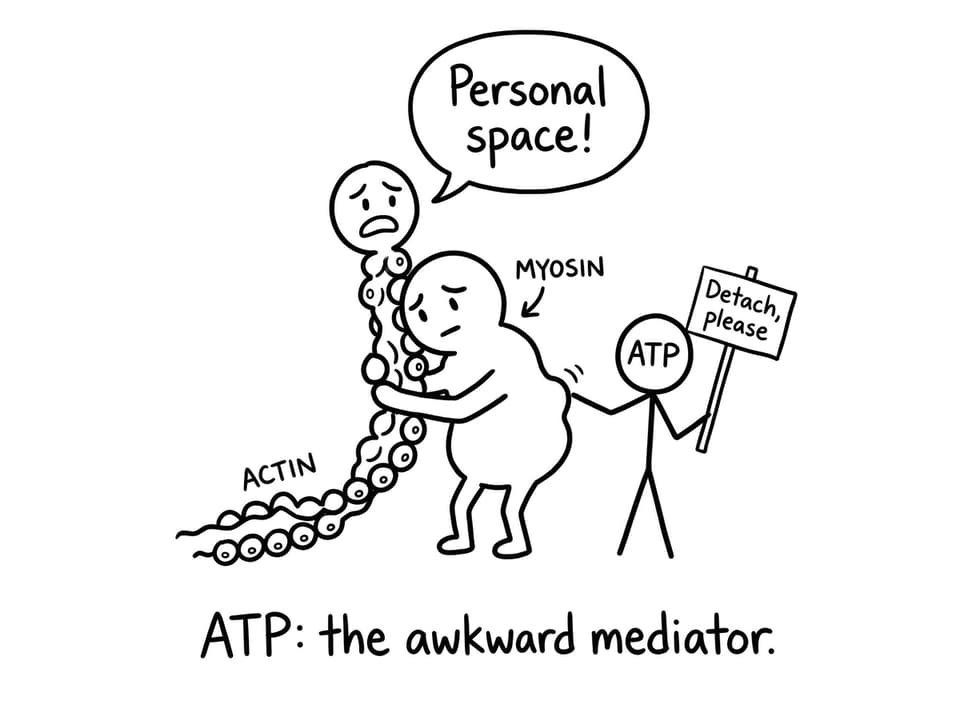
ATP binds to myosin to detach it from actin (cross-bridge cycle)
-
ATP hydrolysis re-cocks the myosin head (restores high-energy state)
-
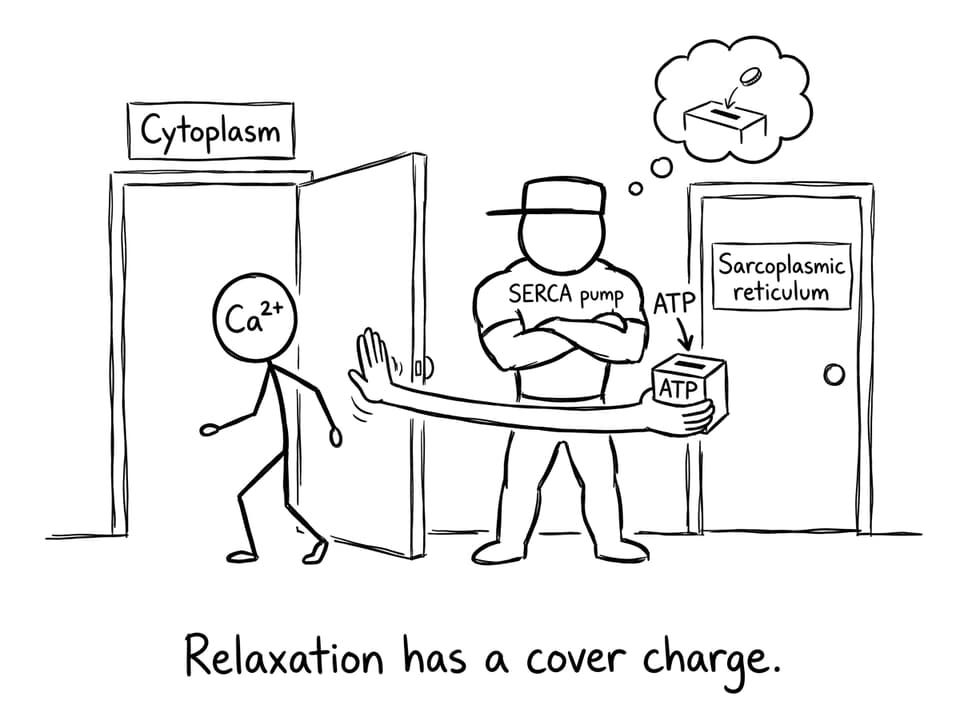
ATP powers Ca2+ reuptake into the sarcoplasmic reticulum (SERCA pumps) for relaxation
-
ATP supports ion gradients (e.g., sodium/potassium pumps) so fibers stay electrically ready
-
Lack of ATP helps explain rigor mortis
For the full muscle topic pathway, use IB Biology B3.3 Muscle and Motility Questionbank (HL) alongside your notes.
IB Biology: ATP and the cross-bridge cycle (contraction needs ATP)
In the sliding filament model, myosin heads form cross-bridges with actin, perform a power stroke, then repeat. The easy mistake is thinking ATP is only needed for the power stroke. In IB Biology, the bigger scoring idea is that ATP is required to keep the cycle moving.
After the power stroke, myosin is stuck to actin in a tight binding state. A new ATP molecule must bind to myosin to make it detach from actin. No ATP, no detachment, no reset.
Then ATP is hydrolyzed to ADP + Pi, and that hydrolysis energy re-cocks the myosin head into a high-energy position, ready to attach again.
If you want a clean refresher on the filament interactions, revise with How Actin and Myosin Filaments Interact to Produce Muscle Contraction.
IB Biology: relaxation is active (ATP powers calcium removal)
Relaxation isn’t “nothing happens.” It’s a different kind of work.
When stimulation stops, Ca2+ must leave the cytoplasm so tropomyosin can cover the myosin-binding sites on actin again. That Ca2+ is pumped back into the sarcoplasmic reticulum by SERCA calcium pumps, which use ATP because they move ions against a concentration gradient.
This links beautifully to membrane transport in IB Biology: active transport requires ATP. If you need the transport language that examiners like, see Key Differences Between Passive and Active Transport Across Cell Membranes.
Rigor mortis: the IB Biology story examiners love
Rigor mortis is basically the “ATP runs out” case study.
After death, ATP production stops. Two key consequences follow:
-
Myosin heads can’t bind ATP, so they can’t detach from actin.
-
SERCA pumps can’t run, so Ca2+ isn’t effectively resequestered, keeping binding sites exposed.
The result is stiffness: muscles become locked in a contracted state because the system can’t complete the normal cycle of release and reset.
Where the ATP comes from (and why mitochondria keep showing up)
Muscle cells are ATP-hungry, which is why they’re packed with mitochondria. In IB Biology, it helps to connect muscle physiology to respiration: aerobic respiration supplies sustained ATP, while anaerobic pathways help in short bursts.
To strengthen that link, revise mitochondria with What Is the Function of Mitochondria? and the efficiency angle with How the Mitochondrion Maximizes ATP Production Efficiency. Then drill respiration using IB Biology Topic C1.2 Cell Respiration Questionbank (SL/HL).
How to revise this fast with RevisionDojo
A reliable routine for IB Biology is:
-
Learn the sequence using Flashcards for B - Form and Function - IB
-
Apply it in the muscle Questionbank
-
Use RevisionDojo’s AI Chat to clarify one confusion at a time (e.g., “What exactly does ATP do after the power stroke?”)
-
Check explanations with Study Notes, then keep yourself honest with Grading tools
-
Build realism with Predicted Papers and Mock Exams
-
Keep coursework stress contained with the Coursework Library, and use Tutors when you need a human to spot patterns
If you’re planning your weeks, How to Study for IB Exams Without Burning Out fits this topic perfectly.
Closing: the simplest way to remember it in IB Biology
ATP is the quiet cost of control.
In IB Biology, muscles need ATP to pull (power stroke cycling) and to stop pulling (detachment plus Ca2+ removal). When you answer exam questions, treat ATP as the molecule that keeps motion reversible: it lets myosin release, it resets the head, and it clears calcium so the fiber can relax.
To lock this in, do one focused loop on RevisionDojo today: read the muscle notes, run a short Questionbank set, convert mistakes into Flashcards, then ask AI Chat to mark and refine your explanation. That loop is how IB Biology knowledge turns into marks.