



IB Math modelling: the hidden part that earns marks
You can feel it the moment a modelling question starts: the numbers look friendly, your calculator is ready, and yet the problem still feels slippery. In IB Math, that discomfort is the point. Modelling questions are designed to pull you away from tidy, exact answers and into judgement.
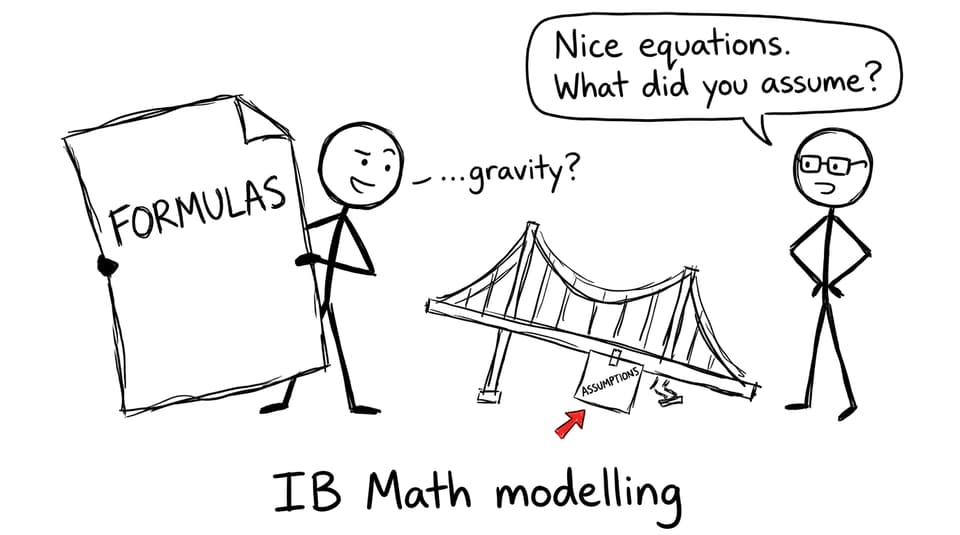
Many students respond by gripping formulas tighter. It’s understandable. Formulas feel like certainty. But in IB Math modelling, formulas are the easy part. The marks often live in something quieter: the assumptions you choose, the reality you simplify, and the honesty you show about where your model stops working.
A quick checklist before you touch any formula
Use this mini-routine whenever IB Math throws you an under-specified modelling prompt:
-
Define variables clearly (and include units).
-
State 2-4 assumptions that make the model workable.
-
Choose a model type (linear, exponential, normal, regression, etc.) and justify why it fits.
-
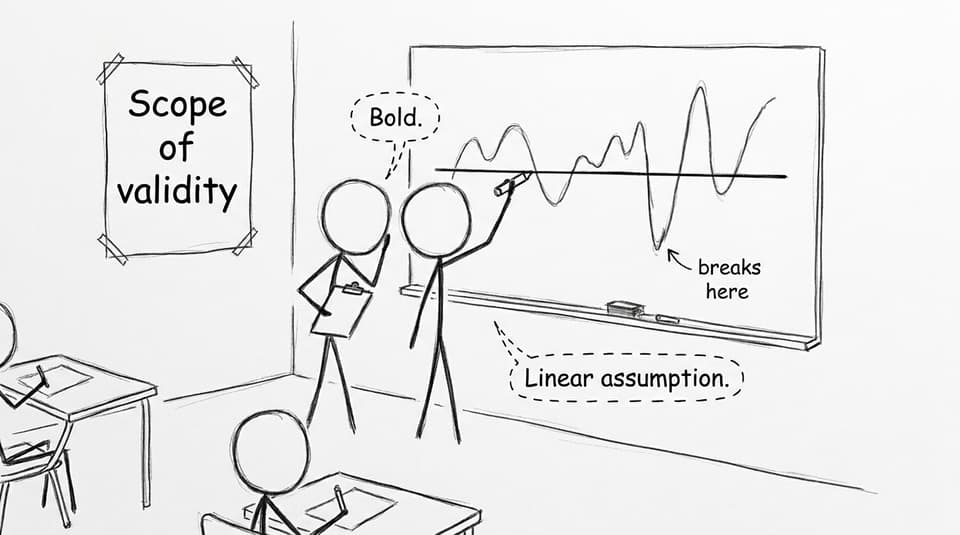
Identify the scope of validity (where it should work, and where it probably won’t).
-
Interpret the result in context, then critique your model’s weaknesses.
If you want a structured process for this, start with How to Approach Math AI SL Modeling Questions and then drill the skills using the IB Mathematics Applications & Interpretation Resources.
Why assumptions matter more than formulas in IB Math
A formula is a tool. An assumption is a decision.
In modelling, you’re always compressing reality: ignoring variables, smoothing messy behaviour, and pretending relationships stay stable long enough to be useful. In IB Math, the examiner wants to see that you understand you’re doing this.
The same regression line can be “correct” algebraically and still be a bad model if the assumptions don’t fit the context. That’s why IB rewards students who can explain why the model makes sense, not just students who can compute it.
RevisionDojo’s Questionbank is especially helpful here because it forces you to practise the full chain: choice, justification, interpretation, and evaluation (not just calculation). Pair it with RevisionDojo AI Chat when you’re unsure how to phrase assumptions in examiner-ready language.

Assumptions define your “scope of validity”
Every IB Math model has an invisible fence around it.
Inside the fence, your model might be useful. Outside it, the same formula can become misleading fast. This is why extrapolation can feel risky: you’re stepping beyond the data and quietly assuming the pattern continues.
If that part of Paper 2 (or Paper 3 at HL) stresses you out, read Why Does Extrapolation Feel Risky but Still Get Tested in IB Maths. Then practise modelling functions directly in the syllabus sequence using SL 2.5 Modelling Functions and the broader Functions Notes.
The exam trick: self-critique is not self-sabotage
A lot of students avoid criticising their own model because it feels like admitting defeat. But IB Math often treats thoughtful self-critique as a sign of control.
Good evaluation sounds like:
-
“This model assumes independence, which may not hold because…”
-
“The linear relationship is reasonable over this interval, but outside it…”
-
“Measurement error and small sample size reduce reliability…”
If you’re also writing an IA, this skill transfers directly. Use How to Reflect on Model Limitations in the IB Math IA as a template for how exam-style evaluation should sound.
Conclusion: treat formulas as tools, not answers
The calm shift in IB Math modelling happens when you stop asking, “What formula do they want?” and start asking, “What assumptions make this model reasonable?”
That single change turns vague questions into structured decisions: define, assume, model, interpret, critique.
If you want to turn that mindset into consistent marks, use RevisionDojo as your full system: Study Notes to understand modelling, Flashcards to retain key conditions (like independence and normality), Predicted Papers and Mock Exams to rehearse under pressure, and the Coursework Library plus Tutors when you need feedback that actually changes your writing. In IB Math, the student who explains their assumptions clearly often beats the student who just calculates faster.