


Rational functions have a special talent: they look simple, then quietly steal marks.
In IB Math, you can do the algebra correctly and still sketch the graph wrong. Not because you’re careless, but because rational graphs punish “close enough” thinking. One missed domain restriction. One cancelled factor you didn’t notice. One asymptote you drew like a wall instead of a behavior clue. And suddenly the sketch tells a story the function never wrote.
The good news: rational functions are hard for predictable reasons. Once you know what the exam is really testing, sketching becomes less like art and more like a calm checklist.
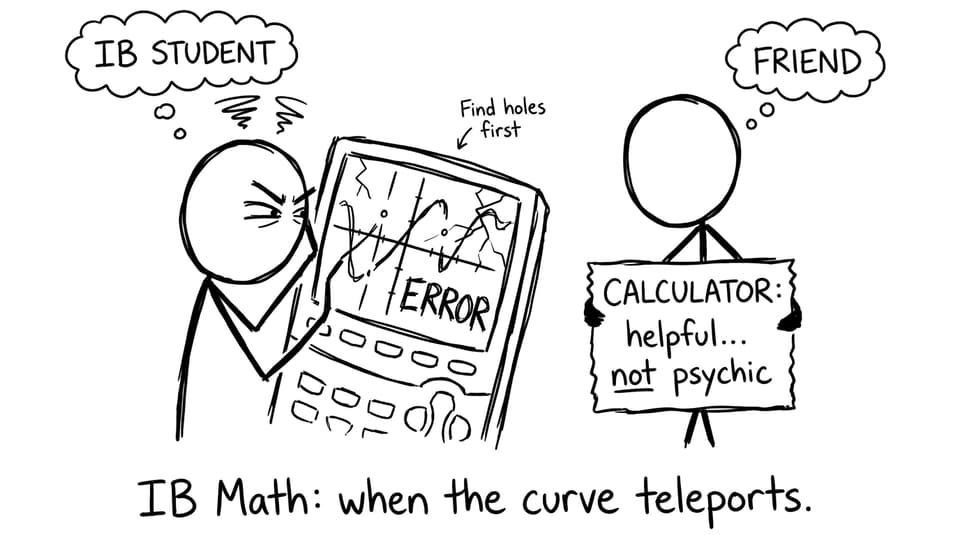
The quick IB Math sketching checklist (save this)
Before you draw anything in IB Math, do this in order:
-
Factor numerator and denominator completely
-
Identify domain restrictions (where denominator = 0)
-
Decide: hole or vertical asymptote?
-
Find intercepts (x- and y-intercepts)
-
Find end behavior (horizontal/oblique asymptote via degrees or division)
-
Test one value in each interval between vertical asymptotes
-
Sketch lightly, then confirm with technology (never the other way around)
If you want topic-aligned practice immediately, start with AHL 2.13 Rational functions and pair it with Question Type 1: Finding horizontal and vertical asymptotes.
Why rational functions feel unfair in IB Math
Polynomial graphs are like highways: continuous, predictable, no sudden disappearances. Rational functions are city streets with missing bridges.
That “missing bridge” is division. The denominator can hit zero, and IB Math expects you to treat that as a structural feature, not a minor inconvenience. Your sketch isn’t just a picture of points. It’s a visual argument about what the function can and cannot do.
This is also why “I used my GDC” can still lose marks. The exam rewards mathematical reasoning: you must show the key features that explain the shape.
For a bigger-picture graph workflow, the post How Do You Sketch Function Graphs Without Getting Lost in IB Maths pairs well with rational functions.
Asymptotes are confusing because students treat them like fences
In IB Math, an asymptote is not a barrier the graph “can’t cross.” It’s a description of behavior.
-
A vertical asymptote happens when the denominator is zero and nothing cancels. The function is undefined there, and values typically blow up to (\pm\infty).
-
A horizontal asymptote describes what happens as (x \to \pm\infty). It’s about long-term direction, not a rule that the graph must “stick under.”
-
An oblique asymptote shows up when the numerator degree is exactly one more than the denominator. You often need polynomial division.
If polynomial division is your weak link, practice with Question Type 3: Applying polynomial division for rational functions.
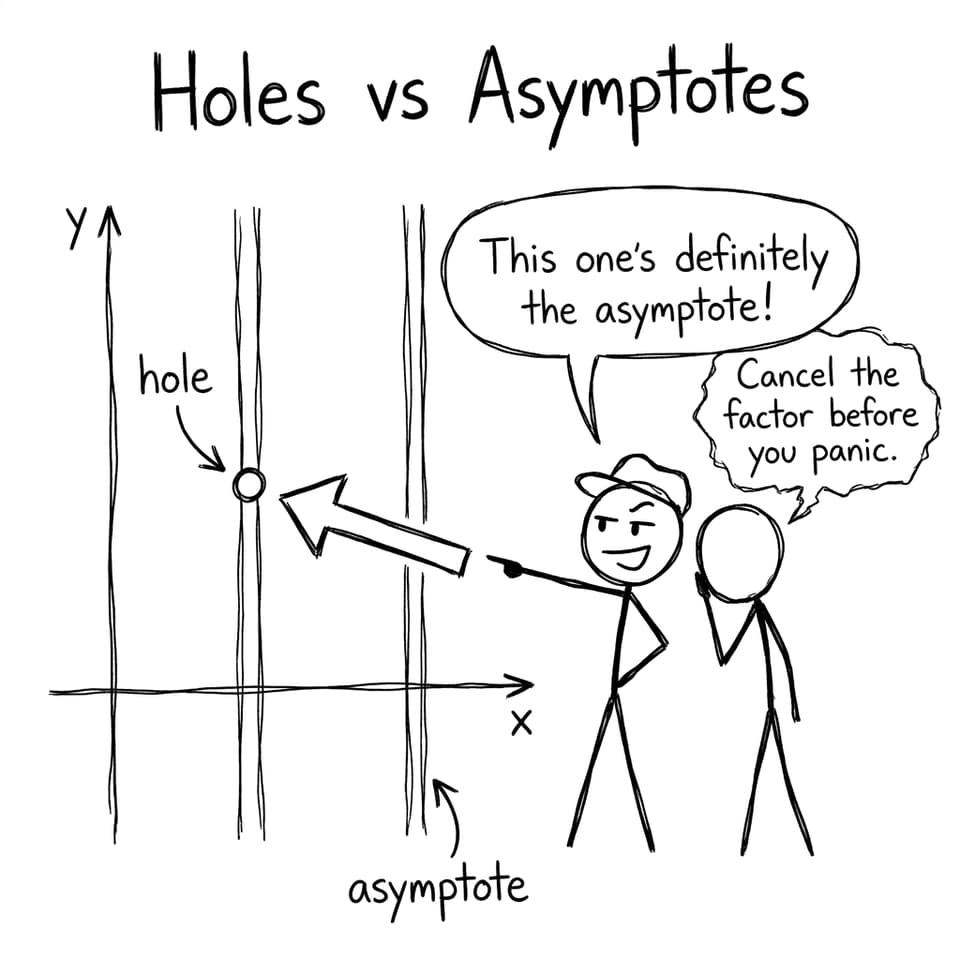
Holes vs vertical asymptotes: the trap IB Math loves
This is the classic mark-loser.
If a factor cancels, you may remove the “infinite behavior” but you do not remove the missing point. That missing point becomes a hole (a removable discontinuity).
A fast way to think about it:
-
Denominator zero after simplification: vertical asymptote
-
Denominator zero before simplification, but cancels, leaving a hole
In IB Math, sketching the wrong one often breaks everything else: intervals, signs, and even where students place intercepts.
If you want more structured support across the whole functions unit, explore IB Mathematics Analysis and Approaches resources and the broader perspective in Understanding Functions in IB Math AA: A Beginner’s Walkthrough.
The hidden difficulty: rational functions require “interval thinking”
Rational graphs are rarely one smooth story. They’re a set of smaller stories separated by restrictions.
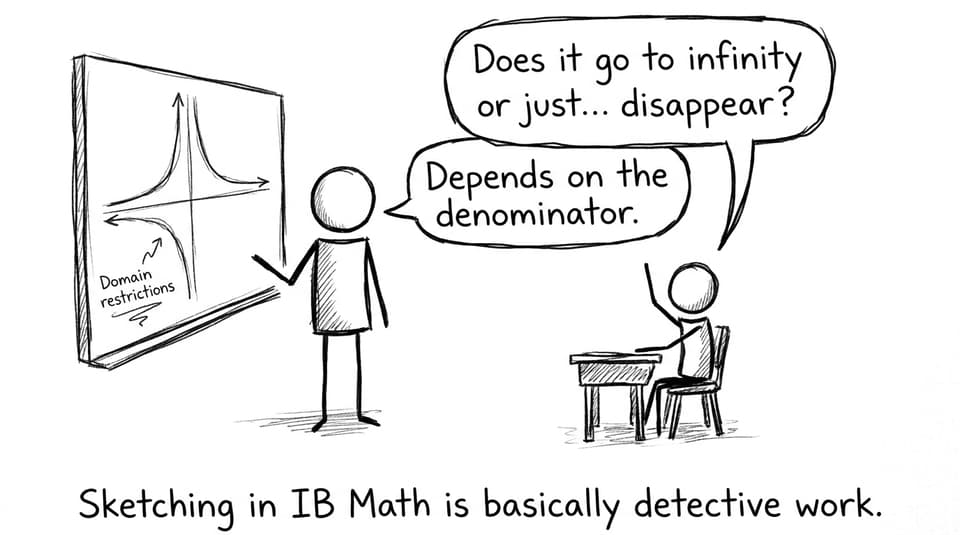
Between two vertical asymptotes (or between an asymptote and infinity), the function usually behaves consistently. That’s why one test point per interval is so powerful in IB Math: it tells you whether that branch sits above or below the x-axis, and whether it’s heading up or down.
This is also where RevisionDojo’s Questionbank helps: you can drill the same skill repeatedly until interval reasoning becomes automatic. When you get stuck, AI Chat can explain why a branch must be positive in a region, instead of just telling you the final sketch.
A calmer way to prepare for rational-function questions
A reliable exam routine in IB Math looks like this:
-
Use Study Notes to learn the checklist once, cleanly
-
Convert the “hole vs asymptote” rule and asymptote rules into Flashcards
-
Drill targeted sets in the Questionbank until mistakes stop repeating
-
Use Grading tools to understand what earns method marks in explanations
-
Rehearse timing with Mock Exams and Predicted Papers
-
If you need human feedback on your process, book time with Tutors
If your revision plan feels scattered, these strategy posts help you structure it: How to Study for IB Exams When You Feel Behind and Is 1 Month Enough to Study for IB Exams?.
Bringing it home: make IB Math rational sketches predictable
Rational functions are hard to sketch in IB Math because they combine three skills at once: algebraic structure, domain logic, and graphical behavior near the “danger zones.” But that’s also why they’re learnable. You don’t need better intuition. You need a repeatable method.
If you want that method to stick under exam pressure, build a short loop inside RevisionDojo: learn the steps in Study Notes, drill with the Questionbank, lock rules in Flashcards, then rehearse with Mock Exams and Predicted Papers. Rational functions stop feeling like a guessing game when your process is the same every time.