


Polynomial functions have a special talent in IB Math: they look polite right up until they take your marks.
A cubic with clean coefficients feels like a break from logs, trig, and all the “real” hard stuff. You expand, factor, solve, move on. Then exam day arrives, and the question quietly asks for interpretation, not just algebra. Suddenly you’re juggling degree, end behaviour, turning points, and what a repeated root means on a sketch. That’s how polynomial functions become harder than they look in IB Math.
The hidden checklist polynomial questions are really testing in IB Math
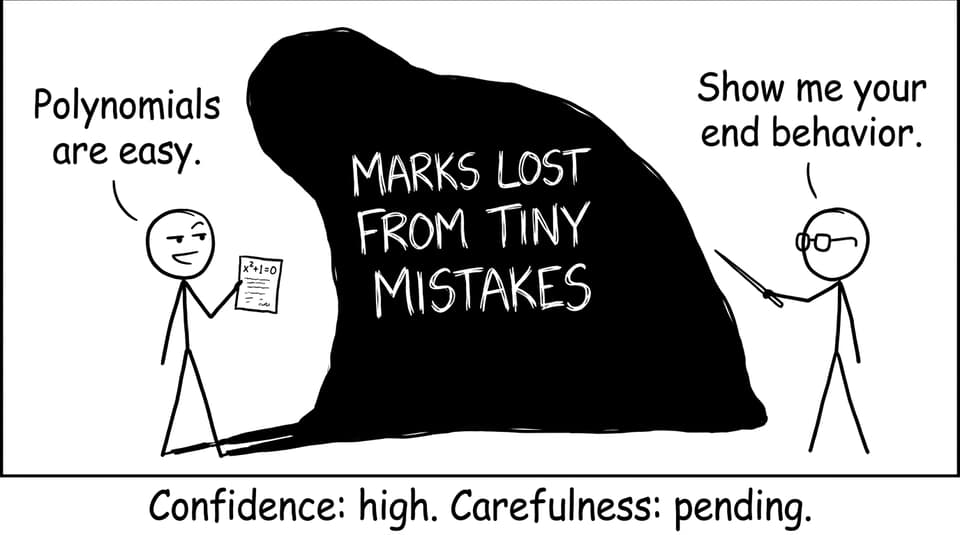
If you want to stop polynomial questions from leaking marks, run this quick checklist before you do anything “clever”:
-
Degree: what’s the highest power, and what does that imply?
-
Leading coefficient: which way do the ends go?
-
Roots and multiplicity: cross, touch, or flatten?
-
Turning points: how many are possible, and where might they be?
-
Context and interpretation: what is the question actually asking you to say?
When this feels fuzzy, it helps to anchor your revision in one place: the IB Mathematics Analysis and Approaches resources page gives you a map of what connects to what, which is exactly what polynomial tasks demand.
Why polynomial functions feel “easy” (and why that’s the trap)
Most topics in IB Math announce their difficulty. Polynomials don’t. They’re just powers added together. No restrictions like logarithms. No asymptotes like rational functions (until polynomials are divided by something, anyway).
So students treat them like a procedure: factorise, solve, done.
But IB-style polynomial questions rarely reward procedure alone. They reward structure, knowing how algebraic form predicts graphical behaviour, and how graphical behaviour explains algebraic results. That’s why a seemingly basic skill like factoring becomes a reasoning task.
If you’re revising the deeper algebra behind this, the Factor and Remainder Theorems notes are a strong reference point for the logic examiners like to see.
Graph sketching: where IB Math polynomial marks quietly disappear
A polynomial graph sketch is less “art class” and more “evidence.” Your sketch is claiming you understand the function.
The common failure mode is simple: students mark intercepts, then improvise the curve. But in IB Math, improvisation is expensive.
Instead, start with end behaviour:
-
Even degree: both ends same direction.
-
Odd degree: ends opposite directions.
-
Leading coefficient decides whether the right end rises or falls.
Then layer in roots and turning points. If you need a calm, repeatable method, How do you sketch function graphs without getting lost in IB Maths builds the exact habit that polynomial questions reward.
Roots, factors, and multiplicity: the “touch vs cross” misunderstanding
In IB Math, a root is never just a solution. It’s a behavioural clue.
-
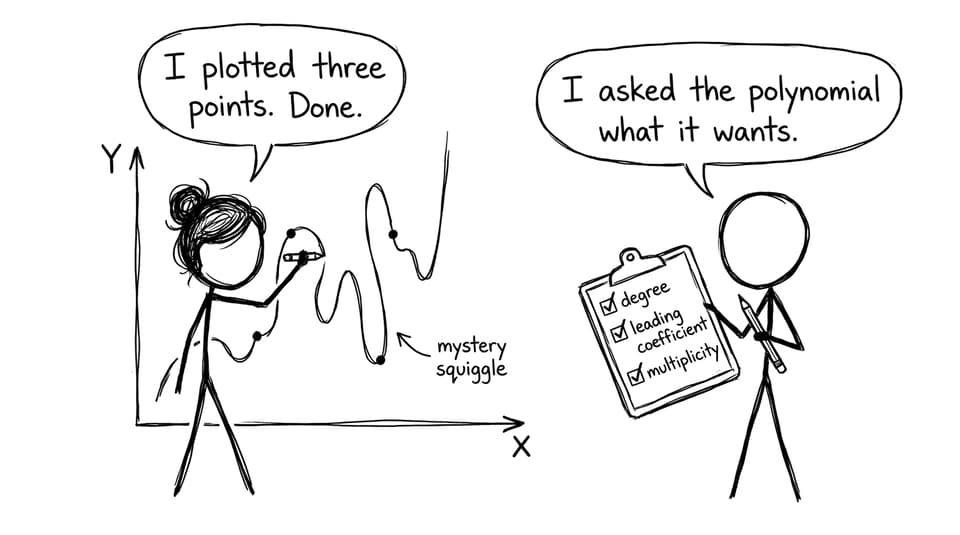
A simple root (multiplicity 1) typically crosses the x-axis.
-
A repeated root (multiplicity 2, 4, ...) typically touches and turns.
-
Higher multiplicity often looks like the graph “lingers” near the axis.
Many students can factor correctly but don’t translate the factorisation into a sketch or interpretation. That’s why exam questions ask things like “state the nature of the root” or “hence describe the intersection.” The “hence” is your warning sign: the algebra is supposed to feed the graph (or vice versa).
For targeted practice, using a dedicated Questionbank matters because you see the same idea tested in multiple disguises. RevisionDojo makes this loop efficient: revise, practise, get feedback, repeat. If you want a guided approach, How to use the Questionbank for targeted math revision shows how to turn weak topics into a plan.
The calculator problem: the graph is not the answer
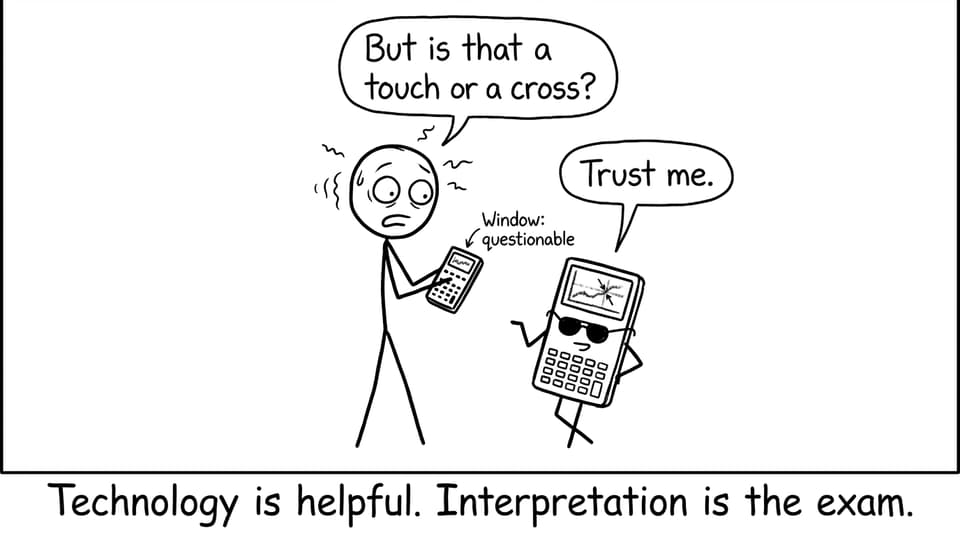
Technology is a powerful ally in IB Math. It’s also a confident liar when the viewing window is wrong.
A calculator graph can:
-
hide a turning point,
-
make a “touch” look like a “cross,”
-
suggest extra roots because of pixel-level noise.
The strongest approach is: predict first, confirm second. If your algebra says a double root exists, your sketch should expect a touch. Then adjust the window to test that expectation. That is what “interpretation” looks like under exam pressure.
How polynomial functions connect across IB Math topics
Polynomial functions don’t stay in the “Functions” chapter. They reappear everywhere:
-
In calculus, when you differentiate and optimise (see SL 5.3 differentiating polynomials questionbank for exam-style practice).
-
In function reasoning, where transformations and features stack (pair this with Why do function transformations feel so confusing in IB Maths).
-
In modelling, where “nice” algebra still needs clear explanation (the habits in How to avoid common mistakes in IB Math IA modeling carry over directly).
When a topic keeps returning, small misunderstandings compound. That’s why polishing polynomial thinking pays interest across the course.
A calmer way to get polynomial marks back in IB Math
Polynomial functions are harder than they look in IB Math because they’re a bundle of small truths: degree tells a story, factors leave footprints, and graphs are arguments, not pictures.
If you want that bundle to feel simple again, build your practice around fast feedback loops: RevisionDojo’s Questionbank, Grading tools, Predicted Papers, Mock Exams, and Tutors help you turn “I knew this” into “I can prove it under time.” And once polynomial functions stop stealing marks, a lot of IB Math starts to feel quieter too.