



In IB Math, there’s a moment that feels oddly satisfying: you take a grouped frequency table, tap a few buttons, and out comes a mean with a lot of decimals. It looks official. It looks finished.
And that’s exactly the trap.
In IB exams, the mean from grouped data is only an estimate. You can compute it perfectly and still lose marks if you describe it like an exact average. The examiners aren’t being picky. They’re testing whether you can tell the difference between a clean calculation and messy reality.
Quick checklist: how to protect marks in IB Math
Use this every time you see grouped data in IB Math:
-
Say “estimated mean” or “approximately”.
-
Mention the midpoint assumption.
-
Avoid overconfident comparisons (especially if two means are close).
-
If asked to comment, say the estimate may be unreliable if values cluster inside classes.
-
Round sensibly (don’t pretend you know more than the table reveals).
For a broader workflow for statistics questions, keep How to Approach Statistics Questions Confidently open while you practice.
What a grouped mean assumes (and what IB Math is really testing)
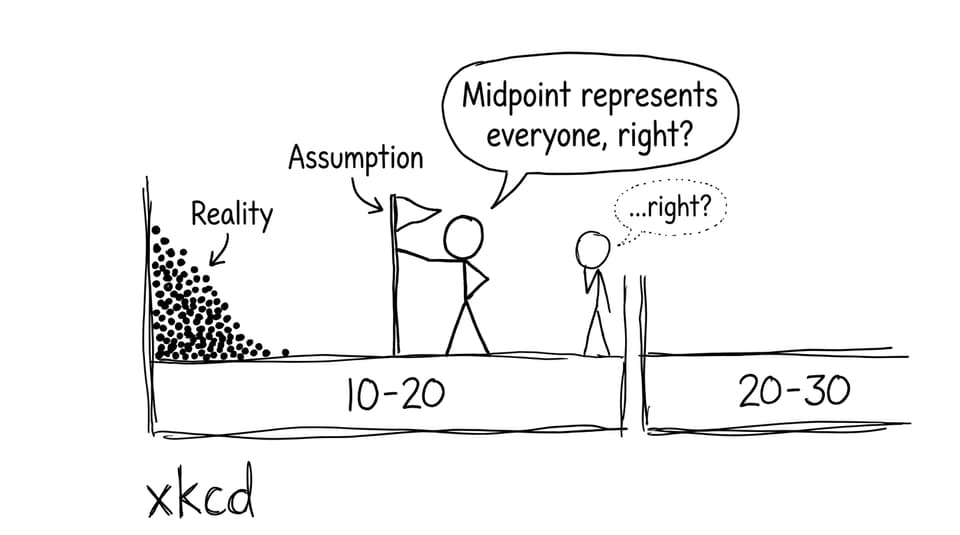
A grouped mean replaces missing information with a single “best guess.” In IB Math, that guess is the class midpoint.
When you calculate the mean from grouped data, you’re acting as if:
-
every value in a class interval is spread evenly across the interval, and
-
the midpoint represents every value in that interval.
That’s not a math mistake. It’s a modelling choice. But it’s also why the result is an estimate: you never see the original data points.
If you want to strengthen this topic inside your revision plan, the Applications and Interpretation statistics hub is a good map: Math AI Statistics and Probability.
Where the estimation error comes from in IB Math
The error isn’t from arithmetic. The error comes from hidden variation inside each class.
Imagine an interval 10-20 with frequency 12. Your calculation pretends all 12 values are 15. But real datasets rarely behave so politely. If those 12 values are mostly 10s and 11s, your grouped mean will be too high. If they’re mostly 19s and 20s, your grouped mean will be too low.
This is also why grouped means can feel tricky when you compare them to ungrouped results. One is based on real values; one is based on midpoints. If you want that comparison skill sharpened, read Why Does Comparing Grouped and Ungrouped Data Feel Tricky in IB Maths.
Why grouped means look “exact” (and why IB Math punishes that feeling)
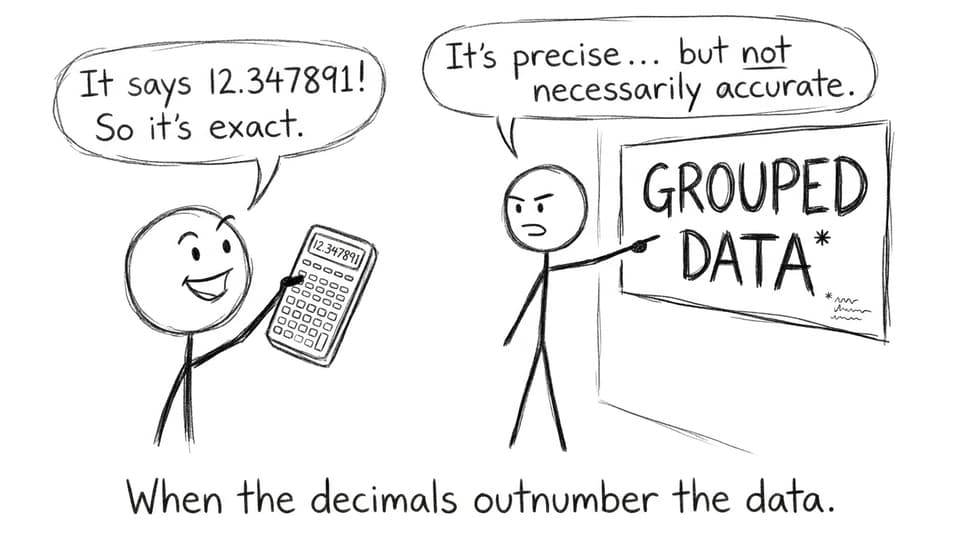
Decimals create confidence. A mean like 12.347891 feels more trustworthy than “about 12.3.” But in IB Math, computational precision is not the same as data accuracy.
IB leans into this because statistics is about judgement, not just button-pressing. That theme shows up across the course: explanation often earns more than calculation. See IB Math: Why Interpretation Beats Calculation in Statistics.
If your dataset is skewed or has outliers, the mean itself can already be a fragile summary, even before grouping. That’s worth revising too: Why Is the Mean So Sensitive to Extreme Values in IB Statistics.
How to write it in an exam (the one sentence that saves marks)
When you present a grouped mean in IB Math, write like this:
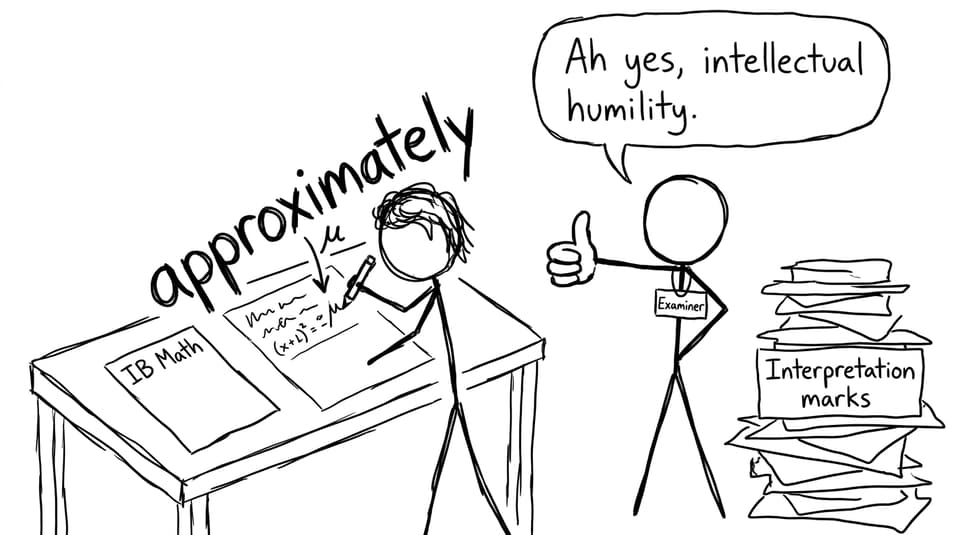
The mean is estimated as approximately 12.3 (using class midpoints), so the true mean may differ depending on how values are distributed within each class.
That single sentence shows the examiner you understand the limitation. It also creates space for cautious conclusions, which is exactly what IB wants.
Bring it home with RevisionDojo
Grouped means are a perfect example of what IB Math is really about: doing the computation, then explaining what the computation can (and can’t) claim.
To train that skill, RevisionDojo gives you the full toolkit: targeted Study Notes, exam-style practice in the Questionbank, quick recall with Flashcards, and clarification in AI Chat when a concept feels slippery. When you want to check whether your wording would earn interpretation marks, the Grading tools and Mock Exams help you practise the examiner’s perspective. And if you need structured support, RevisionDojo Tutors can turn these “small wording” issues into consistent points.
If you remember one thing before your next IB exam: in IB Math, a grouped-data mean is not the truth. It’s a well-reasoned estimate, and you score higher when you say so.