

Limits are the moment many students realize IB Math isn’t only about getting the “right number” -- it’s about reading a function like a story. You can be great at substitution and still freeze when a question asks what happens as (x) gets close to something, without ever arriving. That tiny word approaches changes everything.
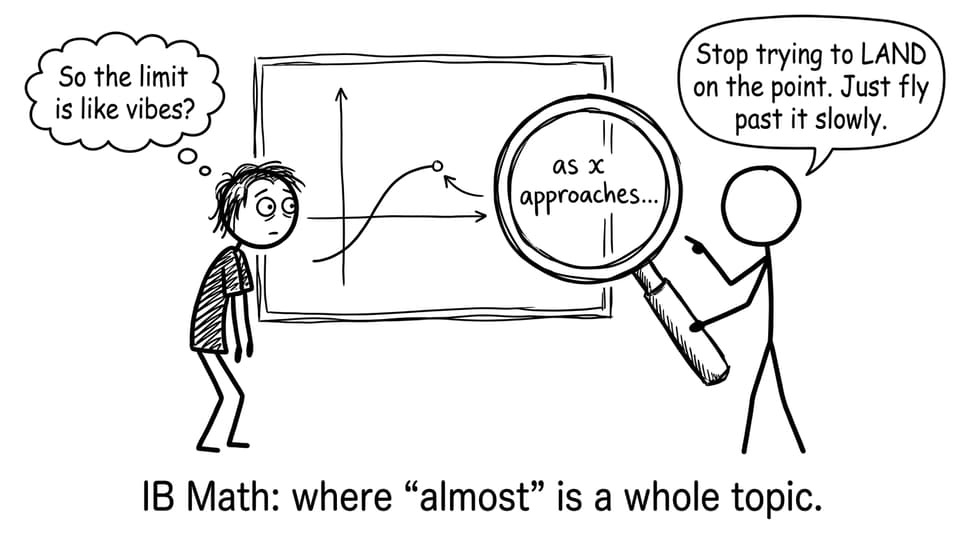
In exams, limits are less like a destination and more like watching a car slow down toward a stop sign. You’re not grading the exact parking spot. You’re grading the motion.
A quick checklist for making limits feel “seeable”
Before you start manipulating algebra, run this quick IB Math limits checklist:
-
Ask: “Am I being tested on the value at the point, or the behavior near the point?”
-
Check for discontinuities (holes, jumps, asymptotes).
-
Compare left-hand and right-hand behavior explicitly.
-
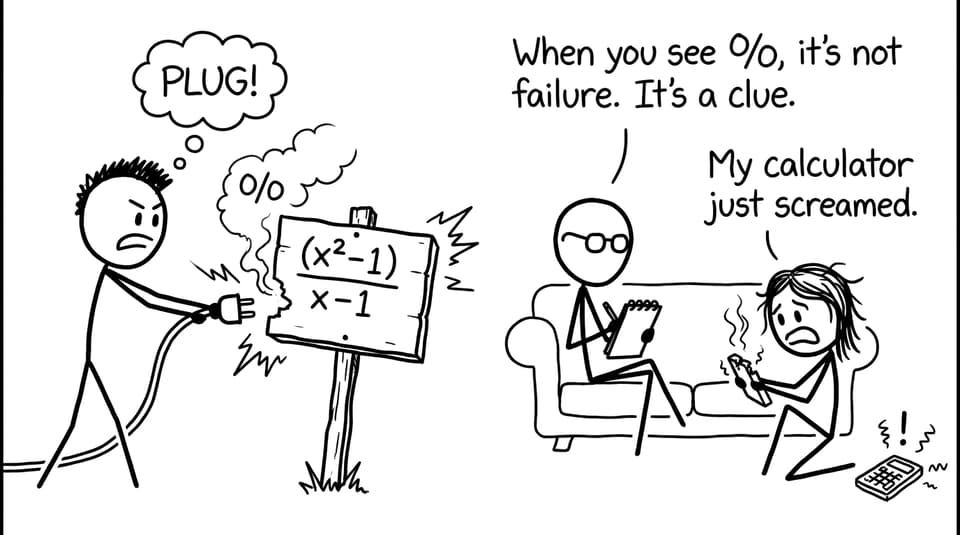
If you see an indeterminate form (like (0/0)), treat it as a clue to simplify.
-
Use a graph or table to confirm the trend before you commit.
For structured practice on this exact skill, start with RevisionDojo’s Notes for SL 5.1--Introduction to Limits.
What a limit is really asking in IB Math
A limit asks: What value does the function get closer to when (x) gets closer to a certain input? The function might never actually equal that value. It might not even be defined at that point.
That’s why limits are so hard to visualise in IB Math: school math trains you to trust exact substitution. Limits train you to trust patterns.
If you’re doing Math AA, limits show up constantly across calculus. RevisionDojo’s IB Math AA Calculus hub is useful here because it lets you move between Study Notes, Flashcards, and Questionbank practice in the same topic flow.
Why substitution fails (and why that’s the point)
Many limit questions are designed so that substituting (x=a) gives something unhelpful: (0/0), (\infty/\infty), or “undefined.” Students often read that as “I did it wrong.” In IB Math, it usually means “good -- now think.”
The exam is checking whether you can change perspective: factor, rationalize, simplify, or use a known limit pattern. Substitution is only step one.
To build this reflex with exam-style questions, use RevisionDojo’s AHL 5.13--Limits and L’Hopitals Questionbank and the matching Notes for AHL 5.13--Limits and L’Hopitals.
The left-hand vs right-hand trap
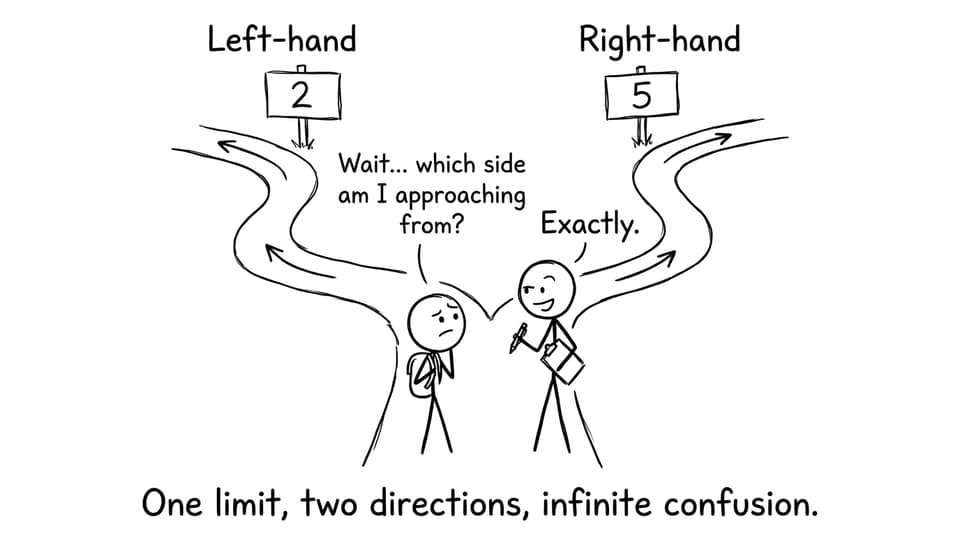
Visualization breaks down fastest when the function behaves differently depending on direction. In IB Math, you can approach (x=a) from the left and from the right and get two different “target values.” If they don’t match, the two-sided limit does not exist.
This is why piecewise functions and discontinuities feel so slippery: your brain wants one answer, but the graph is telling two stories.
A good way to practice directionality is to pair graph intuition with timed questions. RevisionDojo’s How to Master Time Management in IB Math Exams helps you build pace so you don’t rush these “from the left/from the right” checks.
Why limits matter more than this one chapter
Limits aren’t isolated trivia. In IB Math, they’re the logic underneath:
-
Continuity (whether a function “behaves nicely” at a point)
-
Differentiation (rates of change come from shrinking intervals)
-
Asymptotic behavior (what happens far out, or near vertical blow-ups)
-
Clear graph interpretation under pressure
If differentiation ever felt like a set of rules you had to memorize, this is the missing foundation. See the bigger picture in Why Is Differentiation Introduced Using Limits in IB Maths?.
The RevisionDojo way to make limits visual (and exam-ready)
When students say “I can’t visualise limits,” they usually mean: “I don’t trust my interpretation enough to write it down.” RevisionDojo is built to close that gap.
Use the Study Notes to learn the idea, then switch to Flashcards for definitions and common forms, then grind targeted patterns with the Questionbank. If you get stuck, AI Chat can walk through the step you missed, and the Grading tools help you see whether your explanation matches examiner expectations. When you’re ready to simulate pressure, use Mock Exams and Predicted Papers to test whether your limit intuition holds up under time.
If you’re deciding between pathways, RevisionDojo’s IB Mathematics: Analysis and Approaches (AA) complete guide also clarifies where limits fit across SL and HL.
A final thought (and your next step)
Limits are hard to visualise in IB Math because they ask you to value direction, trend, and near-misses -- not just exact hits. But once you train that mindset, limits stop being a scary chapter and become a lens you use everywhere in calculus.
If you want the fastest route to confidence, start with the IB Mathematics Analysis and Approaches Calculus resources on RevisionDojo, then practice until the “approaching” idea feels as normal as substitution. The goal isn’t to memorize limits. It’s to learn how functions behave when nobody is letting you plug the number in.