


Inverse functions in IB Math: the “easy” topic that quietly steals marks
The night before an IB Math exam, inverse functions feel comforting. You swap x and y, solve for y, rewrite as (f^{-1}(x)), and move on.
Then the markscheme arrives like a calm email that ruins your weekend: “domain not stated”, “inverse is not a function”, “range incorrect”.
Inverse functions are rarely hard because the algebra is hard. They’re hard because IB Math asks you to do something more grown-up than rearranging symbols: it asks you to respect what a function is, what a mapping means, and when “undoing” is actually possible.
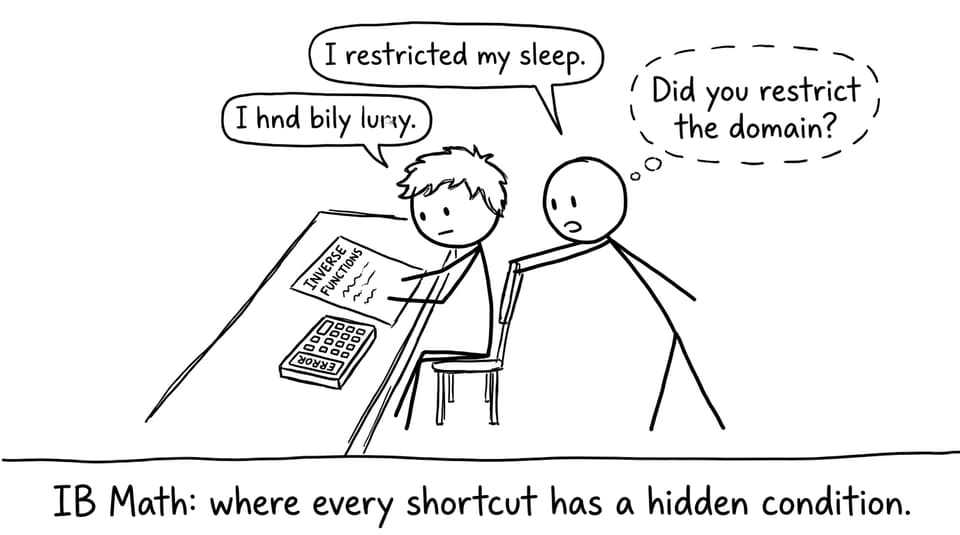
Quick checklist before you write (f^{-1}(x))
Use this mini-routine in IB Math to keep the easy marks easy:
-
Check if the function is one-to-one on the given domain (or if you must restrict it).
-
Swap x and y and solve cleanly.
-
State the domain of the inverse (which equals the original range).
-
Do a fast verification: (f(f^{-1}(x)) = x) on the correct domain.
-
Sanity-check with symmetry: inverse graphs reflect in (y=x).
If you need a structured refresher on domain and range thinking, pair this with SL 2.2 Functions, domain, range and inverse as reflection (Notes) and then jump straight into practice using SL 2.2 Questionbank.
What an inverse function really is (and why IB Math cares)
A helpful way to think in IB Math is: a function is a machine. It takes an input and gives you exactly one output. The inverse is the machine that undoes the first machine.
So if (f(a)=b), then (f^{-1}(b)=a). That’s the entire story.
The “swap x and y” method works because it mirrors that story: you’re literally swapping input and output labels. But the IB wants you to notice the catch: undoing only works cleanly if the original machine never sends two different inputs to the same output.
To build intuition for this bigger picture across function topics (not just inverses), read Understanding Functions in IB Math AA: A Beginner's Walkthrough.
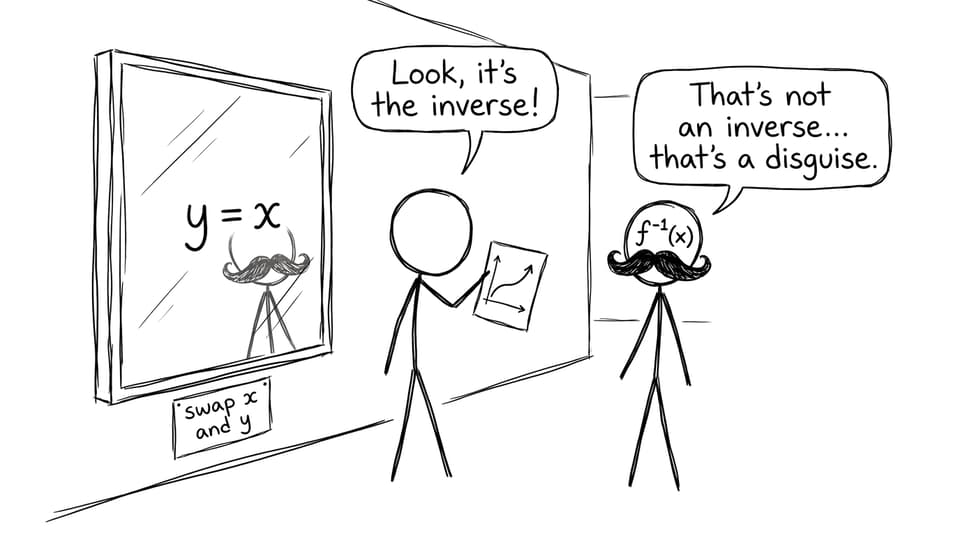
Why not every function has an inverse function
In IB Math, the simplest reason is also the most examinable: an inverse must itself be a function.
If (f) maps two different inputs to the same output, then the “inverse” would need to map one output back to two inputs. That breaks the definition of a function.
This is why IB loves examples like (f(x)=x^2). Over all real numbers, it fails the one-to-one test. But if you restrict the domain to (x \ge 0) (or (x \le 0)), then it becomes one-to-one, and an inverse function exists.
For HL-style extensions (self-inverse functions, odd/even links, and domain restriction thinking), practice with AHL 2.14 Questionbank: self-inverse and domain restriction.
The most common inverse-function mistakes in IB Math
Forgetting domain restriction (even when your algebra is correct)
In IB Math, you can lose accuracy marks by giving the correct formula but the wrong domain. Examiners treat the domain as part of the function definition.
If domains are a recurring pain point, fix the foundation with Why Is Finding the Domain of a Function So Tricky in IB Maths?.
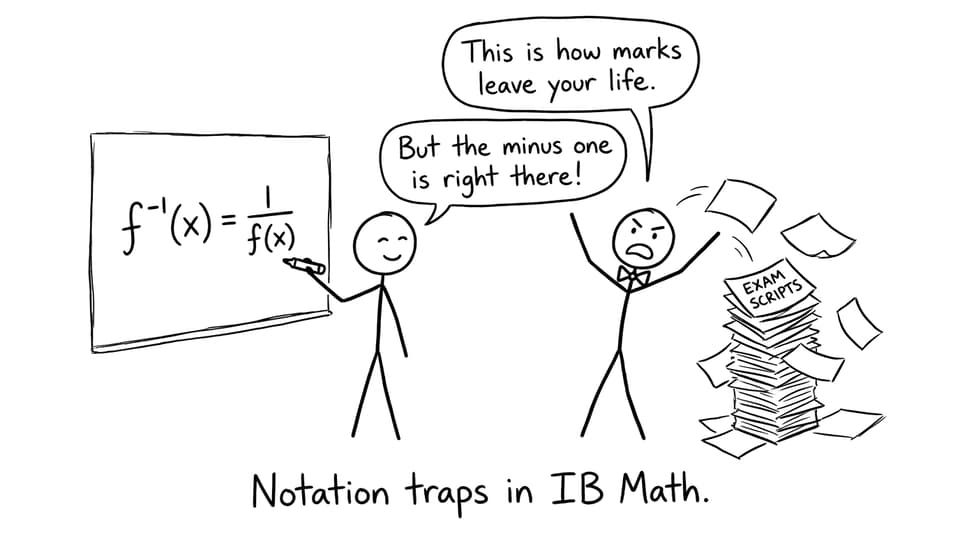
Confusing (f^{-1}(x)) with (\frac{1}{f(x)})
This is a classic notation trap: “minus one” here means inverse operation, not reciprocal. It’s not a small slip in IB Math because it changes the entire meaning.
Mixing up domain and range when writing final answers
Remember: domain and range swap.
-
(\text{Dom}(f^{-1}) = \text{Range}(f))
-
(\text{Range}(f^{-1}) = \text{Dom}(f))
A clean way to practise this is to work inverse questions that explicitly ask for domain/range statements, like SL 2.5 Composite functions, identity, finding inverse (Questionbank).
How IB Math tends to assess inverse functions
Inverse function marks usually arrive in bundles. A typical IB Math question might ask you to:
-
find the inverse algebraically,
-
justify domain restrictions,
-
use symmetry about (y=x) to sketch,
-
verify by composition,
-
interpret the inverse in context.
If you want a single home base for the whole functions unit (AA), bookmark IB Mathematics Analysis and Approaches Resources.
Closing: make inverse functions boring again (in the best way)
Inverse functions in IB Math are easy to get wrong because they sit at the border between algebra and meaning. The fix is not more speed. It’s a tiny habit: check one-to-one, state domains, and verify.
If you want this to become automatic, RevisionDojo is built for it: grind the exact question styles in the Questionbank, lock in definitions with Flashcards, clarify concepts in Study Notes, and use AI Chat plus Grading tools to learn how IB marks your thinking. Add Mock Exams and Predicted Papers when you’re ready to pressure-test, and the topic stops being a trap and starts being free marks in IB Math.