



A tiny symbol, a big mark loss
The most painful IB Math mistakes are rarely “hard topic” mistakes. They’re “I knew this” mistakes.
Function inequalities are the perfect example. You’ll feel confident, do clean algebra, find the right boundary points... and still drop marks because your final answer isn’t a set of points, it’s a region of values. IB Math questions love this because it quietly tests whether you understand functions as behaviour (above, below, between), not just as something you rearrange.
If you’ve ever written an answer, circled it, and then realized you never checked the graph or the domain, you already know why these are easy to mess up.
The quick checklist before you touch the algebra (save this)
Before solving any function inequality in IB Math, run this mental checklist:
-
What exactly is the inequality asking: where is the function above/below something?
-
What are the boundary points (where the two sides are equal)?
-
Is it strict (<, >) or non-strict (≤, ≥)?
-
What is the domain restriction (denominators, roots, logs, given domain)?
-
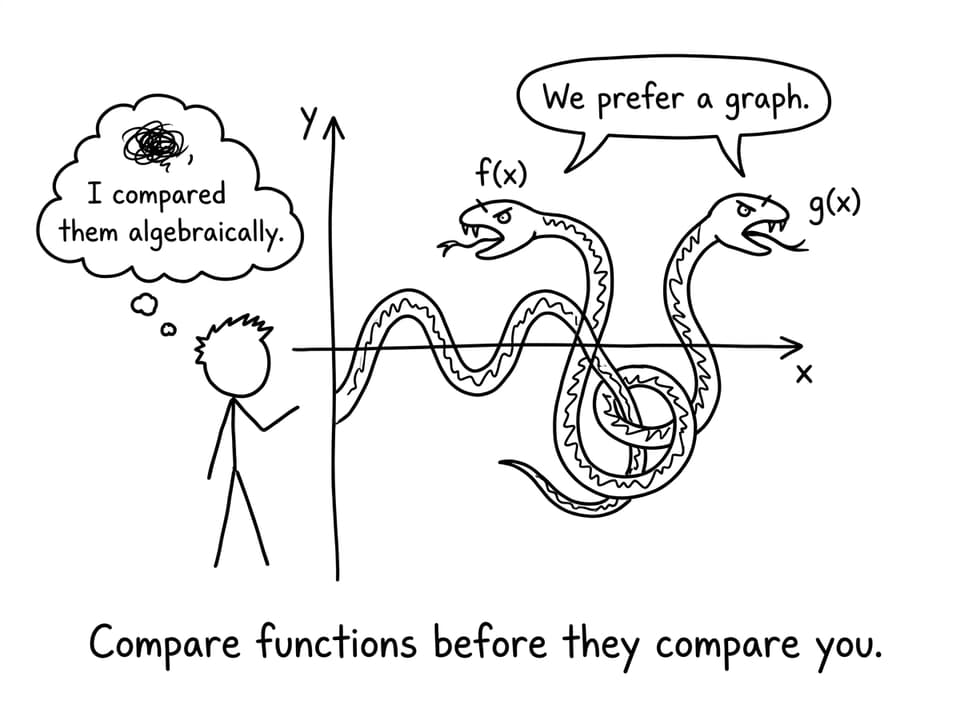
Can you confirm intervals with a quick sketch or sign chart?
For targeted practice on the exact syllabus skill, use AHL 2.15: Solutions of inequalities and then drill the AHL 2.15 Questionbank.
Why function inequalities feel “unfair” in IB Math
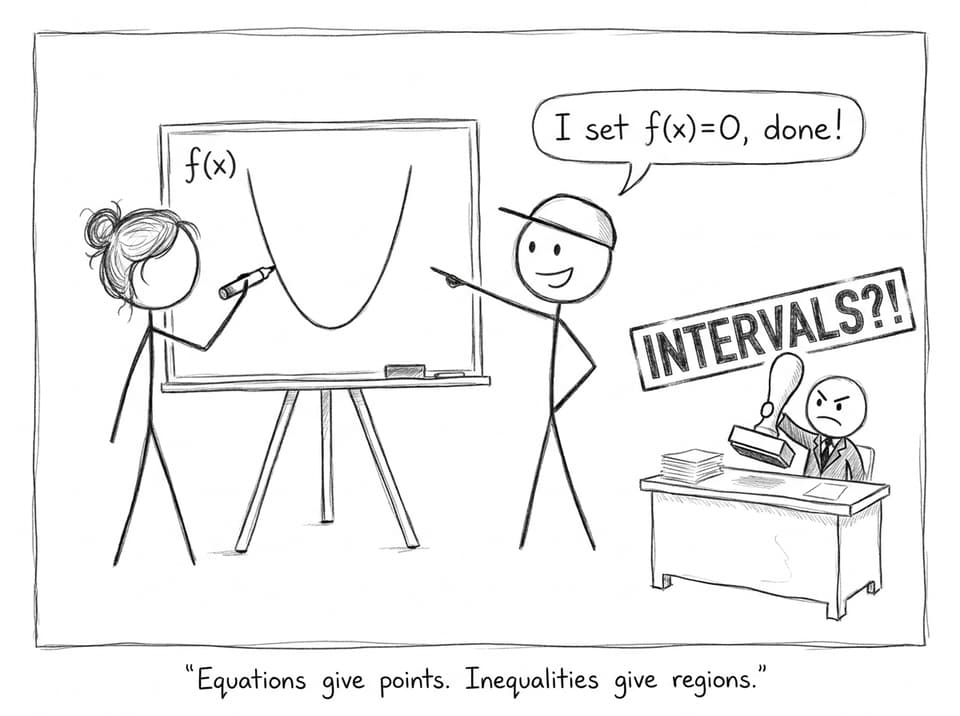
In an equation, you’re hunting for a value of (x). In an inequality, you’re describing a landscape.
That landscape is made of intervals: places where a function sits above the axis, below another curve, or between two boundaries. And that’s where IB Math punishes autopilot.
A common pattern is comparing two functions:
-
Solve (f(x) > g(x))
-
Rearrange to (f(x) - g(x) > 0)
-
Find where the difference is positive
Students often stop after “find the roots” and forget the final step: deciding which intervals actually satisfy the inequality.
If functions still feel shaky, start with Understanding Functions in IB Math AA: A Beginner's Walkthrough to rebuild intuition.
The three traps that steal the most marks
Treating an inequality like an equation
In IB Math, getting the boundary points is often only half the method. You must also state the intervals that work. That means either:
-
a quick sketch, or
-
a sign chart / test value approach.
Boundary points tell you where things can change. They don’t tell you what happens between.
Forgetting domain restrictions
Domain issues quietly delete pieces of your answer.
-
Rational functions: values that make denominators zero are never allowed.
-
Roots: even roots require the radicand (\ge 0).
-
Logs: arguments must be (> 0).
The safest habit: write domain restrictions as a first line, and then intersect them with your interval solution at the end.
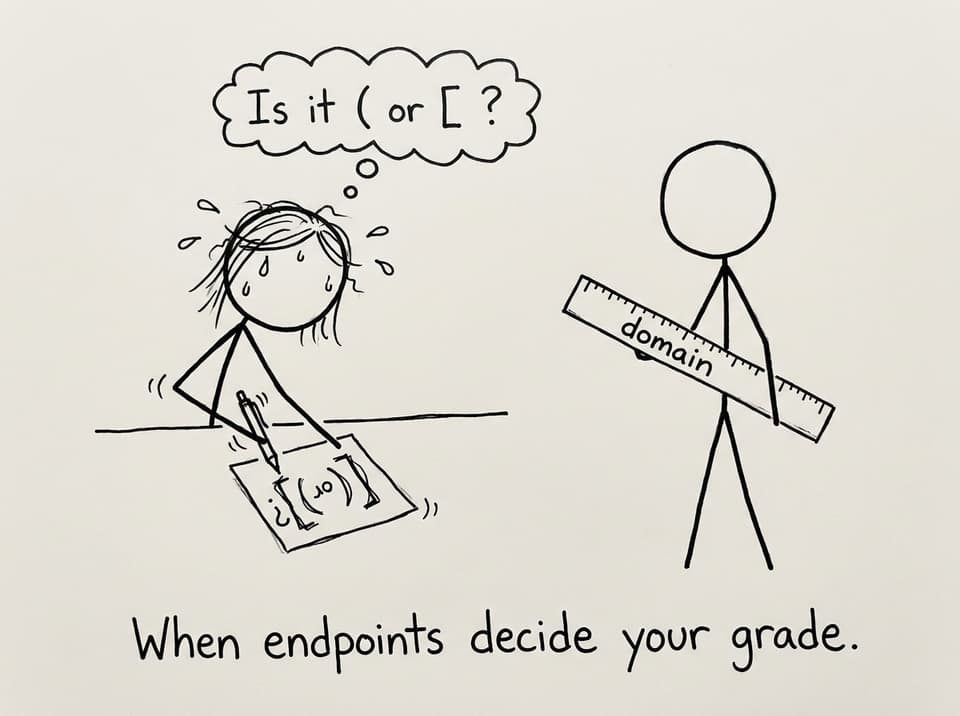
Endpoint confusion (the bracket problem)
Strict vs non-strict inequalities decide whether endpoints are included.
In exam pressure, students often flip (() and ([) accidentally. It feels small, but IB Math markschemes treat it as accuracy.
For structured review, RevisionDojo’s SL 2.7 Notes and SL 2.7 Questionbank are a clean way to practise boundaries plus notation.
A RevisionDojo way to practise this (without burning hours)
Function inequalities improve fast when practice is tight and feedback is immediate.
Use RevisionDojo like this:
-
Do 10 questions in the AHL 2.15 Questionbank or the modulus inequalities questionbank.
-
After each one, check: “Did I give intervals, handle domain, and choose the right endpoints?”
-
Reinforce the method with AHL 2.15 Flashcards.
Then, when you want exam pacing, use Mock Exams and Predicted Papers inside RevisionDojo to simulate the stress that causes these mistakes in real IB Math papers. If you’re stuck on why your interval is wrong, AI Chat can walk through the sign analysis step-by-step, and Grading tools help you match markscheme wording.
Conclusion: think in intervals, not answers
Function inequalities are easy to mess up in IB Math because they look like equations but behave like geography. You’re mapping regions, respecting borders, and checking what’s allowed to exist in the first place.
If you want this to become automatic, build a short practice loop in RevisionDojo: Notes for the method, Questionbank for repetition, Flashcards for the rules, AI Chat for the “why,” and Mock Exams to pressure-test your timing. Master the intervals, and IB Math starts to feel a lot less fragile.