



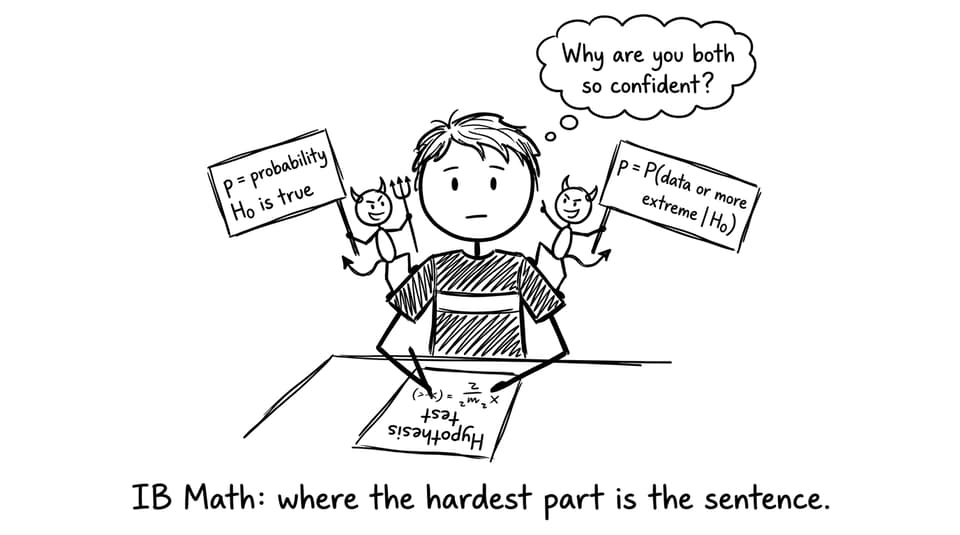
If you’ve ever finished a hypothesis test in IB Math, felt oddly confident, and then lost marks anyway, you’re not alone. The calculator gives you a neat p-value. Your working looks clean. Yet the final sentence, the one you write in English, can quietly undo everything.
That’s the real problem: hypothesis testing is half maths and half meaning. IB examiners aren’t just checking whether you can press buttons. They’re checking whether you understand what the numbers do and do not allow you to claim.
The IB Math hypothesis test checklist (the part that earns marks)
Before you write your conclusion, run this quick IB Math checklist:
-
State H0 and H1 in symbols and in context.
-
Name the test and the conditions you’re assuming (as required).
-
Identify the significance level (\alpha).
-
Use the p-value or critical region correctly.
-
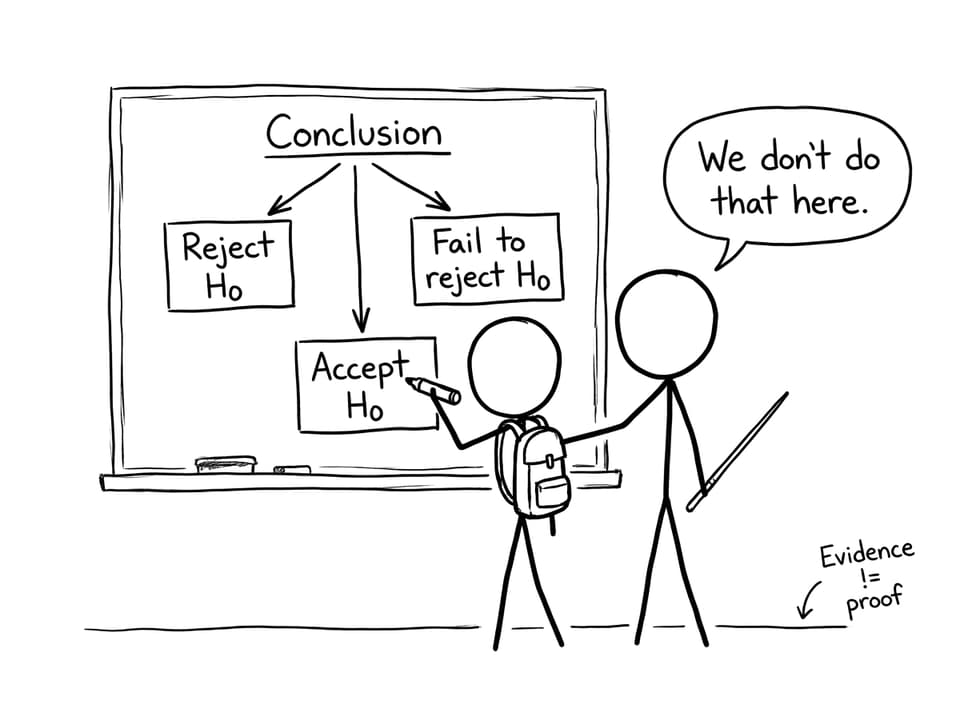
Conclude using reject H0 or fail to reject H0 (not “accept”).
-
Translate the decision back into the real-world context of the question.
If you want targeted practice for this exact structure, the Statistics & Probability hub for IB Math AA is designed for drilling interpretation, not just computation.
Why hypothesis tests feel “easy” in IB Math (until they aren’t)
In IB Math, hypothesis testing is often taught like a recipe: write hypotheses, calculate a statistic, compare, conclude. The recipe works, but only for the calculation marks.
The interpretation marks come from understanding what the procedure means. Hypothesis testing is not a proof machine. It’s a structured way to judge whether your sample is surprising assuming H0 is true. That single assumption is where most misinterpretations begin.
RevisionDojo leans into this with exam-style explanation prompts inside the IB Math AI SL 4.11 Questionbank, so you practice writing conclusions the way markschemes reward.
The null hypothesis feels backwards (and that’s why it traps you)
Students often think, “I’m testing whether the claim is true.” But in IB Math, you’re usually testing whether the status quo can survive the data.
You don’t get to say “H1 is true.” You only get to decide whether the data is inconsistent enough with H0 that you reject H0.
That’s why your conclusion must be about H0. When you write “the null hypothesis is false” or “we proved the alternative,” you’ve shifted from evidence to certainty. IB doesn’t award certainty here.
If you need a refresher on the underlying statistical language (population vs sample, what “random” really implies), the IB Math AA Statistics & Probability Notes are a good reset.
Significance level in IB Math: not “probability H0 is true”
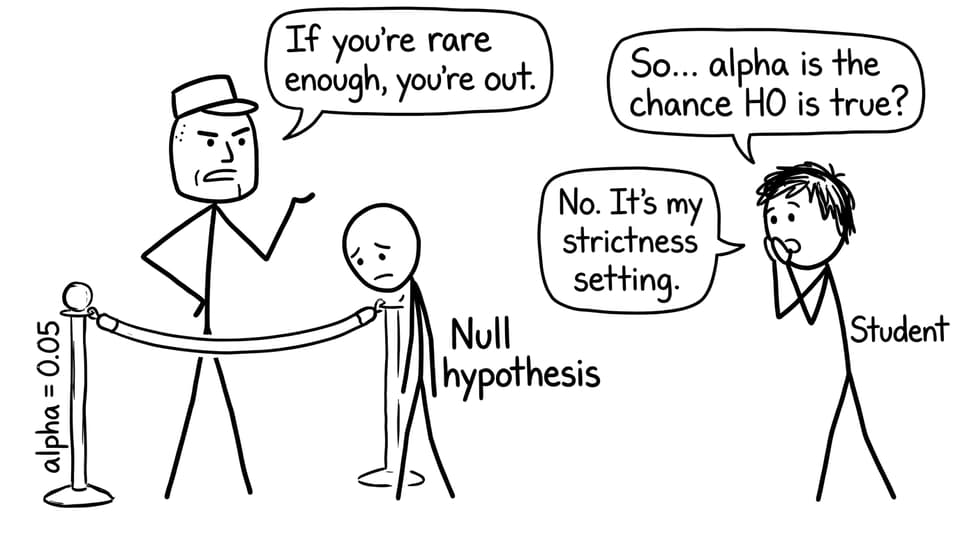
One of the most persistent IB Math myths is that (\alpha=0.05) means “there’s a 5% chance the null is true.” It doesn’t.
(\alpha) is a rule you set before seeing the data. It’s the threshold for how willing you are to make a Type I error (reject H0 when H0 is actually true). Think of it as strictness, not truth.
This matters because IB questions often ask you to interpret what the significance level means in context. If you frame it as “chance H0 is true,” your explanation becomes logically incorrect even if your p-value is correct.
To get comfortable with exam phrasing, it helps to practice with worked explanations like those in the IB Math AI AHL hypothesis testing notes.
P-values: the sentence that must include “assuming H0 is true”
In IB Math, a p-value is not the probability that H0 is true. It is:
The probability of obtaining results at least as extreme as the sample result, assuming H0 is true.
That’s why “small p-value” translates to “this data would be rare if H0 were true,” not “H0 is probably false.” It’s a subtle difference, but it’s exactly the subtlety IB likes to test.
If you want practice questions that force you to interpret p-values across contexts (means, proportions, correlation), try Performing a hypothesis test for correlation under bivariate normality.
A better ending sentence (and how RevisionDojo helps)
The goal in IB Math is a conclusion that sounds like a careful scientist, not a confident guesser:
-
“Since (p<\alpha), we reject H0. There is sufficient evidence, at the 5% level, to support [context claim].”
-
“Since (p\ge\alpha), we fail to reject H0. There is insufficient evidence, at the 5% level, to support [context claim].”
If hypothesis tests keep feeling “easy” until the marks come back, build your practice loop inside RevisionDojo: review Study Notes, drill the Questionbank, lock in language with Flashcards, and stress-test your timing with Mock Exams and Predicted Papers. Start from the IB Mathematics Analysis and Approaches hub or explore the full IB Notes library to anchor every conclusion in meaning, the part of IB Math that actually moves your grade.