



Function equations in IB Math don’t usually defeat you because the algebra is harder. They win because they change the game you think you’re playing.
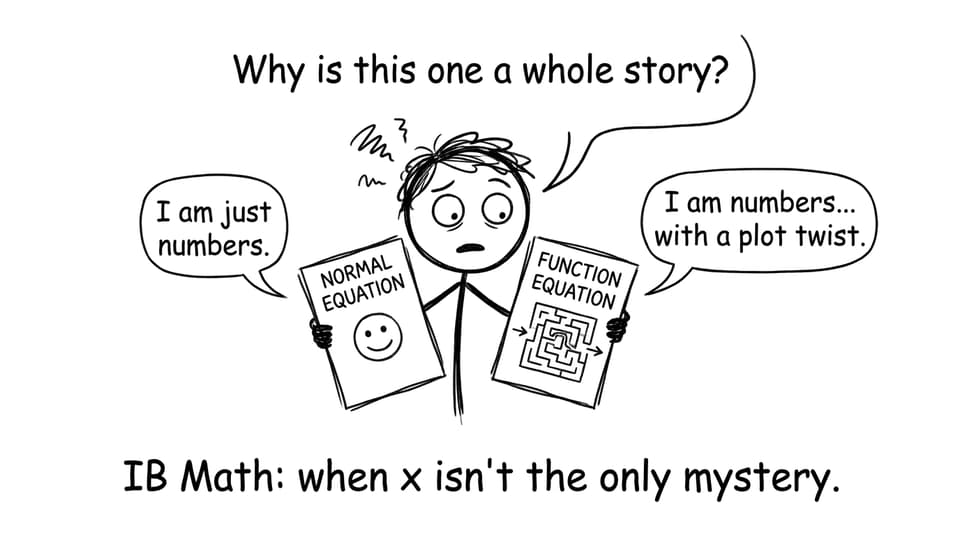
A normal equation feels like a lock with one key: rearrange, simplify, solve. But a function equation is more like a set of instructions written on the lock. You’re not just solving for a value; you’re decoding a process, then solving. That extra layer is where most exam stress lives.
The quick checklist before you touch the algebra (IB Math)
Before you manipulate anything, pause and run this mini-checklist:
-
What is the input and what is the output?
-
Are you equating outputs (like (f(x)=g(x))) or setting an output to a number (like (f(x)=3))?
-
Could this involve composition or an inverse?
-
What are the domain restrictions (hidden ones too)?
-
After solving, will you check solutions back in the original function equation?
If you want a structured place to practise these habits, RevisionDojo’s IB Mathematics Analysis and Approaches Functions hub collects notes, videos, and exam-style practice in one flow.
Why function equations are different from “normal” equations
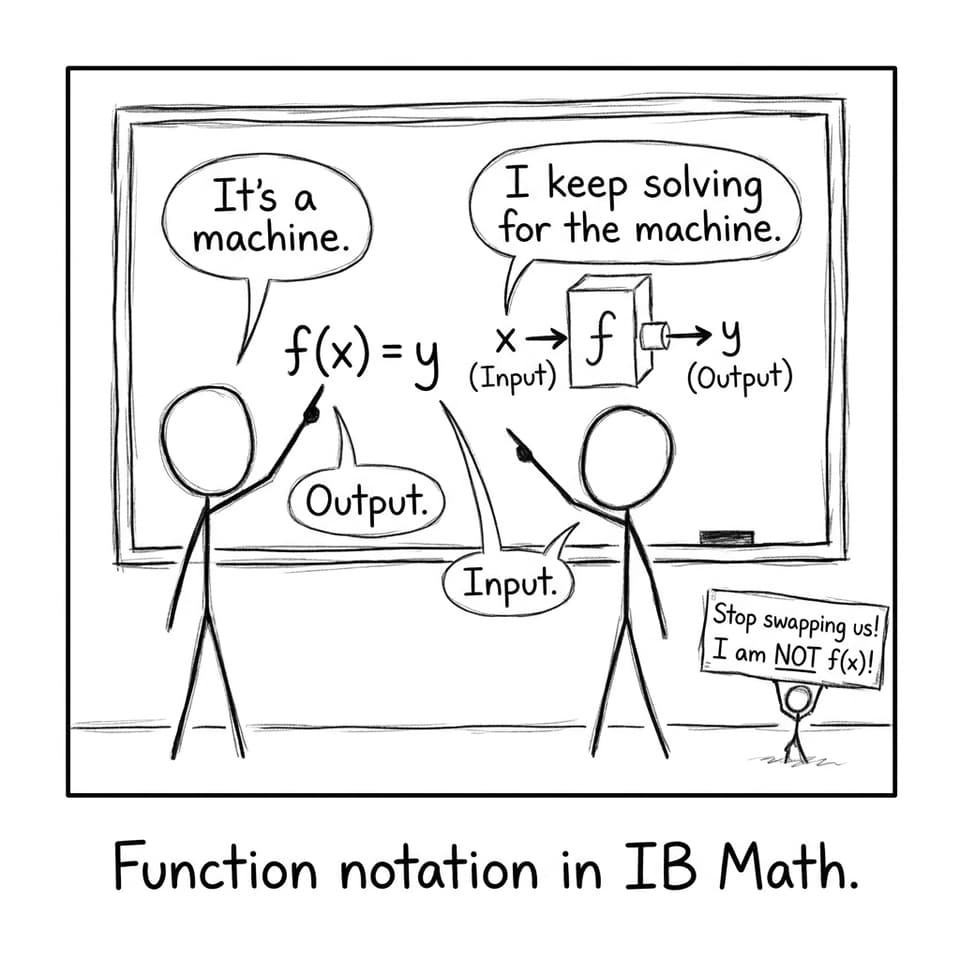
In IB Math, a standard algebraic equation treats symbols like objects you can move around. A function equation treats expressions like (f(x)) as “the result of doing something to (x).” That means you often need to interpret the relationship first.
For example, (f(x)=f(2)) is not asking for “the value of (f).” It’s asking: which inputs produce the same output as input 2? That’s a behavior question, not a rearrangement question.
This is why students who are otherwise strong in algebra can still get clipped by function equations: the marks are often awarded for understanding the mapping and the method, not just the final line.
For a solid grounding in notation and meaning, the SL 2.2 Functions notes are a quick way to rebuild the “input-output” instinct.
Function notation is small, but it hides a lot
The notation is compact on purpose. (f(g(x))) looks like one expression, but it’s really a timeline: do (g) first, then feed the result into (f). Under exam pressure, many students start simplifying without tracking that order.
That’s why composite-function questions can feel like a language test. If you want targeted practice, RevisionDojo’s article on why composite functions cause so many errors in IB Maths breaks down the most common misreads, and the SL 2.5 composite functions questionbank gives you repetition until it’s automatic.
Hidden restrictions: the “gotcha” that steals accuracy marks
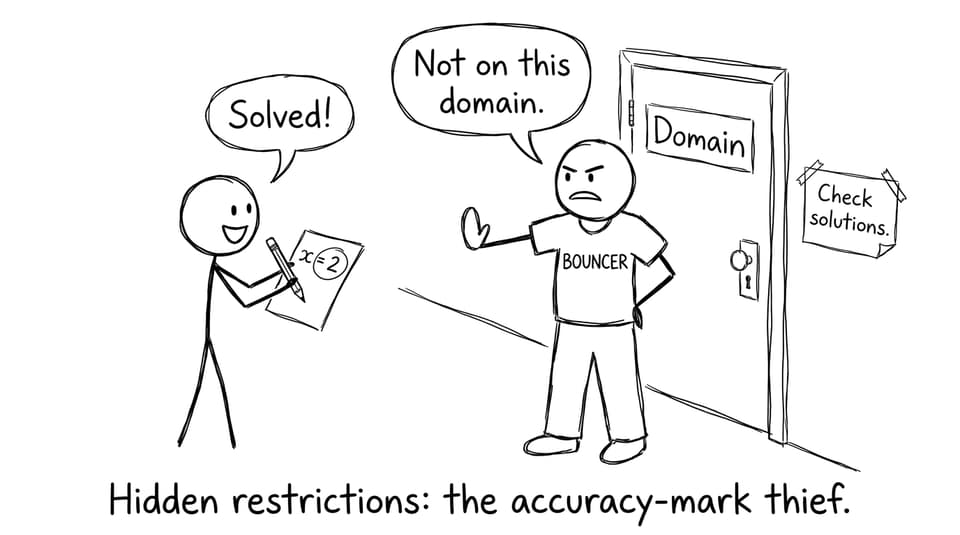
Function equations often generate extra solutions when you manipulate them (especially if you square both sides, multiply by an expression that could be zero, or apply an inverse step too casually). In IB Math, the examiner expects you to notice when a solution is mathematically produced but functionally invalid.
Domain restrictions can come from:
-
the original function definition (e.g., denominators, square roots, logs)
-
a required domain restriction for inverses
-
a composition that makes a previously valid input invalid
This is why “check your solutions” isn’t optional. It’s part of the skill.
To practise that skill directly, use Question Type 4: Finding the inverse with domain restriction and the SL 2.2 questionbank.
How IB Math likes to test function equations
Function equations often appear as blended tasks, such as:
-
solving (f(x)=g(x)) (intersections, sometimes with technology)
-
using an inverse idea to “undo” a function
-
composition/identity relationships like (f(f^{-1}(x))=x)
-
solving, then interpreting solutions in context
If transformations also scramble your intuition (input vs output again), see why transformations of functions cause so much confusion in IB Maths.
A calmer way to practise: build the habit, not the hype
RevisionDojo works best here because it lets you practise function equations the way the exam actually feels:
-
Study Notes to clarify the meaning of notation before you drill
-
Questionbank for exam-style repetition with explanations
-
Flashcards to keep domain rules and inverse properties fresh
-
AI Chat when you’re stuck on why a step is valid
-
Grading tools to spot where your method loses marks
-
Mock Exams and Predicted Papers to rehearse timing and mixed topics
-
a Coursework Library and Tutors if you need guided correction, not just more questions
(If you’re deciding between pathways, the IB Mathematics: Analysis and Approaches (AA) complete guide can help you contextualize how functions connect to the rest of IB Math.)
Conclusion: treat function equations like stories, not locks (IB Math)
Function equations feel harder in IB Math because they ask you to read meaning before you do mechanics. Once you train yourself to interpret notation, respect domains, and check solutions, they stop being “trick questions” and start being predictable.
If you want the fastest path to that predictability, build a short daily routine inside RevisionDojo: one set from the Questionbank, one quick review from Study Notes, and one correction cycle using AI Chat and the Grading tools. That’s how function equations become normal.