

If you have ever finished a probability question feeling oddly confident, then seen the markscheme and thought, Wait… why is everything shifted by 0.5? -- you are not alone.
Continuity corrections are the kind of detail that doesn’t feel “mathematical” at first. It feels like paperwork. And in Math SL, paperwork is exactly what your brain deletes under time pressure. Yet the IB loves this tiny adjustment because it reveals whether you understand what you are modelling, not just which buttons you can press.
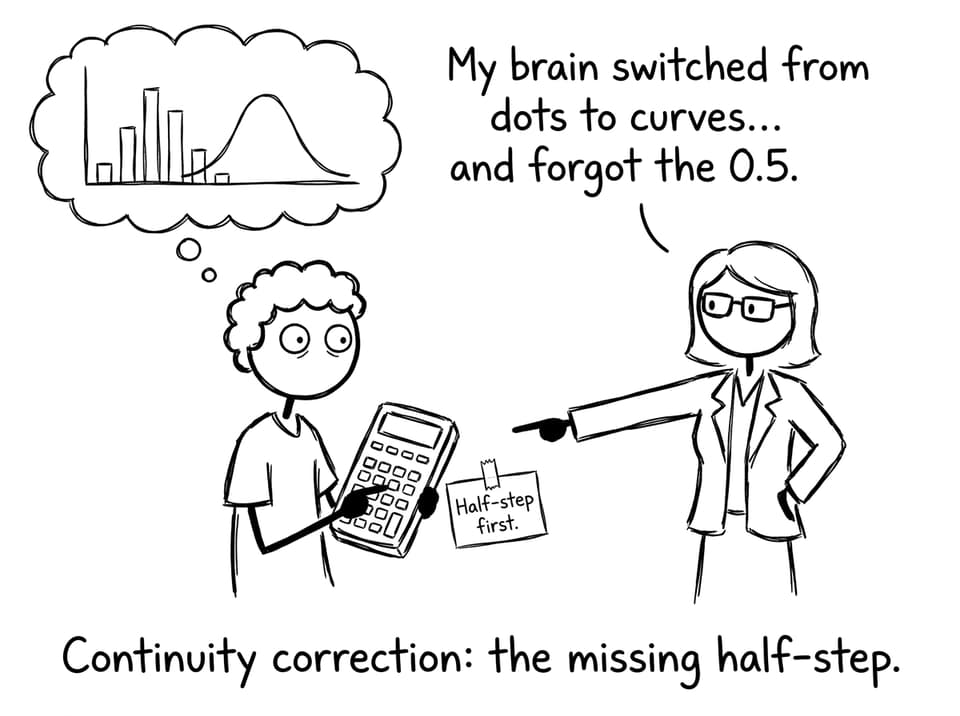
The 20-second checklist (before you touch your calculator)
Use this mini routine every time you see “use a normal approximation” in Math SL:
-
Identify the original variable: discrete (binomial counts) or continuous (normal)
-
Rewrite the probability statement in words: “at most,” “at least,” “between,” etc.
-
Convert whole-number outcomes into an interval using ±0.5
-
Sketch a quick bell curve and mark the corrected boundaries
-
Only then standardise and calculate the probability
That pause is where the marks live.
What continuity correction is really doing
A binomial distribution counts outcomes in steps of 1: 0, 1, 2, 3… It’s discrete. The normal distribution is smooth, continuous, and measures intervals.
So when Math SL asks you to approximate binomial with normal, you are translating “exact counts” into “areas under a curve.” The continuity correction is simply the translator.
Example idea (no heavy numbers needed):
-
“(P(X \le 6))” for a binomial really means the outcomes 0, 1, 2, 3, 4, 5, 6.
-
On a continuous curve, the matching region is (P(Y \le 6.5)).
That extra half step is how you capture the full bar for 6 instead of slicing through it.
If you want a strong foundation on the normal model itself, the Math SL normal distribution material is best revised alongside continuity correction practice: see SL 4.9--Normal distribution and calculations (Questionbank) and Statistics & Probability notes.
Why your brain drops the ±0.5 in Math SL
Continuity correction is easy to forget because it sits in an awkward gap between concepts:
It’s not a “formula step”
Students remember formulas because they feel concrete. Continuity correction is a meaning step. And meaning steps vanish when you rush.
A good fix is to train it as part of your setup, not part of your calculation. On RevisionDojo, that’s why the Statistics & Probability Questionbank is so effective: it forces repeated, exam-style setups until the translation becomes automatic.
You standardise too early
Many Math SL mistakes happen in this order:
-
write (\mu) and (\sigma)
-
jump straight to (z = \frac{x-\mu}{\sigma})
-
realise too late that your (x) value should have been (x\pm 0.5)
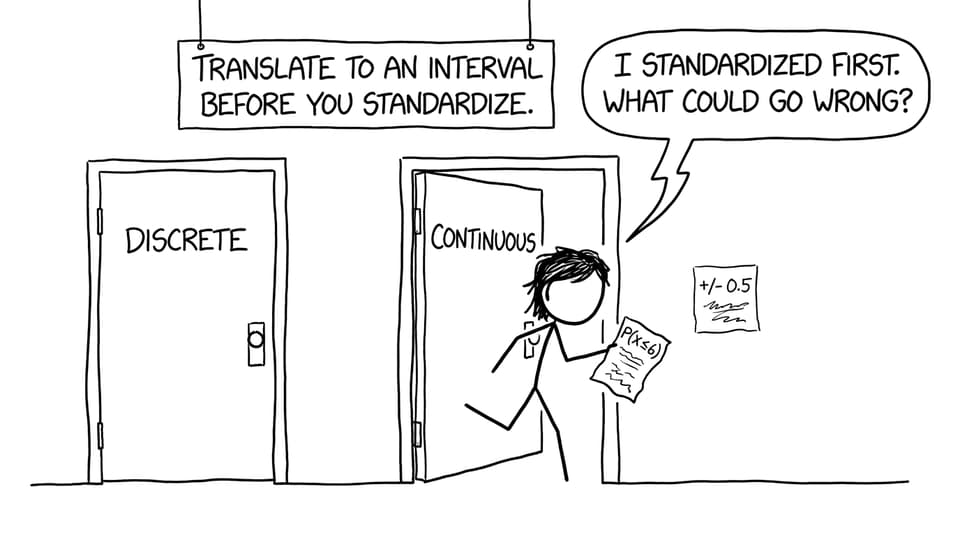
The fix is simple: boundaries first, z-scores second.
Direction mistakes: the sneaky mark-loser
Even when students remember “use 0.5,” they sometimes push it the wrong way.
In Math SL, direction comes from the story:
-
“(X \ge 6)” becomes (Y \ge 5.5)
-
“(X \le 6)” becomes (Y \le 6.5)
-
“(3 \le X \le 7)” becomes (2.5 \le Y \le 7.5)
A fast safeguard: after correcting, ask, “Did my interval get slightly wider to include whole-number bars?” It should.
For binomial context (and when approximation is likely), revise SL 4.8--Binomial distribution alongside your normal work.
When you need it (and when you don’t)
You use continuity correction in Math SL when:
-
you approximate a binomial distribution using a normal distribution
-
your probability statement refers to whole-number outcomes
You do not use it when:
-
you are working with a normal distribution directly
-
the model is already continuous
If you’re mixing up continuity in distributions with continuity in functions, it helps to separate them clearly: Why Does Continuity Matter So Much in IB Maths?

Bring it home: make the half-step part of your routine
Continuity correction is forgettable because it’s small, and because Math SL exams make small things feel optional when the clock is loud. But it is not optional. It is the bridge between a count and an area.
If you want that bridge to feel natural, build a repetition loop: RevisionDojo Study Notes for the concept, Flashcards for the trigger, the Questionbank for exam-style setups, and Mock Exams and Predicted Papers for pressure practice. The point isn’t to remember “0.5” -- it’s to remember what you are modelling. And that is exactly the kind of understanding that lifts grades.