




Arithmetic series questions in IB Math have a weird talent: they look like a gift, then quietly take marks.
It usually happens fast. You spot a constant difference, your hand reaches for a formula, and five lines later you’re staring at an answer that feels… off. Not wildly off. Just off enough to trigger that sinking thought: I mixed up something small. In IB Math, “something small” is often the whole question.
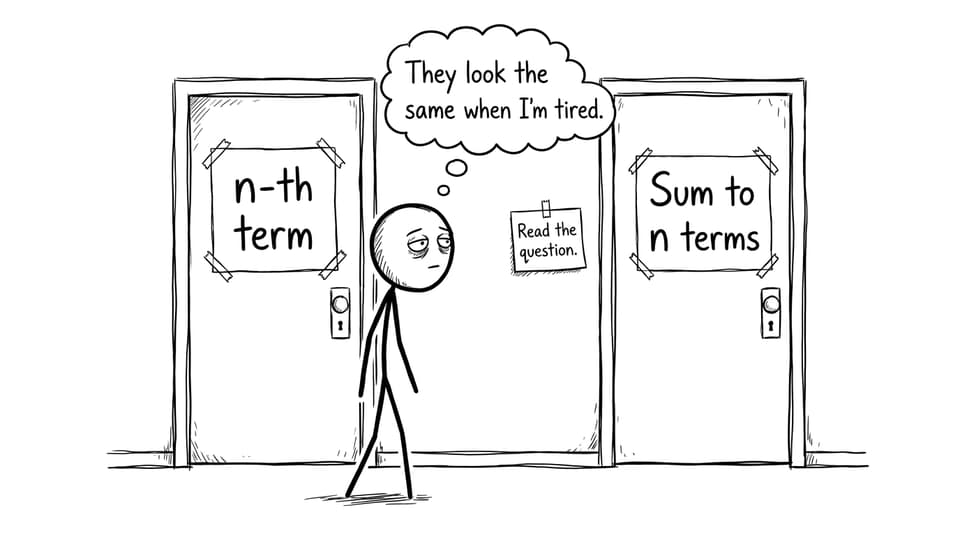
The 30-second IB Math checklist (before any formula)
Use this every time. It’s boring on purpose. It saves marks on purpose too.
-
Are you finding a term (sequence) or a sum (series)?
-
What is the first term (a_1) for this question, not for the pattern in your head?
-
What is the common difference (d)?
-
How many terms are included: (n)? How do you know?
-
Does the index start at (n=1), or somewhere else (like (u_3))?
If you want a syllabus-aligned “home base” for practice, keep SL 1.2 Arithmetic sequences and series open while you revise.
Why arithmetic series are so easy to mix up in IB Math
Arithmetic series are simple mechanically. The trap is structural.
In IB Math, exam questions reward students who can hold structure steady across multiple steps: define terms, interpret indices, and translate words into math. Arithmetic series force you to juggle all three. That’s why they’re easy to mix up even when you “know the formula.”
A great reset is revising the underlying sequence first. This guide on Arithmetic sequences explained for IB Maths (AA SL & HL) helps you lock in (a_1), (d), and the (n)th term before summation enters.
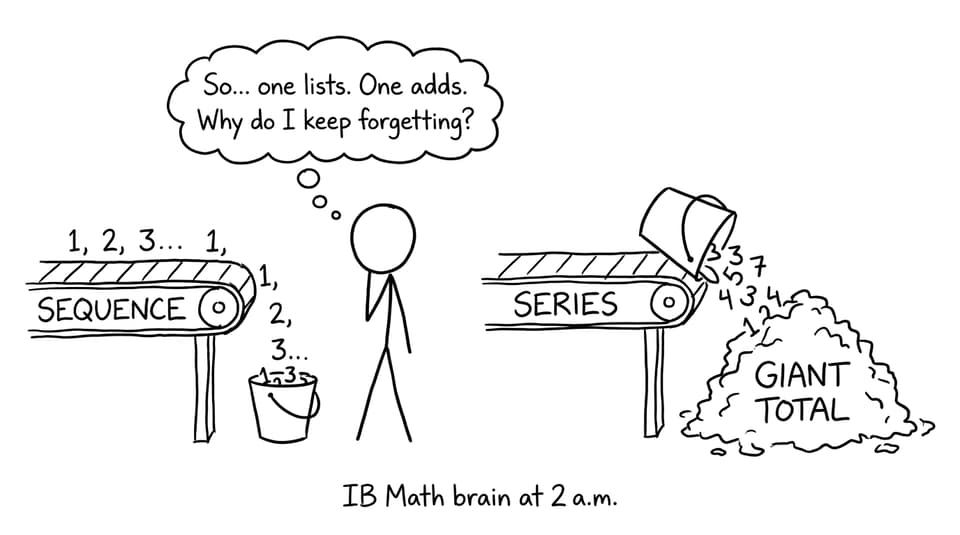
Mix-up #1: sequence vs series (list vs total)
A sequence is a list: (a_1, a_2, a_3, \dots).
A series is the total: (S_n = a_1 + a_2 + \dots + a_n).
The annoying part in IB Math is that both show up in the same paragraph, sometimes in the same sentence. If you don’t pause to name what you’re solving for, you can correctly find (a_n) when the question wanted (S_n), or compute a sum when the question asked for a single term.
For a wider “pattern recognition” toolkit, pair this topic with How to approach sequences and series effectively (Flashcards). The repetition matters in IB Math because the same-looking notation tests different thinking.
Mix-up #2: the sneaky problem of “how many terms”
Many arithmetic series questions are not actually about summation. They’re about counting.
If the sequence starts at (u_5) or the final term is defined by a condition, then (n) is not handed to you. And if (n) is wrong, your sum will be wrong in a way that still looks “reasonable.” That’s the most dangerous kind of wrong in IB Math.
A practical habit: write a tiny line that proves the count.
- “First included term is (u_3), last included term is (u_{23}), so number of terms is (23-3+1=21).”
That one line often protects multiple marks.
For targeted exam-style drilling, use SL 1.2 Arithmetic sequences and series Questionbank and force yourself to write the “count line” every time.
Mix-up #3: worded questions make you choose the wrong first or last term
Word problems are where arithmetic series become emotional.
Payments, stair patterns, daily training plans, saving targets: they feel like stories, not math. But IB Math is checking whether you can turn a story into a clean definition of (a_1), (d), and (n).
Most errors come from a quiet mismatch:
-
You treat the “first month” as (a_1) even though the first payment happens at the end of the month.
-
You use the “increase” as a term instead of the difference (d).
-
You assume the last term is the number mentioned most recently in the paragraph.
A reliable fix is to write the first three terms explicitly before you sum anything. In IB Math, three terms is often enough to expose a misunderstanding.
Mix-up #4: the formula feels friendly, so you rush the setup
The arithmetic series formula is short. That’s the problem.
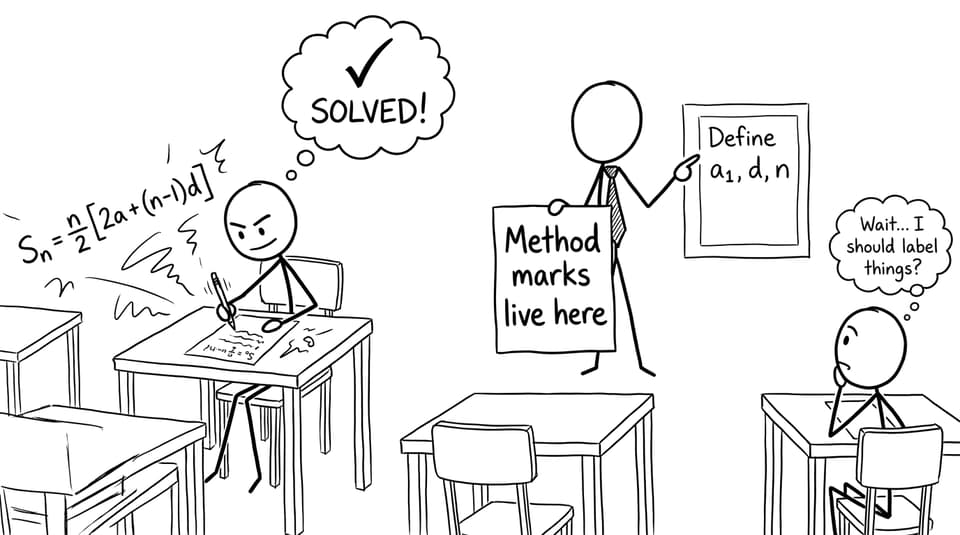
When a formula looks easy, students substitute quickly. But in IB Math, method marks reward careful definitions: labeling (a_1), (d), (n), and (if needed) (a_n). You’re not being graded on memorization. You’re being graded on control.
If you want a clean reference for the exact formulas you’re expected to use, keep the IB Mathematics Analysis and Approaches Data Booklet bookmarked during revision.
How to train arithmetic series the RevisionDojo way
Confidence in IB Math comes from repeating the same high-quality process.
On RevisionDojo, you can:
-
Use the Study Notes for SL 1.2 to review definitions and sigma notation: SL 1.2 Notes
-
Practice under pressure with exam-style sets in Bootcamps: SL 1.2 Exercises
-
Build speed and accuracy with the Questionbank (and learn from worked solutions): SL 1.2 Questionbank
-
Use Flashcards to stop mixing up “term vs sum” automatically: Sequences and series flashcard approach
Then zoom out and track your topic coverage from the AA hub: IB Math AA resources.
The takeaway: arithmetic series aren’t hard, but they punish hurry
Arithmetic series get mixed up in IB Math because they test your ability to stay organized: term vs sum, indexing, and counting terms before calculating.
If you want the fastest path to consistency, build the habit loop: read the question slowly, run the 30-second checklist, then practise with targeted sets. RevisionDojo ties that loop together with Questionbank practice, Study Notes, Flashcards, AI Chat for quick clarifications, and exam-style Mock Exams and Predicted Papers when you’re ready to simulate the real thing. When arithmetic series stop feeling “easy but risky,” they start feeling like free marks in IB Math.