


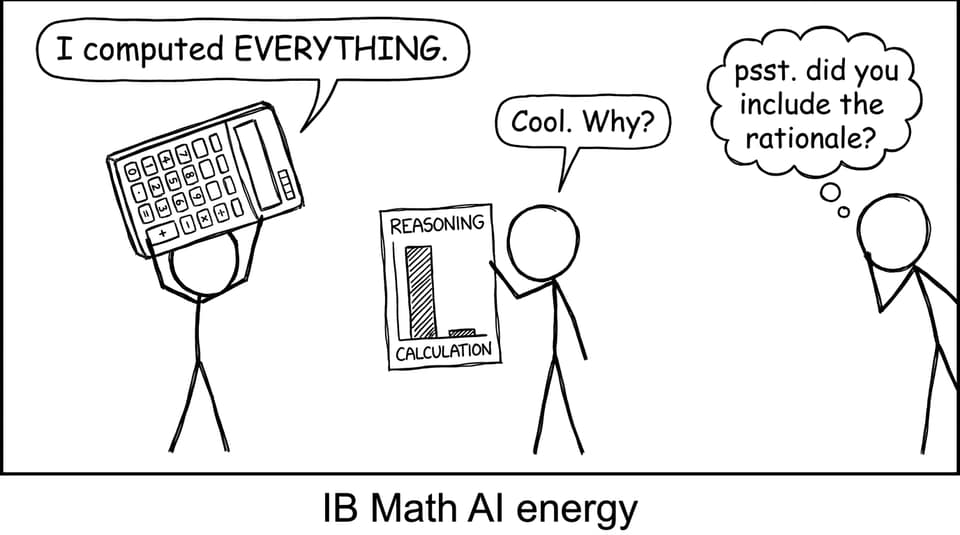
The first time many students meet IB Math AI, they treat it like a speed test: find the formula, press the buttons, move on.
Then the markscheme answers back with a quiet surprise: most of the marks weren’t hiding in the calculation at all. They were sitting in the sentences around it. The assumptions you noticed. The decision you made. The interpretation you wrote like you actually meant it.
That’s the core shift: IB Math AI is less about doing maths and more about thinking with maths.
A quick checklist: what IB Math AI is really testing
Before you practice another set, run this mental checklist:
-
Did I translate the context into variables before calculating?
-
Did I choose a method and justify why it fits?
-
Did I interpret results in words, with units and meaning?
-
Did I mention uncertainty, limitations, or reasonableness?
-
Did I reflect on what could break the model?
If that sounds like analysis, not arithmetic, that’s the point. In IB Math, the calculator can compute. You’re assessed on the thinking that surrounds the computation.
Why IB Math AI rewards reasoning over raw maths
Here’s the uncomfortable truth: most of the maths in IB Math AI isn’t “hard” in the traditional sense. Technology handles regression, distributions, financial calculations, and iterative solutions.
So the exam pivots. It asks what machines don’t do well: deciding what matters.
That’s why multi-step questions often allocate marks to:
-
selecting a model,
-
explaining parameters in context,
-
evaluating reliability,
-
and communicating conclusions clearly.
To practise in the same style, start at the hub for IB Mathematics Applications & Interpretation Resources, then use RevisionDojo’s Questionbank to drill decision-heavy prompts, not just procedural ones.
IB Math AI is “real-world messy” on purpose
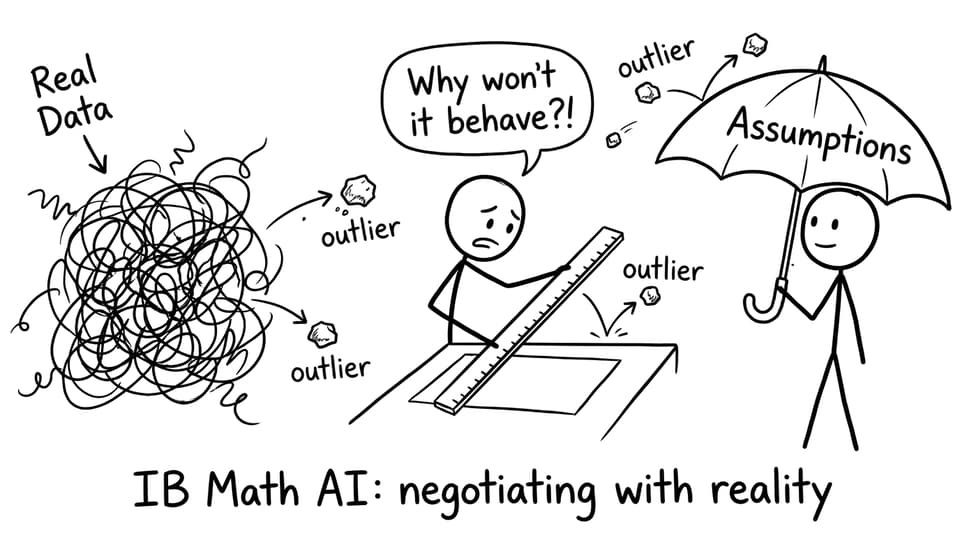
Real data rarely behaves. It has outliers, missing values, awkward units, and correlations that look impressive until you zoom out.
In IB Math, that messiness is not a mistake. It’s the curriculum.
The exam wants you to notice when:
-
a sample is too small,
-
a model is being extrapolated,
-
a relationship is weak despite a neat-looking graph,
-
or assumptions quietly fail.
That’s why this guide on How to Interpret Data in IB Math AI Using Technology matters: it trains the habit of checking meaning, not just producing numbers.
The hidden skill in IB Math: choosing the method
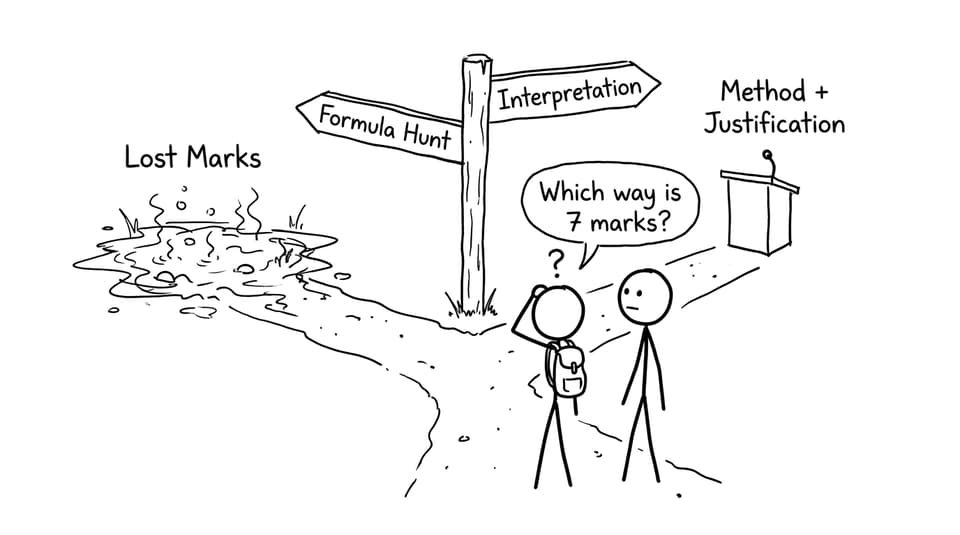
In many IB Math AI questions, you don’t just execute a method. You select it.
Students lose marks when they treat every question like a treasure hunt for “the right formula.” In AI, formulas are tools. Your score comes from matching the tool to the situation and explaining why it belongs there.
A simple way to practise this is to do topic sets with intentional method choice, like RevisionDojo’s AI Questionbank for Number and Algebra or Functions. After each question, write one line answering: Why this method, not another?
How to train “IB Math thinking” (without vague advice)
Thinking sounds abstract until you build a routine.
Try this loop 3 times a week:
-
Read one clean explanation from How to Use RevisionDojo Notes to Simplify IB Math AI Concepts.
-
Do 10 questions in RevisionDojo’s Questionbank in exam style (timed, no pausing).
-
Use AI Chat to ask: “What would an examiner reward in my explanation?”
-
Convert mistakes into Flashcards: not formulas, but phrases (e.g., “This model may be unreliable because…”).
If you need a broader plan across AA and AI, use How to Revise IB Math AA and AI Effectively as your structure.
Conclusion: make IB Math your thinking advantage
The students who score well in IB Math AI aren’t the fastest calculators. They’re the calmest thinkers. They slow down just enough to choose a method, explain what it does, and treat every result as something to evaluate, not worship.
If you want a single home base for that shift, use RevisionDojo: the Questionbank for examiner-style practice, Study Notes to simplify concepts, Flashcards to lock in explanation habits, AI Chat to sharpen reasoning, Grading tools to understand markschemes, plus Predicted Papers, Mock Exams, a Coursework Library, and Tutors when you need human feedback.
In IB Math, the maths is the tool. The thinking is the score.


