

Inflation shows up in IB Math financial modelling questions like a plot twist you didn’t ask for. You’re happily compounding interest, your calculator is cooperating, and then the question asks if someone is “better off” in 10 years. That one phrase quietly changes everything.
The truth is that inflation isn’t there to make the algebra harder. In IB Math, it’s there to test whether you can tell a story with numbers: are you describing money amounts (nominal) or what those amounts can buy (real)? Students lose marks not because they can’t calculate, but because their model describes two different realities at once.
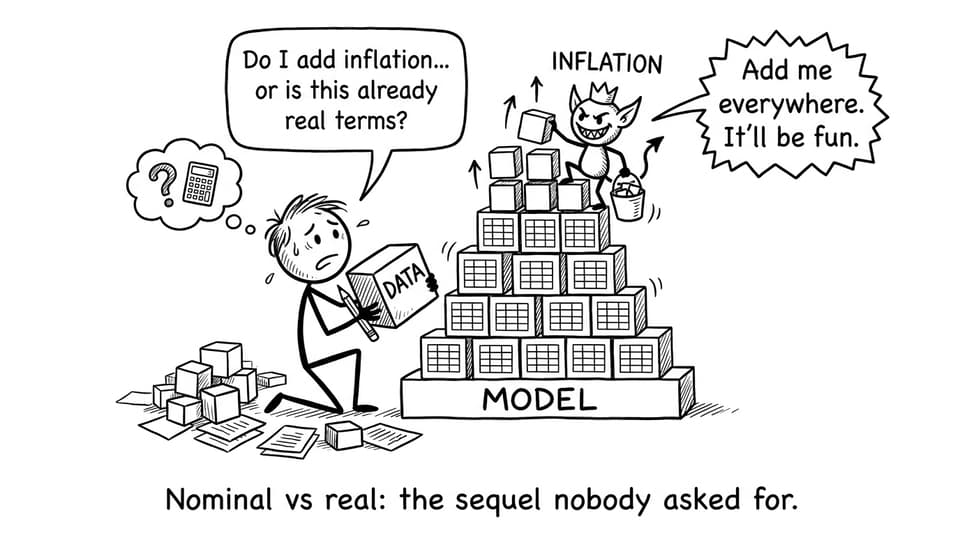
The IB Math rule: inflation is about meaning, not mechanics
Inflation measures how purchasing power changes over time. If prices rise, the same salary or savings balance buys less.
In IB Math, inflation matters whenever the question wants interpretation across time: comparing costs in different years, deciding whether a plan is “worth it,” or judging living standards.
A useful mindset: interest tells you how money grows, inflation tells you what money is worth.
For broader financial context, the explanation in How Does Financial Mathematics Work in IB Maths? pairs well with inflation modelling.
Quick checklist: should IB Math include inflation here?
Use this as your 20-second filter before you touch your calculator.
-
The question asks about “real value,” “purchasing power,” or “in today’s money” ✅ Include inflation
-
It asks whether someone is “better off” or to compare across years ✅ Include inflation
-
It’s purely computing a future balance with an interest rate and no interpretation ⚠️ Often ignore inflation
-
It explicitly says values are already in “real terms” ✅ Do not add inflation again
-
You are given both an interest rate and inflation and asked to comment on the outcome ✅ Include inflation consistently
To practise decision-making like this under exam conditions, RevisionDojo’s IB Math AI hub is built around modelling judgement, not just formulas.
When inflation must be included in IB Math financial modelling
Inflation should be included when the question is fundamentally about comparing value across time.
Long-term savings and “am I better off?” questions
If a model ends with a sentence like “comment on whether the person is better off,” inflation is a major part of that comment. A higher nominal balance can still represent lower real purchasing power.
Salary growth and cost-of-living comparisons
Salary modelling often looks like clean growth, but the interpretation is rarely clean. If the question compares salary increases to living costs, inflation belongs in the model.
If salary questions feel inconsistent, that’s the point: IB Math is testing modelling choices. See Why Does Modelling Salary Changes Feel So Inconsistent in IB Maths.
Comparing prices in different years
If you’re asked to compare a car price in Year 1 to Year 6, or to “convert to today’s money,” you’re being asked for real terms thinking.
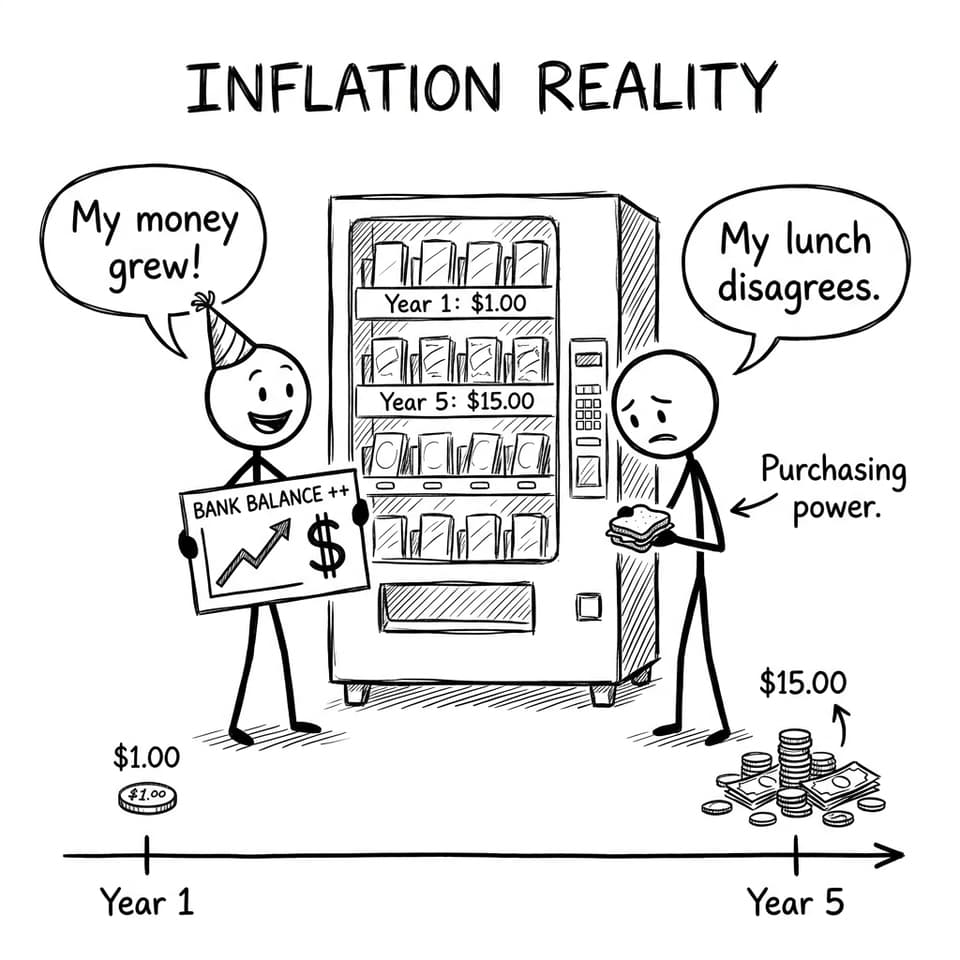
When inflation is not required (and can cost you marks)
In IB Math, adding inflation automatically is a common mistake.
If a question says amounts are already adjusted for inflation (real terms), you don’t apply inflation again. If the question is only asking for the numeric future value using a stated interest rate, inflation may be intentionally irrelevant.
This links to a bigger theme in the course: IB often avoids telling you which tool to use because it’s testing judgement. A helpful read is Why Do IB Maths Questions Avoid Giving Financial Formulas Directly.
The consistency trap: the fastest way to lose interpretation marks
Examiners reward coherent models. They punish models that mix nominal and real values.
If you deflate a future salary to “today’s money” but forget to deflate the future expenses you compare it to, your conclusion becomes meaningless even if each calculation line looks correct.
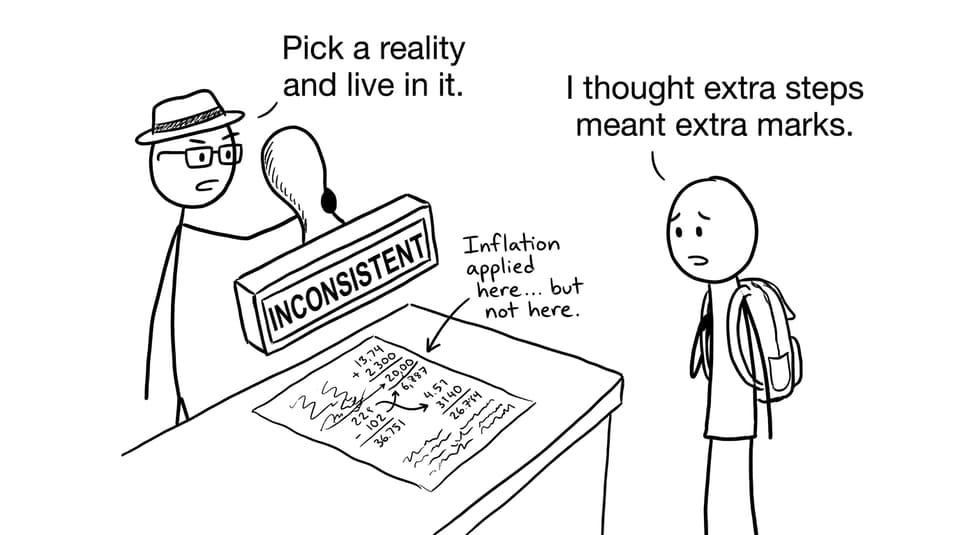
A practical habit in IB Math: label every major quantity as nominal or real, and keep it that way through the entire model.
How RevisionDojo helps you model inflation the IB Math way
When inflation questions feel risky, practice needs to look like the exam: worded contexts, judgement calls, and explanation marks.
RevisionDojo supports that with:
-
The Questionbank for targeted inflation and finance practice with feedback
-
Study Notes and Flashcards to lock in nominal vs real language
-
AI Chat to check whether your interpretation matches your model
-
Grading tools to spot inconsistent assumptions
-
Predicted Papers and Mock Exams to rehearse full financial modelling under time pressure
-
A Coursework Library plus Tutors if you want one-to-one support on modelling clarity
A good starting point for structured practice is SL 1.4 Financial Apps: compound interest and depreciation, plus the matching flashcards.
Closing: make inflation a decision, not a reflex
Inflation in IB Math is less about formulas and more about honesty: what does your number mean? When the question asks about purchasing power, include inflation. When it doesn’t, don’t smuggle it in.
If you want that judgement to feel automatic by exam day, use RevisionDojo to drill finance scenarios in the Questionbank, lock in language with Flashcards, and pressure-test your modelling with Mock Exams and Predicted Papers. Inflation stops being scary when your model tells one consistent story from start to finish.