


RevisionDojo logoRevisionDojo logo
PricingSchools
  1. Home
  2. /Blog
  3. /IB Design Technology: Skills You Need to Succeed

IB Design Technology: Skills You Need to Succeed

IB Design Technology
RevisionDojo Team
•Last updated: 19 Jul 2026•6 min read
Jojo holding a cookie

This site uses cookie tracking technologies. Learn more in our Cookie Policy.

Join 650k+ students breezing through the IBReady to breeze through the IB?

Footer

General

  • For parents
  • For schools
  • Pricing
  • Gift RevisionDojo
  • Tutoring
  • IB syllabus
Share on
Share on
Share on
4.2/5 from students worldwide
Share
Share on X
  • MYP syllabus
  • Blog
  • Research
  • Features

    • Jojo AI
    • Questionbank
    • Notes
    • Flashcards
    • Test builder
    • Exam mode
    • Coursework
    • Coursework grader
    • Coursework examples
    • Predicted papers
    • IB grade calculator
    • Grade boundaries

    Research

    • State of learning survey
    • IB Moderation Analysis
    • Jojo AI vs ChatGPT
    • Jojo AI vs Gemini
    • Jojo AI vs Perplexity
    • Jojo AI vs Claude
    • Jojo AI vs Poe

    Platform

    • RevisionDojo vs Others
    • Content philosophy
    • Trustpilot
    • Join usWe're hiring
    • Terms and conditions
    • Privacy policy
    • Cookie policy
    • Trust Center

    MYP Subjects

    • MYP Biology
    • MYP Chemistry
    • MYP English Lang & Lit
    • MYP Extended Mathematics
    • MYP History
    • MYP Individuals & Societies
    • MYP Physics
    • MYP Standard Mathematics
    • MYP Biology
    • MYP Chemistry
    • MYP English Lang & Lit
    • MYP Extended Mathematics
    • MYP History
    • MYP Individuals & Societies
    • MYP Physics
    • MYP Standard Mathematics

    IB Subjects

    • Arabic ab initio
    • Arabic B
    • Biology
    • Business Management
    • Chemistry
    • Chinese A Lang & Lit
    • Chinese B
    • Computer Science (CS)
    • Computer Science (First Exam 2027)
    • Design Technology (DT)
    • Design Technology (First Exam 2027)
    • Digital Society (DS)
    RevisionDojo logo

    © 2022 - 2026 RevisionDojo (MyDojo Inc)

    RevisionDojo was developed independently of the IBO and as such is not endorsed by it in any way.

    GDPR compliantDownload on the App Store

    In the first week of IB Design Technology, lots of students have the same quiet belief: If I’m creative, I’ll be fine. Then the first serious write-up arrives, and suddenly the hardest part isn’t drawing or making. It’s explaining.

    That’s the real secret of IB Design Technology. The top students aren’t always the most artistic, or the best at CAD, or the ones with the neatest prototypes. They’re the ones who can think in a process, justify decisions, and stay organised for months.
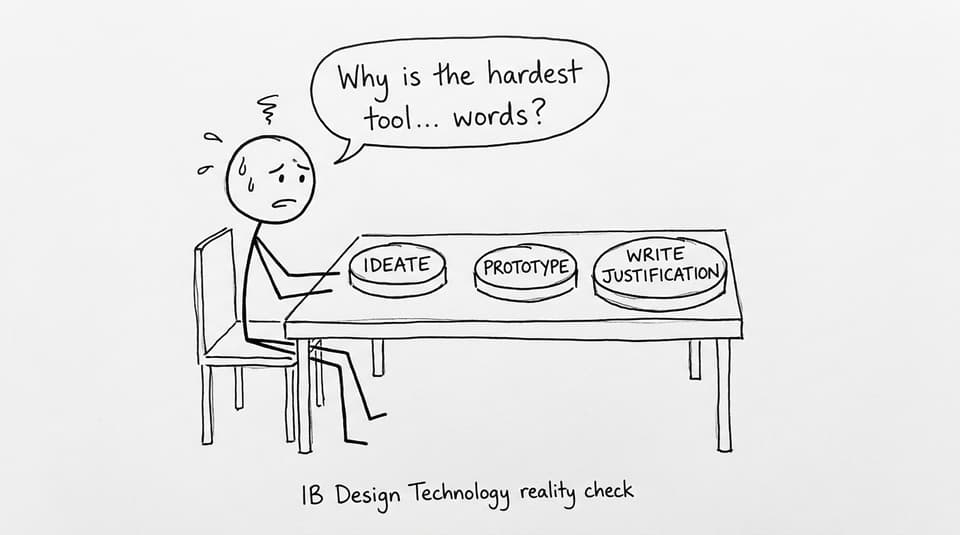
    IB Design Technology reality check comic
    IB Design Technology reality check comic

    The quick skill checklist for IB Design Technology

    If you want a fast self-audit for IB Design Technology, check whether you can do these consistently:

    • Define a specific user and problem (not vague ones)

    • Generate multiple ideas and choose using trade-offs

    • Write clear, marks-friendly justification using DT terminology

    • Research selectively and cite what matters

    • Evaluate honestly and propose realistic improvements

    • Manage time across long projects and exam prep

    A platform like IB Design Technology Resources is useful because it keeps all those skills connected: Study Notes, Flashcards, , , , , , a , and .

  • Economics
  • English A Lang & Lit
  • English A Lit
  • English B
  • Environmental systems and societies (ESS)
  • French A
  • French ab initio
    • French B
    • Geography
    • German A
    • German ab initio
    • German B
    • Global Politics
    • History
    • Mathematics Analysis and Approaches (AA)
    • Mathematics Applications & Interpretation (AI)
    • Philosophy
    • Physics
    • Psychology
    • Psychology (First Exam 2027)
    • Spanish A
    • Spanish ab initio
    • Spanish B
    • Sports, exercise and health science (SEHS)
    • Theory of Knowledge (TOK)
    • Arabic ab initio
    • Arabic B
    • Biology
    • Business Management
    • Chemistry
    • Chinese A Lang & Lit
    • Chinese B
    • Computer Science (CS)
    • Computer Science (First Exam 2027)
    • Design Technology (DT)
    • Design Technology (First Exam 2027)
    • Digital Society (DS)
    • Economics
    • English A Lang & Lit
    • English A Lit
    • English B
    • Environmental systems and societies (ESS)
    • French A
    • French ab initio
    • French B
    • Geography
    • German A
    • German ab initio
    • German B
    • Global Politics
    • History
    • Mathematics Analysis and Approaches (AA)
    • Mathematics Applications & Interpretation (AI)
    • Philosophy
    • Physics
    • Psychology
    • Psychology (First Exam 2027)
    • Spanish A
    • Spanish ab initio
    • Spanish B
    • Sports, exercise and health science (SEHS)
    • Theory of Knowledge (TOK)
    WhatsApp
    LinkedIn
    Facebook
    Questionbank
    AI Chat
    Grading tools
    Predicted Papers
    Mock Exams
    Coursework Library
    Tutors

    Design thinking: staying faithful to the process

    The best IB Design Technology students treat design like a trail, not a jump. They move step by step: empathise, define, ideate, prototype, test, iterate.

    What that looks like in practice:

    • You can explain your problem using evidence (interviews, observations, testing)

    • Your design requirements actually control your decisions

    • You compare ideas instead of falling in love with the first one

    • You iterate with clear reasons, not random changes

    If you want to sharpen this quickly, read How Does Design Thinking Work in IB Design Technology? and practise user-centred thinking in B1.1 User-centred design.

    Written communication: the mark-saving skill nobody trains

    A painful truth: in IB Design Technology, vague writing bleeds marks. You don’t get rewarded for “I chose this because it’s good.” You get rewarded for criteria-based reasoning.

    Train yourself to write like this:

    • Decision: what you chose

    • Reason: linked to user need + spec

    • Evidence: research or testing data

    • Trade-off: what you sacrificed and why it’s acceptable

    To practise that style under exam pressure, use the IB Design Technology Questionbank and focus on short, timed explanations. If you get stuck on command terms or how to phrase evaluation, use AI Chat as a marks-style translator.
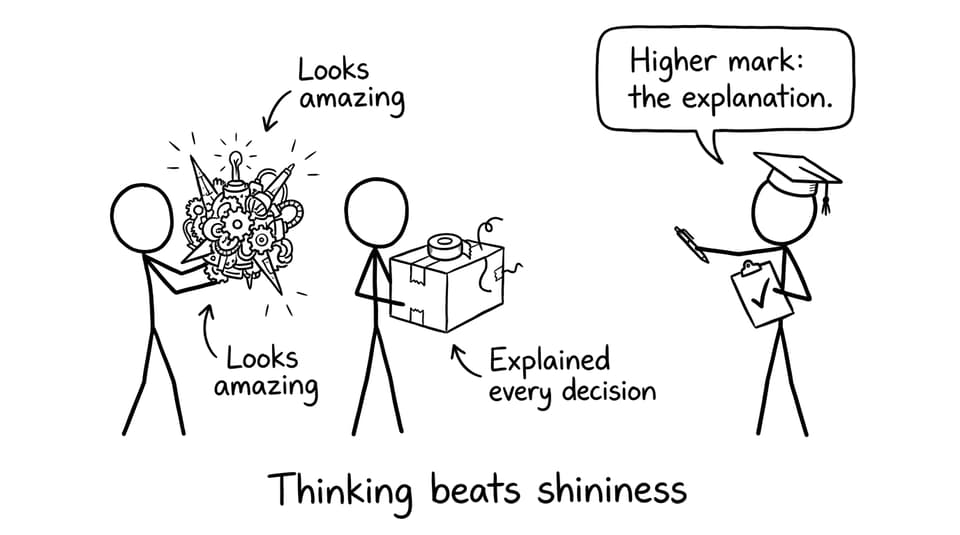
    Thinking beats shininess comic
    Thinking beats shininess comic

    Research and evaluation: being selective, then being honest

    In IB Design Technology, research isn’t a scrapbook. It’s a tool for decision-making. Strong students don’t collect everything; they collect the right things.

    Aim for research that does at least one of these:

    • Defines user needs clearly

    • Justifies materials, mechanisms, or manufacturing choices

    • Reveals constraints (cost, sustainability, safety, ergonomics)

    • Provides measurable criteria for testing

    Then comes the part many students avoid: evaluation that admits limitations. Examiners reward realistic reflection because design in the real world is never perfect.

    A useful content anchor here is topic-based notes like B2.1 The design process (Notes), which helps you keep research, iteration, and evaluation aligned.

    Time management: the hidden grade boundary

    The design project (and exam prep) punishes last-minute energy. IB Design Technology rewards steady documentation: small progress, repeated often.

    A simple routine that works:

    • Weekly DT block for project documentation (even 45 minutes)

    • 10 minutes of definitions via active recall (flashcards)

    • 1 Questionbank set per week, then review mistakes

    • 1 timed section every 1--2 weeks as exams approach

    If your planning falls apart mid-semester, borrow structure from Best Time Management Hacks for IB Students and match it with DT-specific revision ideas from Best Study Strategies for IB Design Technology Students.
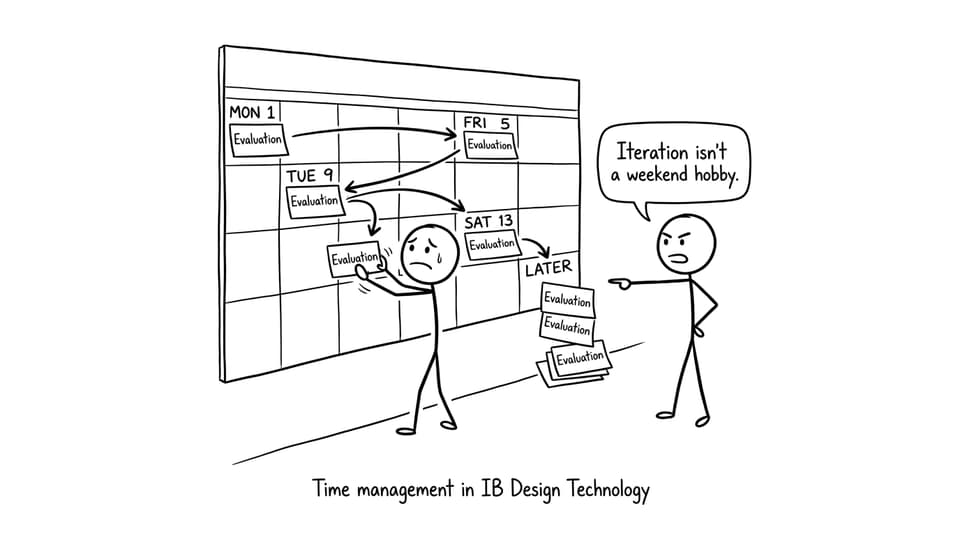
    Time management in IB Design Technology comic
    Time management in IB Design Technology comic

    Iteration and feedback: changing your mind without losing your thread

    The strongest IB Design Technology portfolios feel like a conversation with reality: you propose, test, get feedback, and adjust.

    To improve here:

    • Ask for feedback early (teacher, peers, user)

    • Record what changed and why it changed

    • Keep iteration tied to your design requirements

    • Treat “mistakes” as evidence of learning

    If you’re unsure what counts as acceptable inspiration vs copying, IB Design Technology: Can You Reuse Products or Ideas? is worth reading before you commit to a concept.

    Conclusion: build the skills, then build the product

    If you want to succeed in IB Design Technology, train the skills that compound: design thinking, justified writing, selective research, honest evaluation, and calm time management. Those are the habits that turn effort into marks.

    Start by using the IB Design Technology hub, then reinforce your weakest areas with the Questionbank, Study Notes, Flashcards, and Mock Exams. When you need fast clarity, lean on AI Chat. When you want feedback that actually changes your next draft, use the Grading tools or reach out to Tutors. In IB Design Technology, the product is the outcome, but the process is the advantage.
    How helpful was this article?
    Add as a preferred source on Google

    Continue studying with RevisionDojo

    • IB Coursework GraderCheck an IA, EE, or TOK draft against IB assessment criteria.
    • IB Coursework ExamplesLearn from high-scoring coursework across IB subjects.
    • IB Grade CalculatorEstimate an IB grade using session-specific boundaries.
    • IB Grade BoundariesExplore historical grade boundaries by subject and session.

    Frequently Asked Questions

    IB Design Technology · 4

    What Extra Topics Are Covered in IB Design Technology HL?

    Learn what extra topics IB Design Technology HL students study, how HL content is deeper than SL, and what this means for exams and coursework.

    IB Design Technology · 7

    IB Design Technology IA: How to Show Real Iteration

    IB Design Technology iteration made simple: learn what counts, where to show it in your IA, and how to document changes for higher marks.

    IB Design Technology · 8

    IB Design Technology Problem Statement: Write It Strong

    IB Design Technology problem statement guide: learn the user-first formula, avoid solution language, add evidence, and set up high-scoring IA work.

    IB Design Technology · 8

    IB Design Technology IA Referencing: A Simple Guide

    IB Design Technology IA referencing made simple: what to cite, how to format in-text citations, and how to avoid plagiarism with consistent sources.

    IB Design Technology · 7

    IB Design Technology Without Creativity: Can You Still Excel?

    IB Design Technology success isn’t about being artistic. Learn what examiners reward, how to score higher, and how RevisionDojo helps.

    IB Design Technology · 7

    Common IB Design Technology Exam Mistakes (and Fixes)

    IB Design Technology exam mistakes are predictable. Learn the most common errors and quick fixes for command terms, evaluation, timing, and structure.

    Related Articles
    min read
    min read
    min read
    min read
    min read
    min read