


In the first five minutes of an IB English exam, most students do something totally understandable: they try to be safe. They write a thesis that sounds “true” and “literary” and harmless.
And then the essay drifts.
Because in IB English, safety often looks like summary. It looks like naming devices without making a claim. It looks like a thesis that could fit any text on Earth.
An effective thesis statement does the opposite. It takes a risk, not by being dramatic, but by being specific. It makes a promise to the examiner: this is what the text is doing, and this is why it matters.
What a thesis statement does in IB English (in one sentence)
A thesis statement in IB English is a one- to two-sentence argument that answers the prompt and explains how authorial choices create meaning/effect.
If you want a deeper dive into thesis basics, this pairs well with What Makes a Good Thesis Statement for IB English Essays?.
Quick checklist: the “effective thesis” test
Before you commit to a thesis in IB English, check that it is:
-
Direct: it clearly answers the question.
-
Arguable: a smart reader could disagree.
-
Text-specific: it could not be copy-pasted onto another text.
-
Method-aware: it names authorial choices (language, structure, tone, perspective, symbolism).
-
Meaning-driven: it states what those choices suggest, critique, or reveal.
The simplest formula for an IB English thesis
A reliable way to write an effective thesis statement in IB English is:
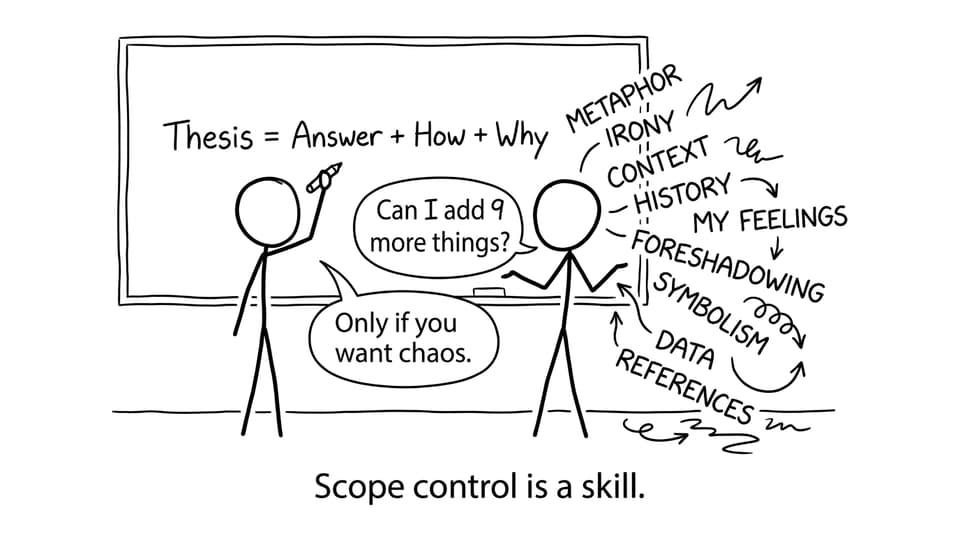
Answer + How + Why
-
Answer the prompt using its keywords.
-
Explain how meaning is built (choices in language and structure).
-
Explain why that matters (purpose, critique, effect on reader).
Example: weak vs strong
Weak (device list):
“Shakespeare uses imagery and language in Macbeth.”
Stronger (claim + method + meaning):
“In Macbeth, Shakespeare’s recurring imagery of blood and darkness frames ambition as a corrosive force, suggesting moral collapse is less a moment of evil than a gradual surrender to self-justification.”
Notice what changes: the strong version still mentions imagery, but it uses imagery to argue.
How to build your thesis quickly in Paper 1
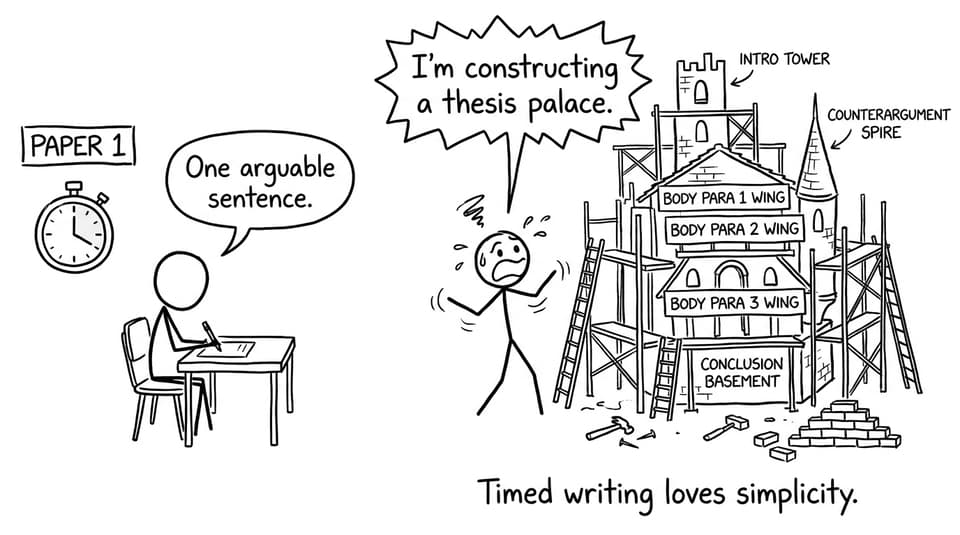
Paper 1 rewards control under pressure. Your thesis should not try to be a mini-essay. In IB English, a Paper 1 thesis is often your best attempt at describing the text’s purpose + tone + main method.
A strong starting point is the TAPAC approach, explained in Mastering IB English Paper 1: 7 Expert Strategies, and extended further in Writing a Commentary for IB English A: Step-by-Step Guide.
Paper 1 thesis template (fast and usable)
“In [text type], the writer uses to [create effect], ultimately [revealing/criticising/complicating] [central idea].”
If you’re revising routines, Step-by-Step Guide to Revising IB English Paper 1 is a good companion.
How to build a comparative thesis for Paper 2
Paper 2 punishes “two separate mini-essays.” Your thesis must compare from the start.
A practical approach is to build one sentence with a clear contrast word:
“While Text A [argument], Text B [argument], revealing [bigger insight].”
You can see Paper 2 structure and examples in Structuring Your IB English Paper 2 Essay and planning strategy in How to Approach Comparative Essays in IB English Paper 2.
Paper 2 example thesis (comparative and debatable)
“While The Great Gatsby presents isolation as a byproduct of status performance, A Doll’s House frames it as a consequence of social roles, suggesting ‘freedom’ can function as a story societies tell rather than a condition people live.”
Common thesis mistakes IB English examiners spot instantly
In IB English, these errors usually create essays that feel busy but not persuasive:
-
Theme-only theses: “The text explores power and identity.” (Too generic.)
-
Plot summary theses: “The poem is about sadness.” (Not analysis.)
-
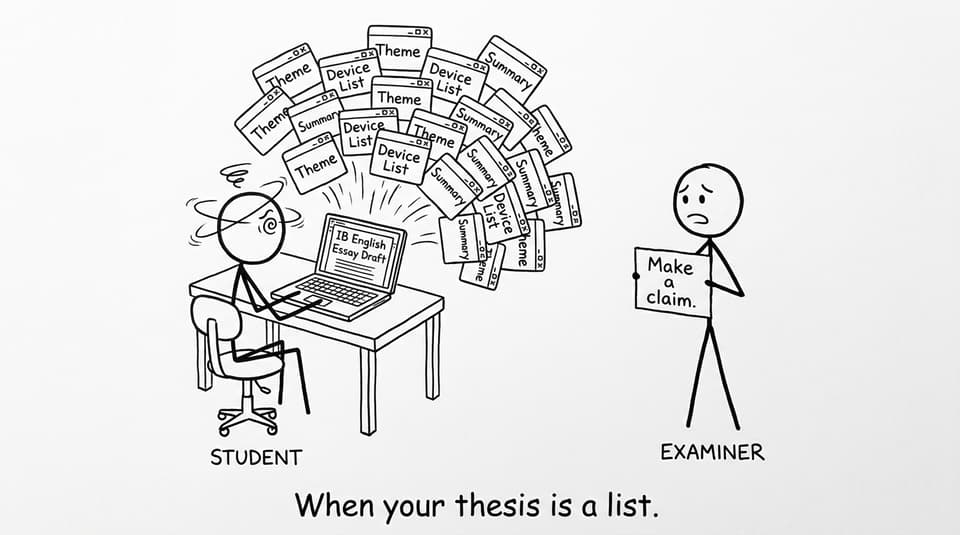
Laundry-list theses: naming five devices without a single controlling idea.
-
Two-theses-in-one: two unrelated arguments crammed together.
A useful fix is to tighten your introduction around one clear argument. If that’s a weak spot, use Writing Effective Introductions and Conclusions in IB English Essays.
How RevisionDojo helps you turn a thesis into marks
A thesis is only powerful if your paragraphs prove it. RevisionDojo helps you practice that loop:
-
Use the Questionbank to drill thesis-writing from real prompts.
-
Use Study Notes and Flashcards to build technique vocabulary that actually supports analysis.
-
Use AI Chat when you’re stuck between two interpretations and need to sharpen the arguable angle.
-
Use Grading tools to test whether your thesis and body paragraphs stay aligned.
-
Use Predicted Papers and Mock Exams to make your thesis-writing automatic under time pressure.
-
Use the Coursework Library and Tutors when you need feedback that’s clearer than “add more analysis.”
If you want a structured hub for skills and practice, start with IB English A Lang & Lit Resources.
Closing: the thesis is your promise
A strong thesis statement in IB English is not decoration. It’s a promise you make, then keep, paragraph by paragraph, quote by quote, insight by insight.
If you want that promise to feel easier under exam pressure, build the habit on RevisionDojo: practice with the Questionbank, tighten your thinking with AI Chat, and test your writing with Grading tools until your thesis becomes the calmest sentence you write all day.