This site uses cookie tracking technologies. Learn more in our Cookie Policy.
IB Design Technology: Writing a Strong Problem… | RevisionDojo
Join 600k+ Students Already Crushing Their Exams
The moment your IA either tightens--or drifts
Most IB Design Technology students don’t lose marks because their final product looks “bad.” They lose marks much earlier, in a quieter place: the first time they describe the problem.
A weak problem statement feels harmless. It’s only a few lines. You can always “fix it later.” But in IB Design Technology, those few lines become the roots of everything: what you research, what requirements you write, how you test, and how convincing your evaluation sounds. When the roots are fuzzy, the whole project grows crooked.
If you want your IA to feel like a clear argument (not a scrapbook), start by making your problem statement sharp.
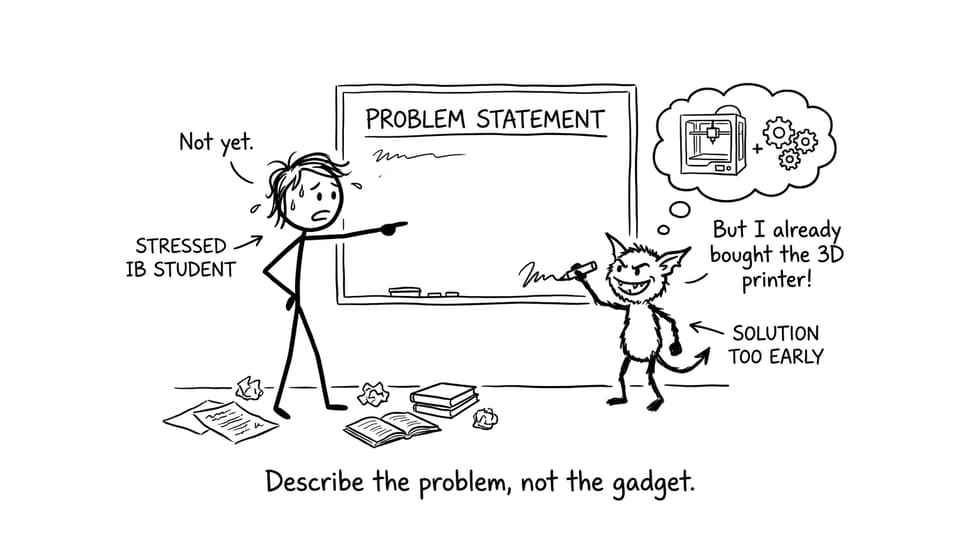
Comic about not writing the solution too early
Quick checklist: what a strong IB Design Technology problem statement includes
Use this as your 60-second filter before you commit.
A specific user (real person or clearly defined client group)
A specific context (where/when the issue happens)
A specific pain (what is not working, and how it affects the user)
A hint of evidence (observation, short interview quote, survey result)
No solution language (no “design a,” “create a,” “build a”)
If you can’t point to each item, your IB Design Technology problem statement probably needs one more pass.
What a problem statement is (and isn’t) in IB Design Technology
A problem statement in IB Design Technology is a short, user-centred description of a situation that needs improvement. It should explain:
Who is experiencing the problem
What they struggle with
Why it matters (impact, consequence, frustration, inefficiency, safety)
Where/when it happens (the real setting)
It is not a product pitch. It’s not your final idea. It’s the starting point of design thinking.
If you’re unsure how the problem-definition stage fits into the design cycle, RevisionDojo’s syllabus-aligned topic page on The Design Process (B2.1) helps you place your problem statement where it belongs.
Why the problem statement affects your marks (even when it isn’t “a criterion”)
In IB Design Technology, examiners reward logical progression. When the problem is precise, your IA naturally becomes easier to justify:
Research becomes targeted, not random
Design requirements become testable, not generic
Testing produces meaningful iteration, not cosmetic change
Evaluation sounds evidence-based, not opinion-based
This is why it’s worth understanding how marks are actually awarded. Read How is the IB Design Technology IA graded? when you want the rubric language translated into practical writing decisions.
The 4 traits of a strong IB Design Technology problem statement
Specific user, not a vague crowd
“We need something for students” is a foggy start. Strong IB Design Technology work names a user in a way that forces design decisions.
Too broad: “Students struggle to organise school materials.”
Stronger: “A Year 12 IB student who moves between classes in 4-minute transitions struggles to access the correct folder quickly because their bag layout forces them to unpack multiple items in crowded corridors.”
Notice what happens: the context creates measurable needs (time, access, movement, space). That becomes gold later for requirements and testing.
Evidence, not invention
You don’t need a huge study. But you do need proof that the problem exists.
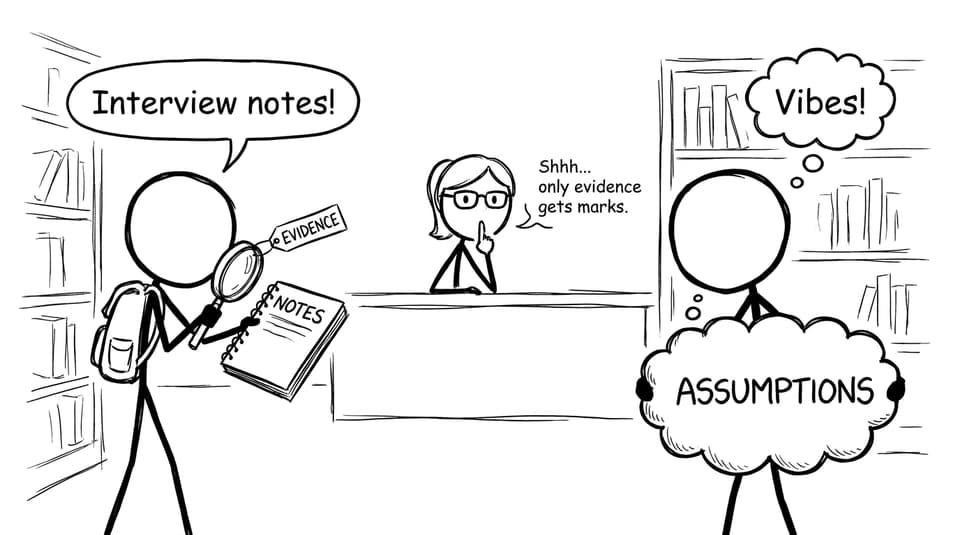
One observation. Two short interview answers. A quick photo diary. Even a small survey. In IB Design Technology, evidence turns your IA from “I think” into “I found.”
Comic about evidence vs assumptions
If you want a structured place to store supporting definitions and concepts while you research, RevisionDojo’s Flashcards with Spaced Repetition (SRS) can keep key DT terminology accurate when you write.
Problem-first language (no early solution)
This is the most common mark-limiter.
Solution-first: “The problem is that there is no adjustable desk.”
Problem-first: “The user experiences discomfort during extended study sessions because fixed desk height and chair setup restrict posture changes and cause wrist strain.”
The second version leaves space for multiple solutions, which is exactly what design development needs.
Manageable scope
A strong IB Design Technology problem statement describes something you can realistically investigate, prototype, test, and refine.
If your problem requires industrial manufacturing, medical certification, or a city-wide policy change, you’ll end up writing around your limitations. Better to narrow the context until you can actually collect data and iterate.
“[Specific user] in [specific context] experiences [specific problem] because [cause(s)], which results in [impact]. Initial evidence includes [brief evidence].”
Once you have a draft, compare it with examiner expectations using RevisionDojo’s IB Design Technology IA Grader to spot vagueness early.
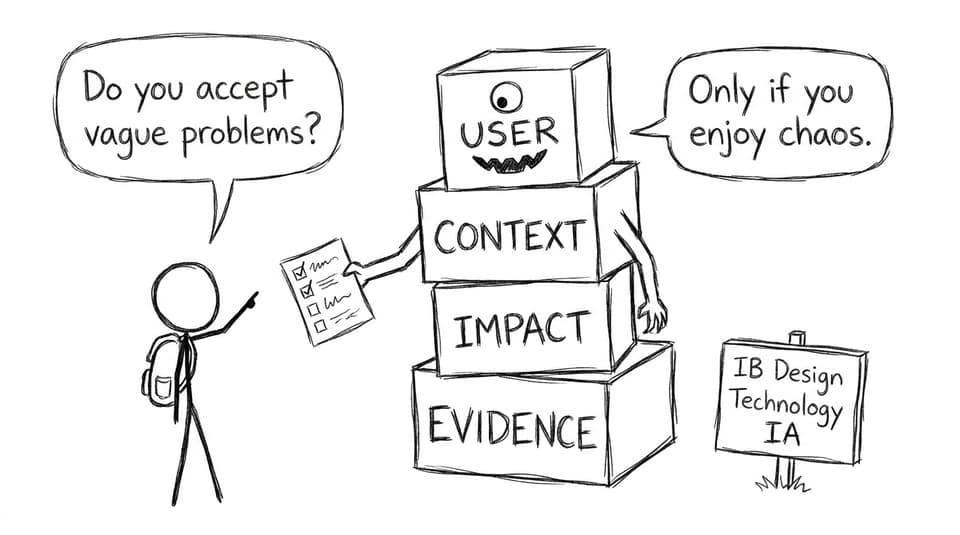
Comic about the rubric monster and vague problems
Common mistakes to avoid
Writing a problem so broad it could fit any user
Describing your inconvenience instead of the user’s need
Using solution verbs: “design,” “build,” “create,” “make”
Claiming impact without a real setting (no where/when)
No evidence at all (or evidence that isn’t linked to the problem)
Closing: write the problem so the solution can earn its marks
A strong problem statement in IB Design Technology is calm, specific, evidence-based, and stubbornly focused on the user. It doesn’t try to impress. It tries to be true.
If you want a faster path from “draft” to “examiner-ready,” build your workflow around RevisionDojo: use the Study Notes to anchor concepts, the Flashcards to lock in definitions, the Questionbank and Mock Exams to practise application, AI Chat to clarify gaps, the Grading tools to self-check against rubrics, and the Coursework Library plus Tutors when you need examples and feedback. Then come back to your IB Design Technology problem statement and sharpen it one more time--because the rest of your IA will follow where it leads.