
In the first minute of an IB English exam, you make a quiet promise.
Not to your teacher. Not to the rubric. To the examiner, a tired, intelligent reader who wants one thing: a clear argument they can follow.
That promise is your thesis statement. It’s the sentence that decides whether your essay feels like a guided tour (confident, deliberate, persuasive) or like someone searching for a light switch in a dark room.
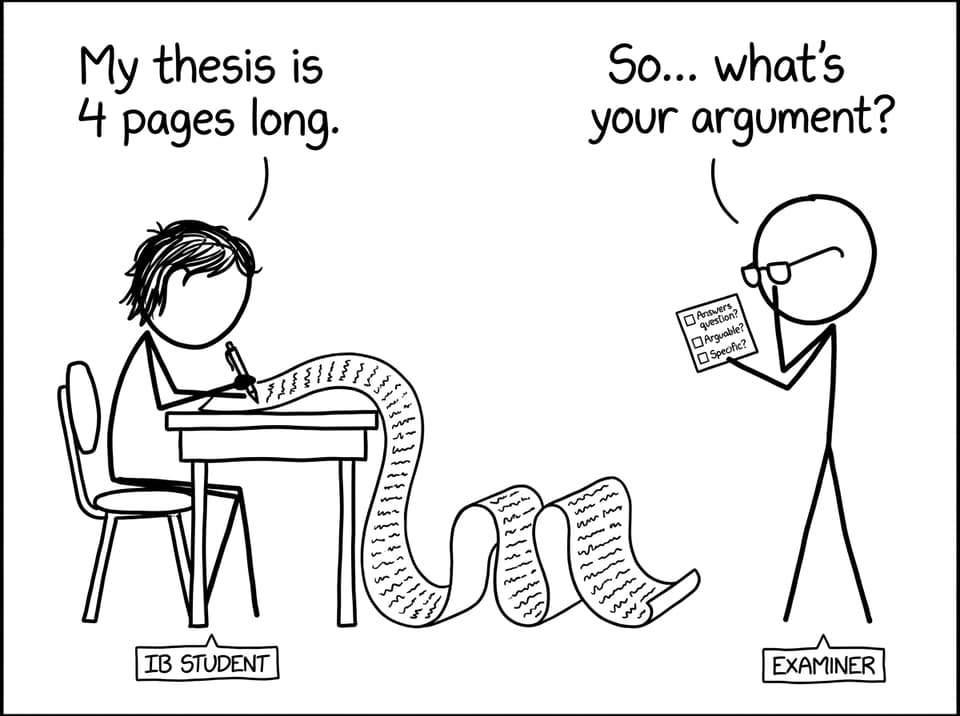
A quick checklist for a strong IB English thesis
Before you draft body paragraphs, run your thesis through this fast filter:
-
It answers the question using the prompt’s key words.
-
It makes an arguable claim, not a theme announcement.
-
It names how meaning is made (technique, structure, choices).
-
It stays specific and narrow enough to prove in 3-4 paragraphs.
-
It creates a roadmap (your paragraphs can clearly link back).
If you want a step-by-step framework for building your whole essay around that promise, pair this with Writing Effective Introductions and Conclusions in IB English Essays.
What makes a good thesis statement in IB English?
A good thesis statement in IB English is an interpretation turned into an argument.
That sounds abstract, but it’s practical: your thesis should tell the examiner (1) what you think the text is doing, (2) how it does it, and (3) why it matters.
It directly answers the prompt (no detours)
Students often write what they wish the question asked. Examiners reward what the question actually asks.
If the prompt says “How does the writer create suspense?” then your thesis must include suspense, and it must commit to a method.
Weak: “The writer uses many techniques to engage the reader.”
Stronger: “The writer builds suspense by delaying key information through fragmented syntax and strategic shifts in perspective, forcing the reader to mirror the narrator’s uncertainty.”
That stronger version is already doing IB English work: it’s focused, it’s technique-first, and it’s measurable.
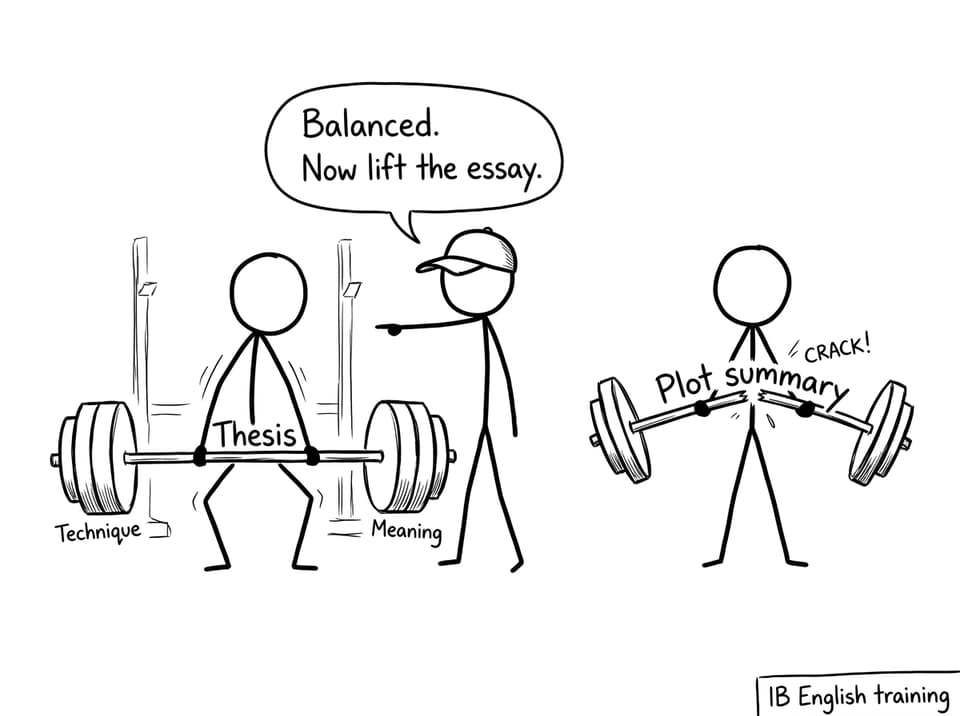
It argues, not summarizes
Summary is safe. Argument is risky. IB English rewards the risk.
A thesis that lists what happens in the text (or repeats the theme like “power is shown”) gives you nowhere to go. But a thesis that claims how power is constructed and what that construction reveals gives you a path.
A useful trick: if someone could reply, “I disagree,” and you could defend your claim with evidence, you’re writing a thesis, not a summary.
It previews the essay’s direction without becoming a shopping list
In IB English, your thesis is not meant to cram in every paragraph point. It’s meant to set your angle.
You can signal direction in three common ways:
-
Technique-led: language, structure, tone, imagery, symbolism
-
Effect-led: what the reader is pushed to feel, question, or realize
-
Concept-led: identity, power, memory, belonging, conflict (but always with method)
For planning your body paragraphs so they actually prove the thesis, see Structuring Your Points.
It is precise enough to be proven under time pressure
A beautiful thesis that can’t be proven in exam time is just decoration.
Aim for one or two sentences. Keep it tight. Make every word earn its place.
If you’re prepping for timed writing, the pacing breakdown in Being Smart With Exam Time helps you protect those first minutes where thesis clarity is born.
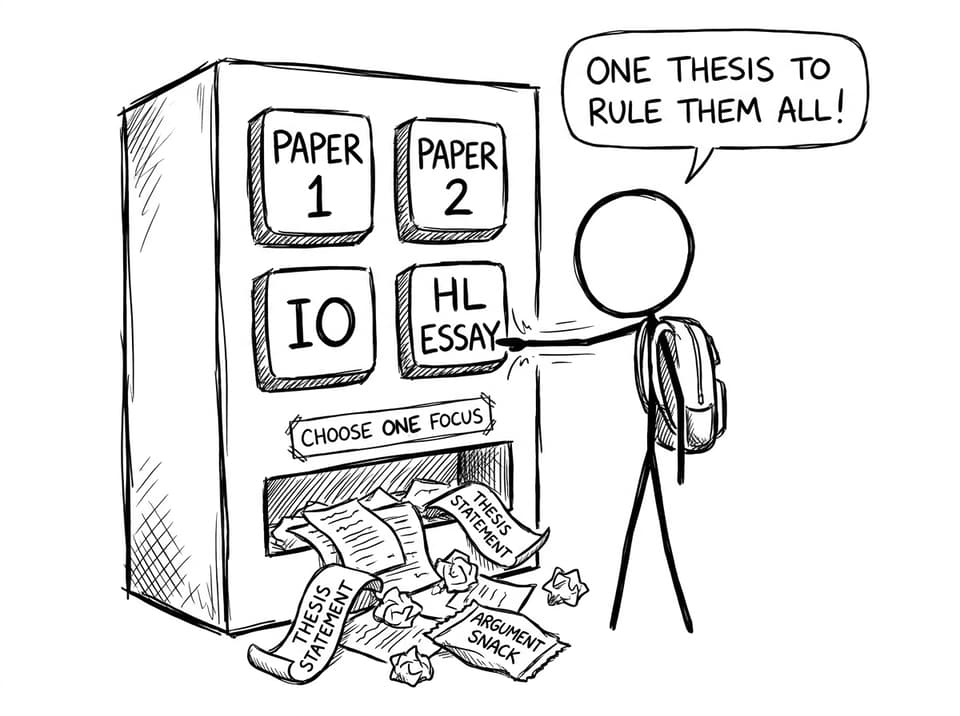
How the thesis changes across IB English assessments
Your thesis stays the “promise,” but the shape of that promise changes slightly depending on the task.
Paper 1: unseen analysis
For IB English Paper 1, your thesis should connect purpose + choices + effect.
A strong Paper 1 thesis usually mentions:
-
the writer’s purpose
-
2-3 key choices (tone, structure, diction, imagery, etc.)
-
the impact on the reader
To practise this in the exact exam style, use Mastering IB English Paper 1: 7 Expert Strategies and Writing a Commentary for IB English A.
Paper 2: comparative essay
In IB English Paper 2, the thesis must make a comparison (not just mention both texts).
A reliable template is:
“While Text A ____, Text B ____, revealing ____ about ____.”
If you want a clean structure that keeps comparison consistent, read Structuring Your IB English Paper 2 Essay and How to Approach Comparative Essays in IB English Paper 2.
Individual Oral (IO)
For the IO, your thesis is a spoken anchor: it should name the global issue precisely and show how both texts illuminate it.
If you struggle to make your global issue specific (not just “identity” or “power”), this guide helps: Understanding the Fields of Inquiry in IB English A.
HL Essay
The HL Essay thesis needs the same clarity, just more stamina. It must be arguable, text-driven, and narrow enough to develop over 1,200-1,500 words.
For thesis-building specifically, use Crafting a Strong HL Essay Thesis and the workflow in How to Prepare for the IB English HL Essay.
Common thesis mistakes (and quick fixes)
Even strong students lose marks in IB English because the thesis quietly fails.
-
Vague theme claim: “The text explores identity.”
Fix: Add method + interpretation: “Through shifting narration and recurring mirrors, the text frames identity as performative rather than stable.” -
Technique list with no meaning: “Uses imagery, tone, and diction.”
Fix: Tie choices to an effect: “The harsh sensory imagery and clipped tone make empathy feel withheld, reinforcing the text’s moral discomfort.” -
Paper 2 with two separate mini-theses
Fix: Force comparison into one sentence using “while/however/similarly.”
A final thought (and a practical next step)
A good thesis statement in IB English isn’t a fancy sentence. It’s a decision.
It’s you choosing one clear interpretation and building an essay that keeps its promise under pressure.
When you practise that decision consistently, your writing gets calmer and your analysis gets sharper. That’s also where RevisionDojo helps most: you can drill thesis-writing with the Questionbank, tighten your phrasing with Study Notes and Flashcards, test arguments with AI Chat, and polish drafts using Grading tools, Mock Exams, Predicted Papers, and Tutors when you want targeted feedback.
If you rewrite one thesis tonight using the checklist above, your next IB English essay will already feel more controlled.