


In the moment you see a 2, your brain does something unhelpful: it turns a number into a story about you.
A 2 in IB Math can feel like proof that you’re “not a math person,” that you’ve fallen too far behind, or that the exam will be a disaster no matter what you do. But the IB doesn’t grade personalities. It grades evidence: methods, steps, and decisions under time.
A 2 is painful because it’s honest. It usually means your current approach isn’t producing enough marks consistently. And that’s also the good news: approaches can change.
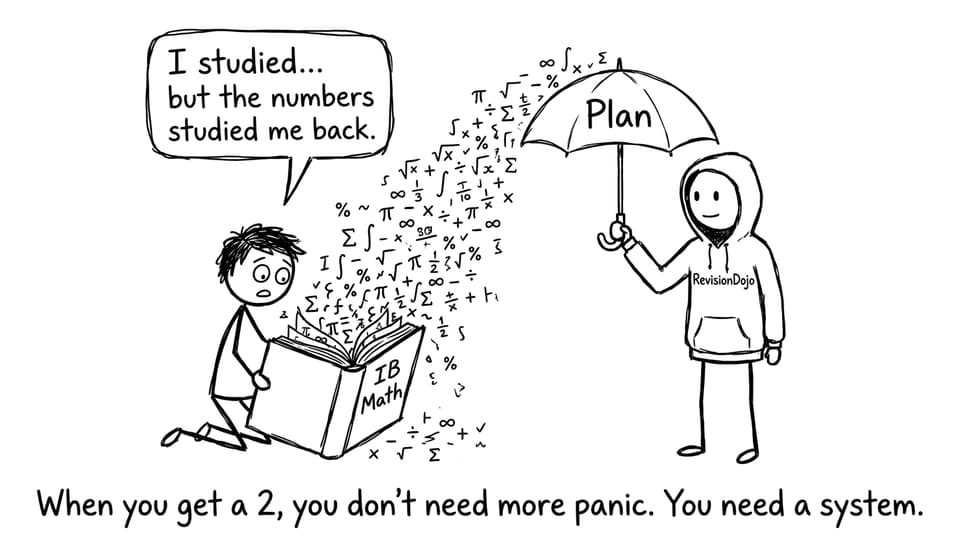
Quick checklist if you got a 2 in IB Math
Use this as your calm reset (30 minutes, no spiraling):
-
Compare your recent scores to typical grade boundary ranges your teacher uses (boundaries vary by session, but your percentage trend matters).
-
Split mistakes into two buckets: concept gaps (didn’t know) vs exam technique (knew, but lost marks).
-
Prioritize core topics that appear everywhere: algebra manipulation, functions, trig basics, and interpretation.
-
Decide your practice engine: daily targeted sets from a Questionbank, plus weekly timed paper sections.
-
Stabilize your coursework: your Math exploration (IA) should not be an afterthought.
If you need a structured place to start, the IB Math hubs on RevisionDojo make the syllabus feel like a map instead of a fog: IB Math AA resources and IB Math AI resources.
What a 2 in IB Math actually means
A 2 in IB Math generally signals very limited evidence of understanding across the course and/or very inconsistent performance on exam-style questions.
In practice, students at a 2 often have one (or more) of these patterns:
-
They can do homework when it’s guided, but freeze when questions look unfamiliar.
-
They get stuck early, so they don’t reach the later parts where method marks live.
-
They rely on a calculator (or avoid it) in ways that don’t match the paper.
-
They don’t show working clearly, so they lose method marks even when the final answer is close.
It can also put your diploma goals under pressure, especially if math is an HL or a prerequisite for future plans. But the number is not a verdict. It’s a diagnostic.
Why students end up with a 2 in IB Math
Most 2s come from predictable causes, not “low ability.”
Weak foundations compound
IB Math is built like a tower. If algebra and functions are shaky, everything above them wobbles: calculus steps, trig identities, modeling, probability, even interpretation.
Revision starts to work when you stop treating weaknesses as “chapters” and start treating them as skills. That’s why targeted practice matters more than random practice. A good starting point is RevisionDojo’s guide: IB Math targeted revision using the Questionbank.
Timing and exam decisions break down
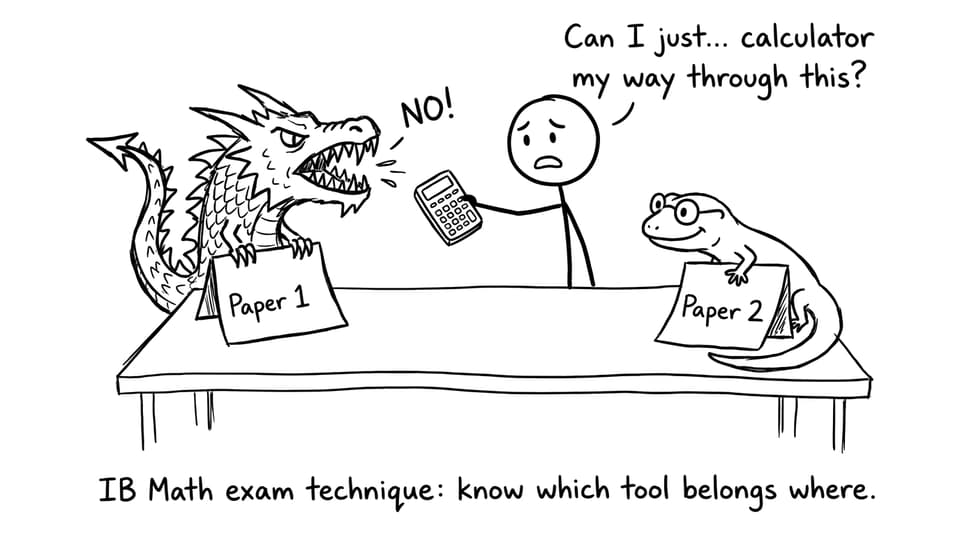
A 2 often hides a brutal truth: you might be able to answer questions, but not at exam speed. Or you spend too long trying to perfect early parts and never attempt later marks.
This is where timed practice and marking discipline help. RevisionDojo’s IB Math mock exam preparation guide is useful because it treats mocks as feedback loops, not one-off events.
The IA (exploration) gets neglected
In many schools, the exploration is where students either quietly recover marks or quietly lose them.
If you’re sitting at a 2 in IB Math, you can’t afford to let coursework drift. Use RevisionDojo’s Coursework Library to reduce uncertainty, and ask a tutor to sanity-check your direction before you spend hours polishing the wrong thing.
How to go from a 2 to a passing grade in IB Math
The goal isn’t to “learn everything.” The goal is to build reliable marks.
Rebuild the core: learn, then prove
Pick one high-frequency skill at a time. Examples:
-
rearranging equations cleanly
-
solving quadratics accurately
-
function features (domain, range, transformations)
-
trig basics (exact values, solving simple equations)
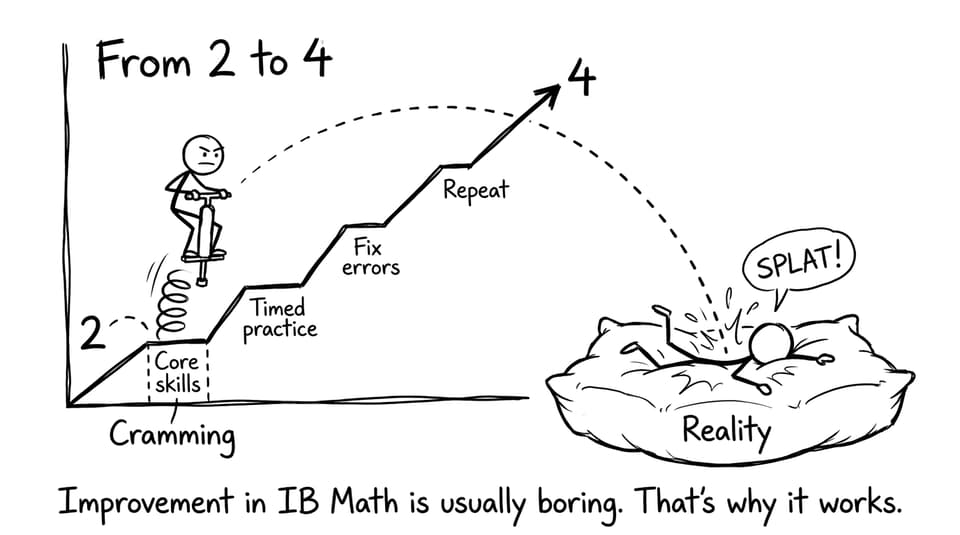
Then do the loop: Study Notes -> Questionbank -> mark -> fix -> repeat.
RevisionDojo is designed around that loop: Study Notes to relearn quickly, Flashcards to keep formulas alive, and the Questionbank to force exam-style proof. For topic practice, you can jump straight into a focused set like the Math AA Calculus Questionbank (even if calculus isn’t your weakest area, it shows how targeted the sets can be).
Train paper skills, not just topics
A student can “know statistics” and still lose marks by misreading command terms or skipping method steps.
Add one paper-skill goal per session:
-
show every algebra step that earns method marks
-
write final answers with correct rounding and units
-
label graphs and define variables in context
-
check reasonableness (does your answer make sense?)
If you’re unsure how to structure your overall routine, borrow a system: The Ultimate IB Math Study Routine for Busy Students.
Use AI support without outsourcing thinking
When you’re stuck, you don’t need an hour of confusion. You need a five-minute unblock.
RevisionDojo’s AI Chat helps you identify the exact step where you derailed, and its Grading tools make markscheme logic clearer. That combination is powerful when you’re trying to climb from a 2 in IB Math, because you’re often losing marks for fixable reasons.
Closing: a 2 is a signal, not a ceiling
Getting a 2 in IB Math is not a character judgement. It’s a signal that your current system isn’t producing enough exam evidence yet. Build a calmer system: relearn one core skill, drill it with the Questionbank, lock it in with Flashcards, and pressure-test it with Mock Exams and Predicted Papers.
Start where your course lives, and keep it simple: IB Math AA resources or IB Math AI resources. If you want the fastest route out of a 2, RevisionDojo gives you the full toolkit in one place: Study Notes, Questionbank, AI Chat, Grading tools, Predicted Papers, Mock Exams, Coursework Library, and Tutors that help you turn confusion into points.