
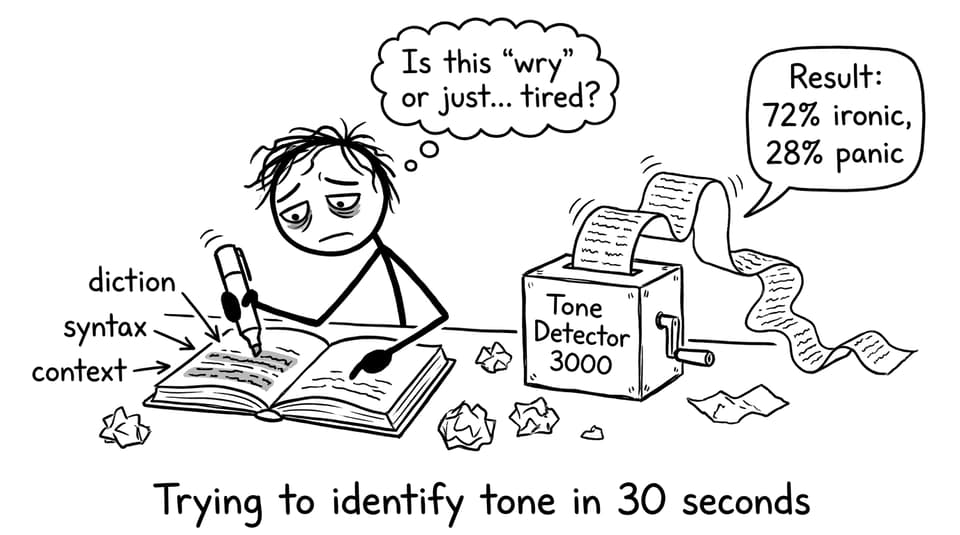
Tone is one of those things you think you understand until you sit down in a timed exam and your brain goes blank. You read a line, you feel something, such as sharpness, warmth, or distance, but you cannot name it quickly enough to use it.
In IB English, that naming matters. Tone is often the bridge between “I noticed a technique” and “I can explain meaning and purpose.” The good news is tone is learnable, and once you train your eye for it, it becomes one of the fastest ways to sound perceptive in Paper 1, Paper 2, and the Individual Oral.
What is tone in literature? (IB English definition)
In literature, tone is the writer’s or narrator’s attitude toward the subject, characters, or audience. It is the “voice behind the words,” the emotional stance that shapes how the text lands.
In IB English, tone is not an extra decoration. It is evidence of authorial choice. When you identify tone accurately, you are usually already halfway to discussing purpose, audience effect, and context.
A quick example:
-
Cynical: “Naturally, the committee took swift action, right after lunch, and next month.”
-
Reverent: “The cathedral rose in the pale light, more promise than stone.”
The events are simple. The attitude is not. That attitude is tone.
If you want a broader tone-and-mood walkthrough, pair this guide with How to Interpret Tone and Mood in IB English Texts.
A fast tone checklist for IB English analysis
Use this before you write any paragraph in IB English:
-
Name the tone with 1-2 precise adjectives (avoid “good,” “sad,” “serious”).
-
Underline 3 tone signals (diction, syntax, imagery, punctuation, sound, structure).
-
Track any shift (does the tone harden, soften, turn ironic, become intimate?).
-
Link tone to purpose (why choose this attitude for this audience?).
-
Turn it into a sentence using: technique -> evidence -> effect -> meaning.
For timed practice structures, keep Step-by-Step Guide to Revising IB English Paper 1 open as your weekly routine.
How to identify tone in IB English texts
Tone is created by patterns. Train yourself to look for clusters, not single devices.
Diction (word choice) is usually the loudest signal
Words carry connotations. A writer can describe the same scene as “orderly,” “sterile,” or “disciplined,” and each choice plants a different attitude.
In IB English, the best tone adjectives often come from noticing register:
-
Elevated or ceremonial diction often supports reverent, solemn, admiring tones.
-
Slang or conversational diction can suggest intimate, playful, blunt, or confessional tones.
-
Clinical vocabulary can signal detached, analytical, or dehumanizing tones.
Syntax and punctuation control emotional temperature
Short sentences can feel clipped, urgent, confrontational, or decisive. Long sentences can feel reflective, dreamy, overwhelmed, or deliberately controlled.
Watch for:
-
Fragments (impatience, tension, intensity)
-
Lists (build-up, overwhelm, persuasive momentum)
-
Rhetorical questions (challenge, disbelief, urgency)
If you want a methodical approach to this in unseens, use How to Analyze Language and Style in Unseen Texts (Paper 1).
Context and perspective decide what “attitude” even means
Ask: who is speaking, to whom, and under what pressure? A sarcastic tone toward authority, for instance, becomes sharper when you situate it in social inequality or political control.
This is why tone is gold for IB English: it naturally pushes you into interpretation, not summary.
Tone vs mood (the distinction examiners notice)
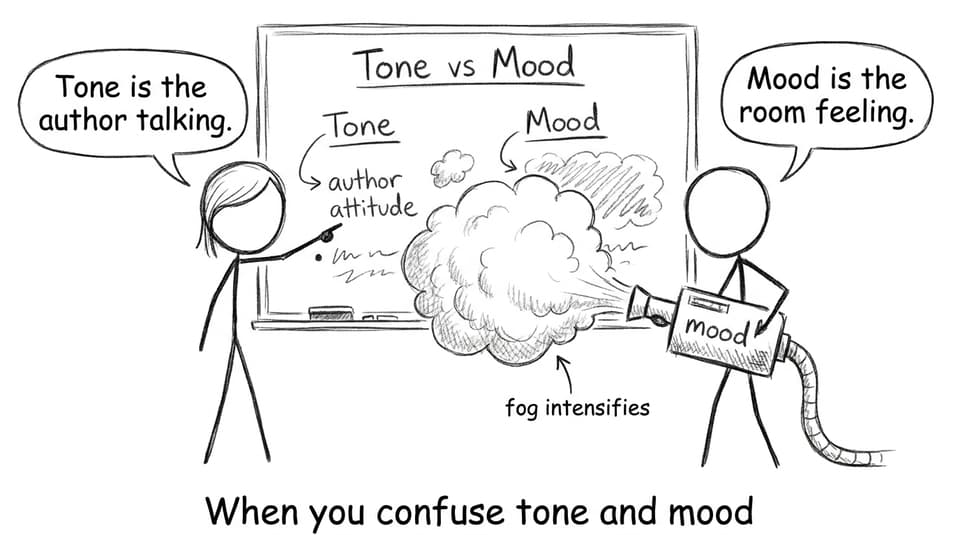
Tone and mood are linked, but not interchangeable.
-
Tone = the author/narrator’s attitude.
-
Mood = the atmosphere the reader feels.
You can have a reflective tone that creates a haunting mood. Or a playful tone that creates an uneasy mood (especially when the subject is serious).
To sharpen this distinction further in IB English, read IB English: How Tone and Mood Shape Your Analysis.
Turning tone into exam-ready paragraphs (IB English)
The biggest trap is writing: “The tone is sad.” Then moving on.
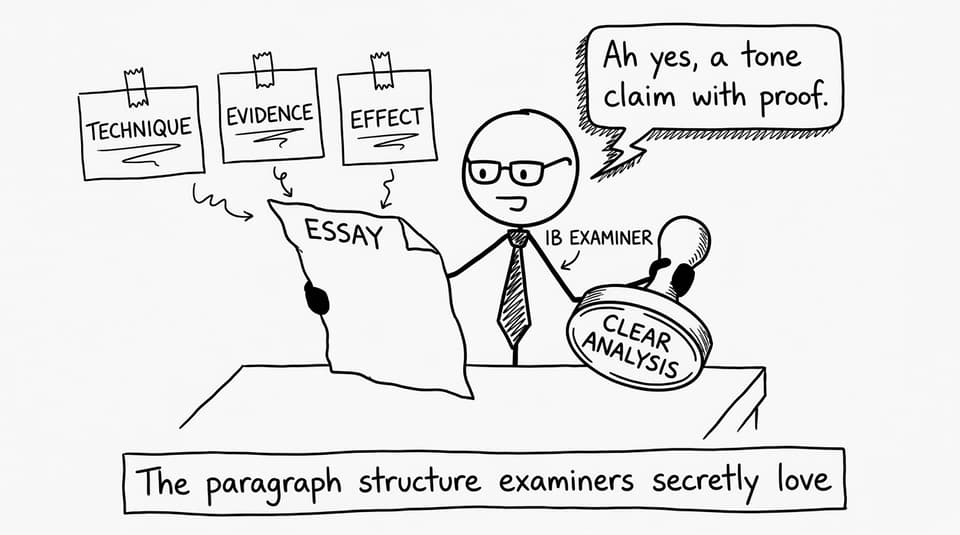
A stronger IB English paragraph does four things:
-
Claim: name the tone precisely.
-
Evidence: quote or reference language choices.
-
Effect: explain how those choices shape reader response.
-
Purpose: connect to authorial intent, theme, or context.
A model sentence frame:
Through a controlled yet scornful tone, created by dismissive diction and clipped syntax, the writer positions the audience to distrust the institution’s promises, reinforcing the text’s wider critique of authority.
For complete Paper 1 planning and structure, use Mastering IB English Paper 1: A Complete Guide and the IB English A Lang & Lit Resources hub.
Tone beyond novels: speeches, ads, and media in IB English
In Language and Literature, tone is just as important in non-literary texts:
-
A charity campaign may adopt an urgent, morally insistent tone.
-
A political speech may sound warm and inclusive while still being strategically evasive.
-
A magazine profile may use a lightly ironic tone to signal sophistication.
To practise voices in spoken language and power dynamics, pair this with How to Analyze Speech and Dialogue in Texts.
And if you are building close reading habits, Close Reading Techniques for Prose and Poetry helps you spot tone shifts faster.
Closing: make tone your shortcut to top-band IB English analysis
Tone is not a fancy add-on. In IB English, tone is the quickest path from “spotting techniques” to “explaining meaning.” When you can name attitude, prove it with patterns, and connect it to purpose, your analysis starts to sound like it belongs in the top markbands.
If you want to turn this into a habit, RevisionDojo is built for repetition under pressure: practise tone-focused prompts in the Questionbank, lock in tone vocabulary with Flashcards, review examiner-ready Study Notes, and refine drafts with AI Chat and Grading tools. When exam season tightens, you can simulate full conditions using Mock Exams, then sharpen timing with Predicted Papers (without guesswork), and strengthen coursework links through the Coursework Library and Tutors.
Tone is a skill. Build it once, and it pays you back across every IB English assessment.