
If you have ever watched a government insist “this is our decision,” you have already met sovereignty in real life. In IB Global Politics, sovereignty is the quiet rule sitting behind almost every loud headline: who gets to decide, who gets to intervene, and what counts as legitimate authority.
In exam terms, sovereignty is the state’s authority to govern itself. It explains why states are treated as primary legal actors in the international system, why borders matter, and why international rules often depend on consent. And in IB Global Politics, it is rarely presented as a simple yes-or-no condition. It is a concept you define, apply, and then challenge.
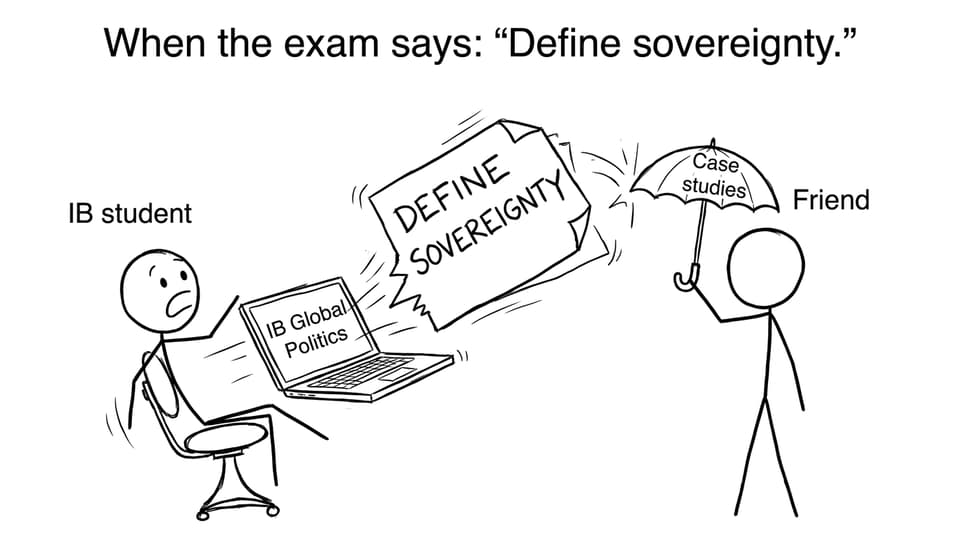
Sovereignty in IB Global Politics (fast checklist)
Use this quick scan before you write any IB Global Politics response on sovereignty:
-
Define sovereignty clearly in one sentence.
-
Split it into internal sovereignty and external sovereignty.
-
Add one short, relevant example or case study.
-
Show a challenge: globalization, intervention, or supranational rules.
-
Finish with a judgement: weakened, pooled, or transformed.
If you want a syllabus-aligned home base while revising, start with IB Global Politics Resources.
What sovereignty means (and why it is so exam-friendly)
A strong IB Global Politics definition has three parts: authority, territory, and non-interference. Sovereignty is the idea that a state has the right and capacity to make and enforce rules over a defined population and territory, without other states having a legal right to control those decisions.
It is “exam-friendly” because it links naturally to power, legitimacy, human rights, development, and security. The concept also gives you built-in evaluation: sovereignty can be asserted, negotiated, pooled, contested, or undermined.
To practise wording that matches IB command terms, the IB Global Politics Sovereignty topic hub is a useful reference point.
Internal sovereignty vs external sovereignty
In IB Global Politics, splitting sovereignty into two dimensions helps you avoid vague answers.
Internal sovereignty
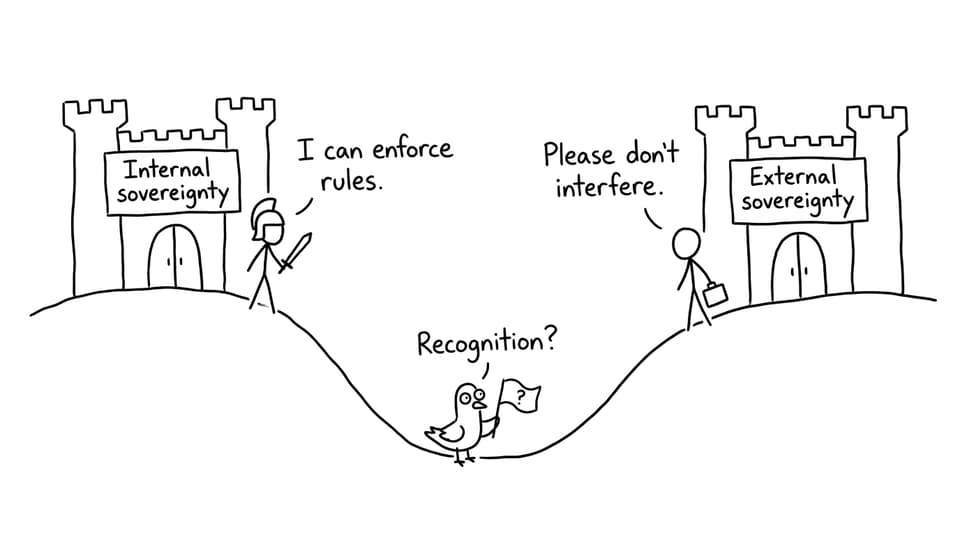
Internal sovereignty is about control inside the state: enforcing laws, maintaining order, delivering services, and keeping authority over competing groups. If the government cannot reliably apply rules across its territory, internal sovereignty is weakened, even if the flag and borders remain.
External sovereignty
External sovereignty is about independence from outside control. It includes diplomatic recognition and the principle that other states have no legal right to interfere in domestic affairs. This principle supports the idea of legal equality among states, even when power is wildly unequal.
For quick drills, use the Sovereignty Questionbank and write two-sentence distinctions under timed conditions. Then ask RevisionDojo’s AI Chat to critique clarity and precision.
Why sovereignty shapes global order (and why it is not absolute)
Sovereignty helps explain why international organizations often rely on consent rather than enforcement. Treaties, courts, and institutions work best when states voluntarily accept limits. That is why global governance can feel powerful on paper and fragile in practice.
But sovereignty is not absolute. In IB Global Politics, high-scoring responses show how states share or limit sovereignty to gain benefits: trade access, security guarantees, or coordinated rules. Supranational and intergovernmental cooperation can restrict freedom of action, but it can also increase influence.
To explore how sovereignty is pressured by real-world forces, see Challenges to state sovereignty.

How to use sovereignty in IB Global Politics exam answers
When students lose marks, it is usually because they describe sovereignty like a dictionary entry and stop there. Instead, treat sovereignty like a moving part inside an argument.
A practical method is: define it, split it, apply it, then evaluate it. Build one paragraph around internal sovereignty and another around external sovereignty, each with a mini-example. Then add a final evaluative line: under what conditions is sovereignty protected, negotiated, or overridden?
RevisionDojo makes this easier because the tools connect: read targeted IB Global Politics Revision Notes, lock in definitions with Sources of sovereignty flashcards, practise with the Questionbank, then use Grading tools to tighten your explanations.
For essay structure specifically, keep these open while you practise: IB Global Politics Paper 2 Guide and the Paper 2 essay structure guide.
Closing: Make sovereignty do work in your answers
Sovereignty is not just a definition to memorize. In IB Global Politics, it is a lens for judging power, legitimacy, and responsibility in a world where borders still matter and global problems ignore them.
If you want to turn this concept into marks, build a tight loop: revise with IB Global Politics Resources, drill the Sovereignty Questionbank, generate timed practice with Mock Exams and Predicted Papers, and use RevisionDojo’s AI Chat plus Grading tools to polish explanations until they sound effortless. That is how sovereignty stops being a chapter and starts becoming an advantage.
