


In IB Math, there’s a moment that feels unfair: you’re told to prove something is true for every positive integer, and you’re given only a few lines and a shaky pen. It’s like being asked to guarantee an infinite future using a single page of working.
Proof by induction exists for exactly that feeling. It’s the part of IB Math where marks come from structure and logic, not speed. And once you understand its rhythm, induction becomes one of the most reliable ways to pick up method marks under pressure.
What is proof by induction in IB Math?
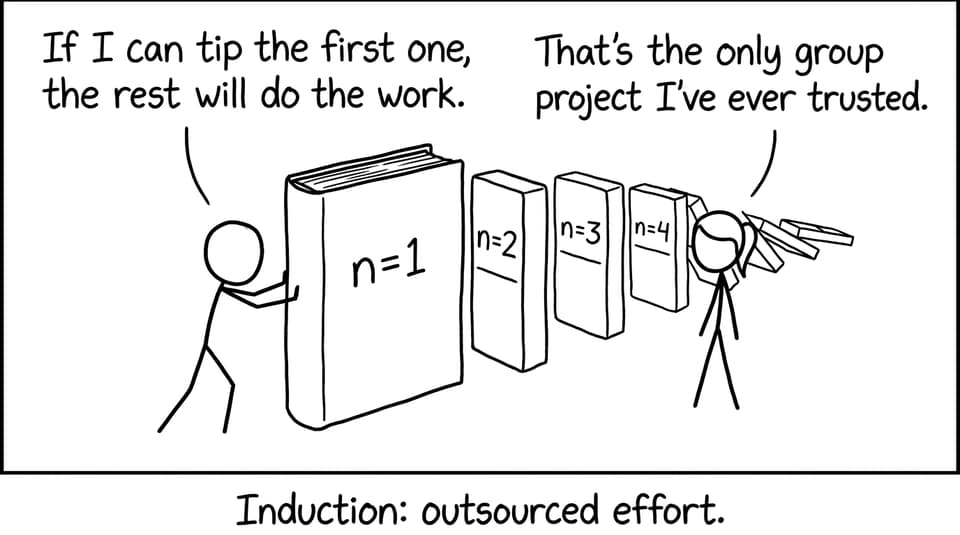
Proof by induction is a method used to show a statement is true for all positive integers (or all integers from some starting point). Instead of checking every value of (n), induction shows two things:
-
The statement works at the start.
-
If it works for one integer (n), then it must work for the next integer (n+1).
That “next-step” logic is why induction is so common in IB Math, especially in Algebra, sequences and series, divisibility, inequalities, and even proofs involving (n)th derivatives.
If you want the official syllabus home for this topic, start at AHL 1.15: Proof by induction, contradiction, counterexamples and keep it open as your map while you practise.
A quick induction checklist (the examiner-friendly version)
Before you write anything, run this fast checklist. It keeps your IB Math induction proof tight:
-
State clearly what you’re proving (write (P(n))).
-
Show the base case works.
-
Write the induction hypothesis (assume (P(k)) is true).
-
Use that assumption to prove (P(k+1)).
-
End with a conclusion: “Therefore, (P(n)) is true for all (n\ge 1)” (or your correct domain).
To practise exactly this structure with examiner-aligned prompts, use the AHL 1.15 Questionbank.
The three core steps of proof by induction (with IB Math wording)
In IB Math, induction isn’t about being clever. It’s about being explicit.
Base case
You verify the statement at the starting integer, often (n=1). This is not optional. It’s the anchor.
Example style sentence:
- “For (n=1), LHS = … and RHS = …, so (P(1)) is true.”
Induction hypothesis
You assume the statement is true for some arbitrary integer (n=k). You don’t assume what you want to prove for (k+1). You assume only (P(k)).
Example style sentence:
- “Assume (P(k)) is true for some (k\in\mathbb{N}), i.e. …”
Inductive step
You prove the statement for (n=k+1) by using the induction hypothesis somewhere meaningful.
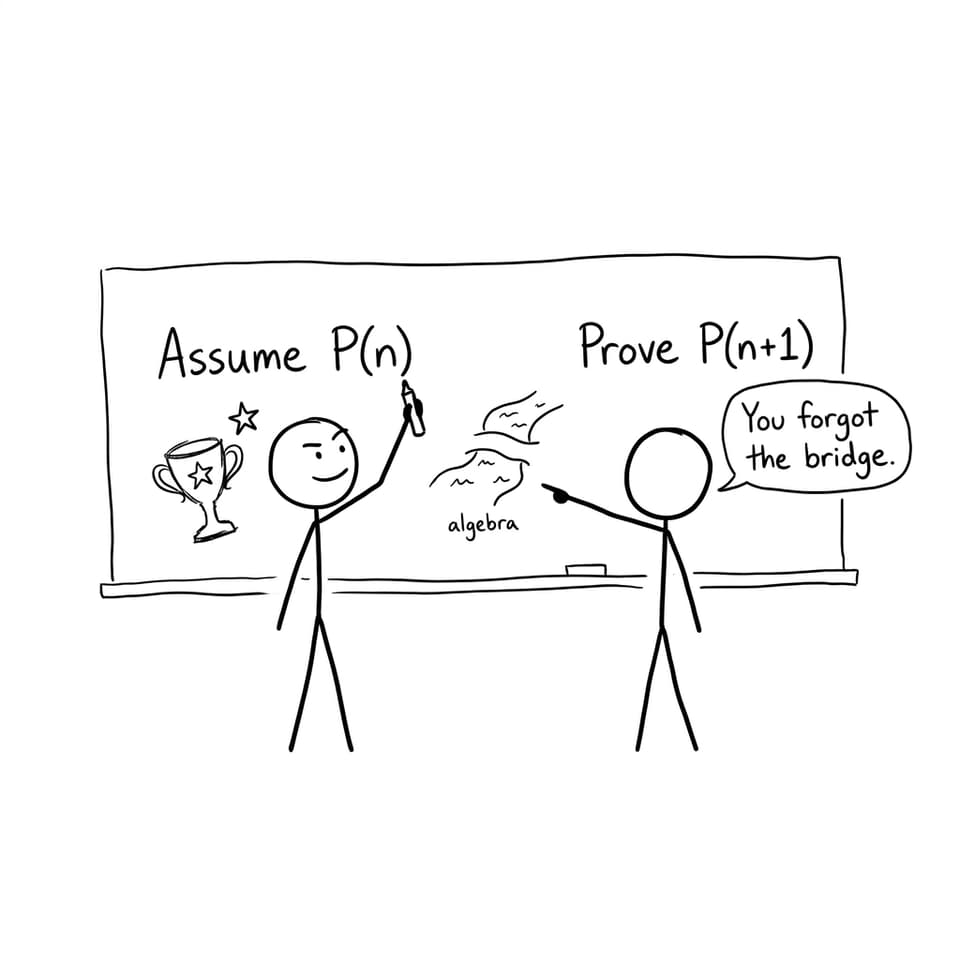
This is where IB Math marks are won or lost: the examiner wants to see the bridge from (k) to (k+1).
If you want more guidance on proof language in general (not just induction), How to Learn from Famous Mathematical Proofs (Proof Builder) is a great companion read.
Why induction shows up so often in IB Math exams
Induction questions are popular because they test multiple IB Math skills at once:
-
Logical structure (can you build an argument?)
-
Algebraic control (can you manipulate expressions without losing the plot?)
-
Mathematical communication (can the examiner follow your reasoning line-by-line?)
It also scales beautifully. An induction proof can be short and accessible, or it can become HL-style by adding complexity: divisibility, inequalities, series, or calculus patterns.
If your revision plan is “do more practice,” make it more precise: read a short note, watch a targeted explainer, then do 6-10 questions on exactly that sub-skill. RevisionDojo is built for that loop with Study Notes, Videos, Flashcards, and the Questionbank inside the IB Mathematics AA hub.
Common induction mistakes (and how to fix them)
Even strong IB Math students lose marks here because induction is strict.
Forgetting to use the induction hypothesis
If your (k+1) proof never uses the line “assume (P(k)),” your solution often becomes a separate direct proof attempt. The fix: literally substitute the assumed statement into your (k+1) working.
Doing algebra that changes the goal
Students sometimes simplify until they’ve proven a different statement. The fix: keep writing what you’re aiming for (e.g., “We need to show …”) and check you still match it.
Not concluding properly
IB Math markschemes like explicit endings. The fix: finish with “Therefore, by induction, … is true for all …”
For induction drills by type, these are gold:
How to practise induction efficiently with RevisionDojo
Induction improves fast when practice is deliberate.
-
Use Study Notes to copy the structure once, cleanly: AHL 1.15 Notes.
-
Use Flashcards to memorise the skeleton and key language: AHL 1.15 Flashcards.
-
Use the AI Chat when you don’t understand why a step is valid.
-
Use Grading tools to check if your proof is structurally complete, not just “ends correctly.”
-
Then repeat with the Questionbank until the pattern becomes automatic.
If you’re aiming for top marks across the course, pair this with a broader plan like How to Score 7 in IB Math AA HL.
Closing: make induction your “free marks” topic in IB Math
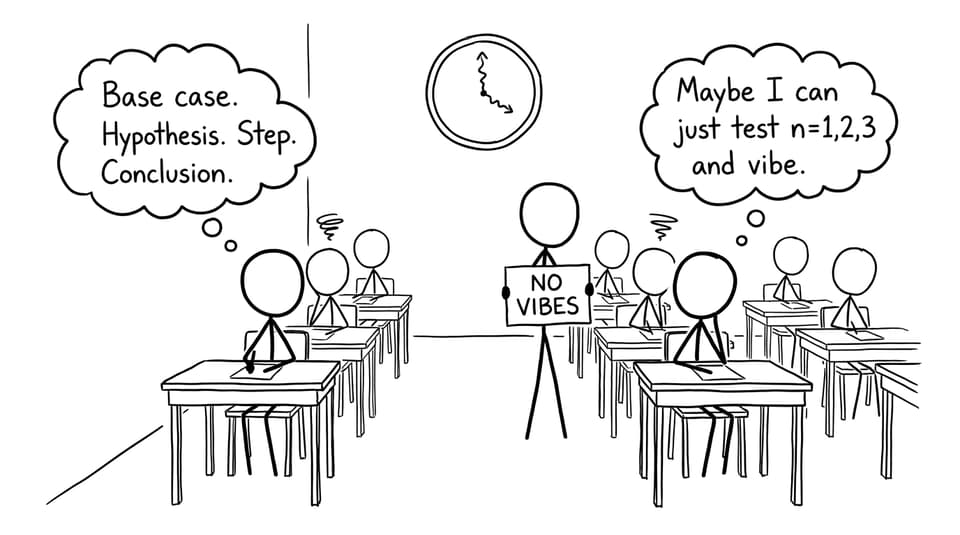
Induction can feel like a strange ritual the first time you meet it in IB Math. But the hidden advantage is that it rewards calm structure more than inspiration. Once you can write the base case, hypothesis, and inductive step cleanly, you’ve turned a scary proof into a repeatable routine.
When you’re ready to make that routine automatic, use RevisionDojo as your loop: Study Notes for the template, Flashcards for the language, Videos for the intuition, Questionbank for volume, Mock Exams and Predicted Papers for timing, and Tutors when you need a human to spot the one line you keep missing. That’s how IB Math proof by induction becomes less of a hurdle and more of a reliable scoring opportunity.