
Irony is one of those IB English terms that feels obvious until you have to explain it under exam pressure. You’re staring at an extract. Your pen is hovering. You know something doesn’t match the surface meaning, but the question is: can you prove it, name it, and link it to effect?
That’s the real point of irony in IB English. It isn’t a decoration. It’s a gap: between what’s said and what’s meant, between what’s expected and what happens, between what a character understands and what we understand. Writers live in that gap because it creates tension, humour, tragedy, and critique, often all at once.
What is irony in IB English?
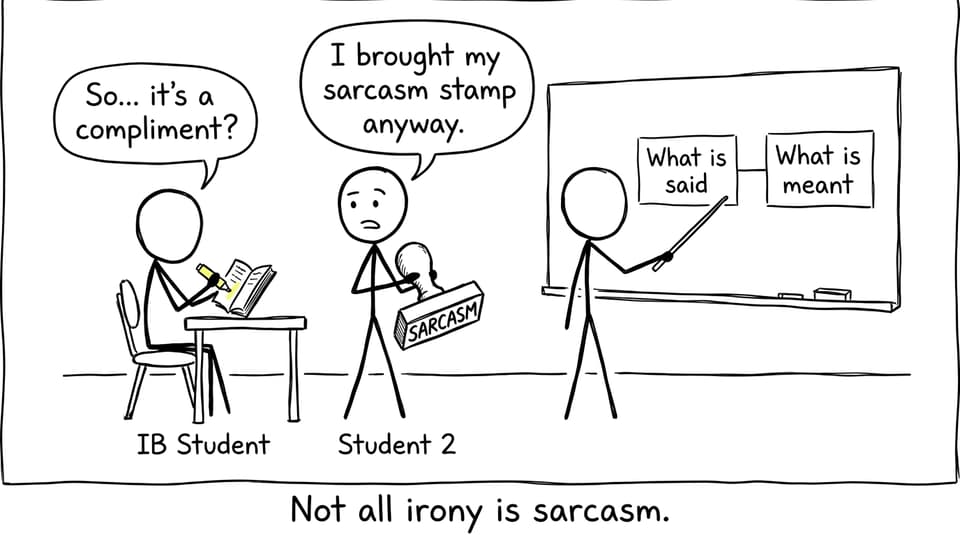
In IB English, irony is a literary device where the intended meaning contrasts with the literal meaning or the expected outcome. Put simply: the text sets up one thing, then quietly (or brutally) gives you another.
A useful working definition for exams is:
- Irony = contrast between appearance and reality (or expectation and result, or words and meaning).
Irony matters in IB English because it helps you analyse tone, authorial purpose, and the way a reader is positioned to judge a character, society, or idea. If you can explain irony with precision, you’re doing what examiners reward: moving from “spotting” to interpretation.
For a broader technique toolkit, pair this with Mastering Literary Devices in IB English Exams.
Irony quick checklist (for Paper 1, Paper 2, and the IO)
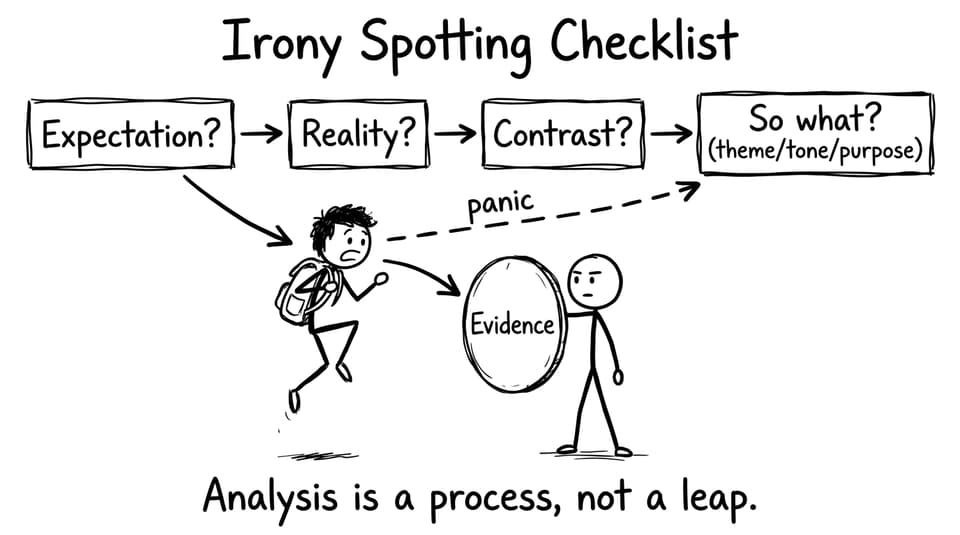
Use this mini routine whenever you suspect irony in IB English:
-
Identify the type of irony (verbal, situational, dramatic).
-
State the literal layer (what is said / what seems to be happening).
-
State the hidden layer (what is meant / what is really happening).
-
Explain the effect (tone, tension, humour, tragedy, critique).
-
Link to a bigger idea (theme, characterization, power, hypocrisy, values).
If you want a step-by-step method that fits this, keep Close Reading Techniques for Prose and Poetry nearby during practice.
Types of irony (with IB English-friendly examples)
Verbal irony
Verbal irony is when a speaker says one thing but means another. In IB English, this often appears in dialogue, narration, satire, and even understated description.
A classic example is Mr. Bennet in Pride and Prejudice, offering praise that is actually a quiet critique. The exam-friendly move is to show how the “compliment” creates distance: the character’s words signal politeness, but the meaning signals judgment.
Verbal irony can overlap with sarcasm, but they are not identical. Sarcasm is usually sharper and more openly mocking; verbal irony can be subtle, even gentle.
Situational irony
Situational irony happens when events turn out opposite to what we expect. In IB English, it’s especially useful for analysing plot outcomes as meaningful design, not just “what happened.”
In Romeo and Juliet, the lovers’ attempt to control their fate collapses due to miscommunication. That reversal doesn’t just shock; it underlines themes of haste, chance, and the fragility of human plans.
Situational irony is also central to political allegory and social critique. Orwell’s Animal Farm is a strong reference point: “freedom” becomes another form of tyranny, exposing the corruption of ideals.
Dramatic irony
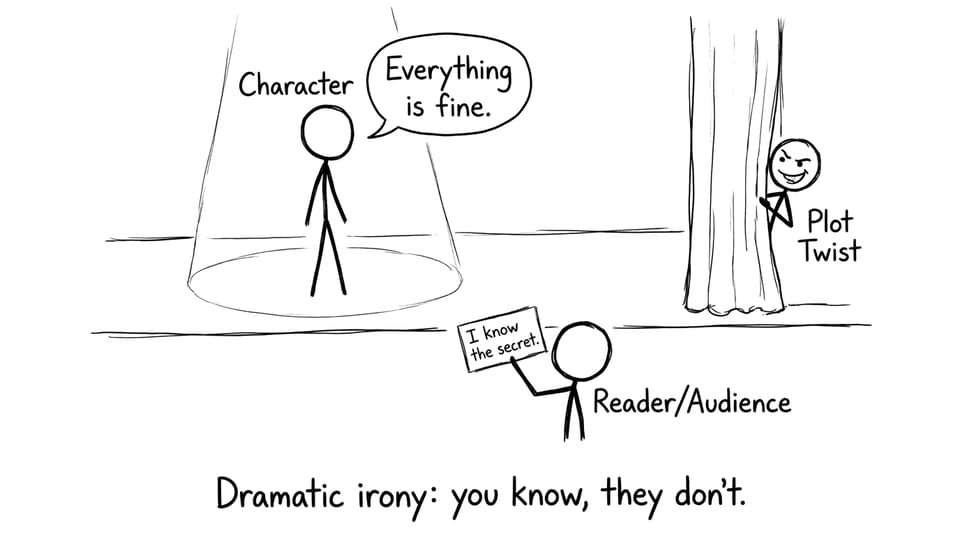
Dramatic irony is when the audience knows something a character does not. This is gold for IB English because it links directly to reader positioning and tension.
In Othello, we understand Iago’s manipulation long before Othello does. The tragedy becomes unbearable because we are forced to watch a character interpret reality using the wrong information.
How to analyse irony in IB English (a paragraph template)
A strong IB English analysis paragraph on irony usually follows this logic:
-
Name the irony clearly.
-
Prove it with a precise quotation or moment.
-
Explain the contrast (literal vs intended / expected vs actual).
-
Analyse the effect on tone and character.
-
Connect to authorial purpose or theme.
Example sentence frame you can adapt:
“Through dramatic irony, the writer allows the audience to recognise ___ while the character remains unaware, creating a tone of ___ that reinforces the text’s critique of ___.”
To practise this under timed conditions, RevisionDojo’s IB English A Lang & Lit Paper 1 Questionbank helps you drill technique-based analysis instead of memorising explanations.
Where irony earns marks in IB English assessments
Irony shows up across the course, but it earns the most when it’s tied to method and meaning:
-
Paper 1: Irony often sits inside tone shifts, juxtaposition, or unreliable voice. Use the same discipline you’d use in a commentary structure (see Writing a Commentary for IB English A: Step-by-Step Guide).
-
Paper 2: Irony becomes a comparative weapon: two authors can critique society through different kinds of irony (structure help: How to Approach Comparative Essays in IB English Paper 2).
-
Individual Oral (IO): Irony can connect directly to a global issue by revealing hypocrisy, power, or contradiction (start here: How to Approach the IB English Individual Oral (IO)).
On RevisionDojo, you can reinforce the same skill in multiple ways: Study Notes to lock in definitions, Flashcards to retain them, Questionbank to apply them, AI Chat to test interpretations, and Grading tools to see whether your explanation is actually top-band.
Final takeaway: treat irony as evidence, not decoration
The fastest way to improve in IB English is to stop treating irony as a label and start treating it as a relationship: between surface and truth, between expectation and result, between who knows and who doesn’t.
When you practise that relationship regularly, your Paper 1 commentary becomes sharper, your Paper 2 comparisons become more conceptual, and your IO becomes more controlled.
If you want to turn this into a repeatable routine, use RevisionDojo’s Study Notes, Flashcards, Questionbank, AI Chat, Mock Exams, Predicted Papers, Coursework Library, and Tutors to practise irony until it stops feeling like a trick and starts feeling like a tool, the kind that keeps paying you back across every IB English assessment.