
A lake can look calm and still be in trouble. One week it’s clear enough to see stones on the bottom; the next, it’s a green soup that smells like something went wrong in a science lab. That shift is exactly why IB Biology loves eutrophication: it’s a simple chain of events with big, testable consequences.
What is eutrophication in IB Biology terms?
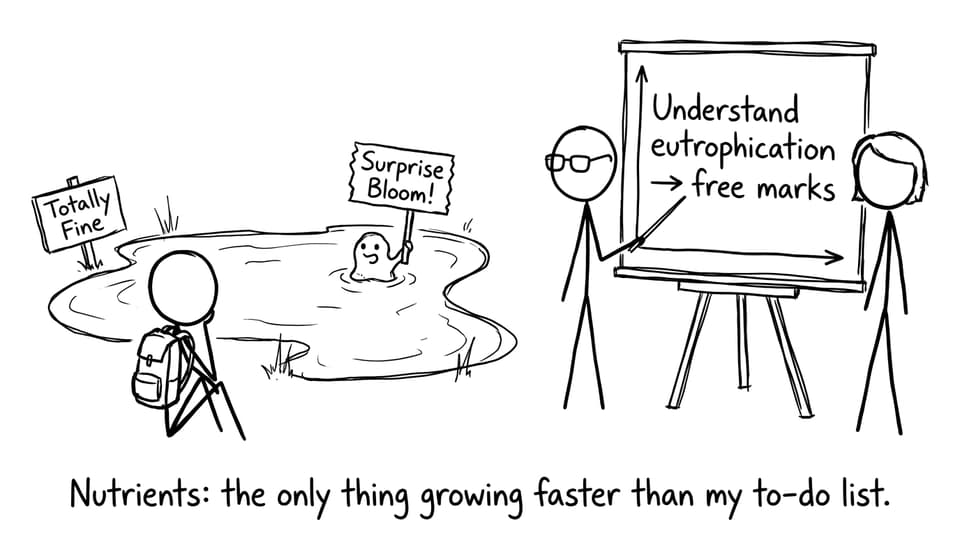
In IB Biology, eutrophication is when a water body becomes over-enriched with nutrients (mainly nitrates and phosphates), leading to rapid algal/plant growth, followed by oxygen depletion as that biomass decomposes. The key idea examiners reward is that eutrophication is primarily an oxygen-loss process, not just “too much algae.”
If you want a syllabus-aligned definition you can copy into short answers, keep it tight: nutrient enrichment -> algal bloom -> decomposition -> low dissolved oxygen -> fish/invertebrate decline.
For a deeper breakdown, use Eutrophication of aquatic and marine ecosystems notes alongside the IB Biology Key Definitions glossary.
Quick exam checklist (keep this in your head)
-
Define eutrophication in one sentence using IB Biology vocabulary (nutrients, bloom, decomposition, dissolved oxygen).
-
Name the nutrients: nitrates and phosphates.
-
Explain why oxygen drops: bacterial respiration increases BOD.
-
State at least two sources (fertiliser runoff, sewage).
-
Add one management strategy (buffer strips, better wastewater treatment).
The eutrophication process (the chain you must explain)
Eutrophication usually starts on land, not in the water. Rain carries soluble nutrients into rivers, lakes, or coastal areas.
Nutrient inputs: where nitrates and phosphates come from
Common human sources you can mention in IB Biology answers:
-
Agricultural fertilisers (runoff/leaching)
-
Sewage and animal waste
-
Some industrial discharges and nutrient-rich effluent
Bloom, shading, then the oxygen crash
Once nutrients arrive, algae (often including cyanobacteria) can reproduce quickly and form a bloom. That bloom reduces light penetration, so submerged plants photosynthesise less. When algae die, decomposers break them down.
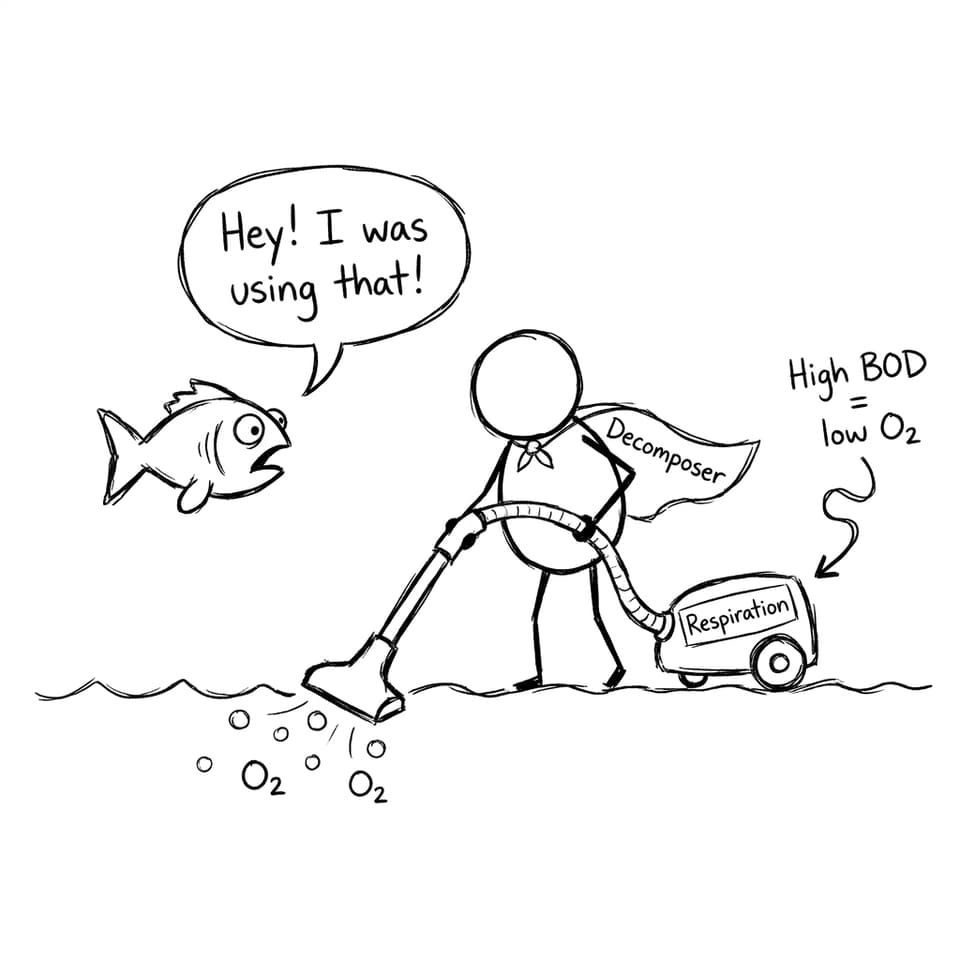
Here’s the scoring sentence: decomposition increases biochemical oxygen demand (BOD), so dissolved oxygen falls, creating hypoxia (or even anoxia). That’s when fish kills and “dead zones” appear.
To connect this to broader ecology revision, the IB Biology Ecology hub helps you link eutrophication to energy flow, community change, and stability.
Impacts you can write about (beyond “fish die”)
In IB Biology, stronger responses show multiple levels of impact:
-
Biodiversity loss: oxygen-sensitive species disappear first, food webs simplify.
-
Community shift: tolerant organisms dominate in low-oxygen water.
-
Water quality decline: turbidity increases, odor and aesthetics worsen.
-
Potential toxins: some blooms can be harmful; still, oxygen depletion is the core mechanism to emphasize.
If you’re also taking ESS, these links are useful for cross-subject phrasing: Notes for 4.4 Water pollution (ESS) and 4.4E Algal blooms and anoxic/hypoxic waters (HL) notes.
Managing eutrophication (what IB Biology expects you to propose)
Management is about reducing nutrient input and helping systems recover:
-
Use fertiliser more precisely (right amount, right timing)
-
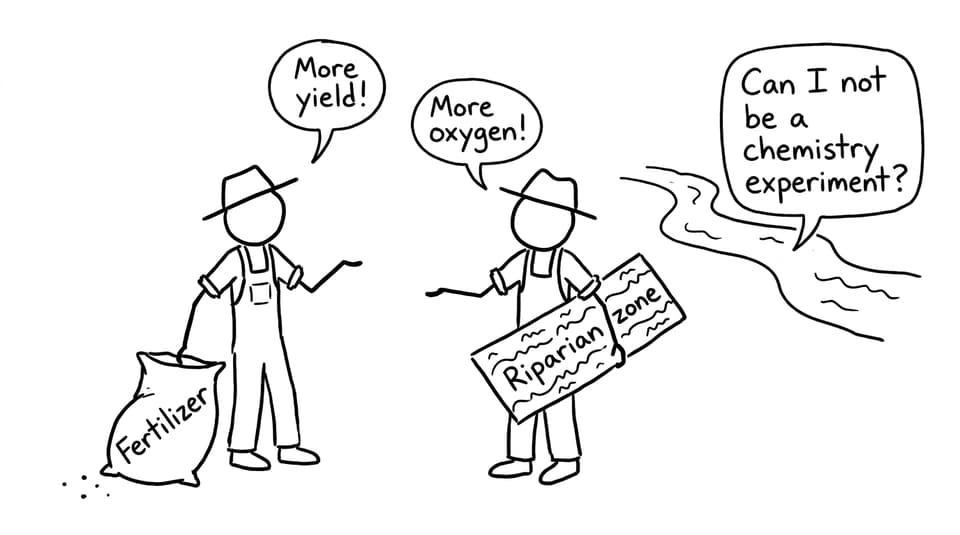
Create vegetated buffer zones and wetlands to trap nutrients
-
Improve wastewater treatment to remove nitrates/phosphates
-
In severe cases, consider aeration or nutrient removal plans
To practise how these ideas appear in marks schemes, use IB Biology Topic D4.2: Sustainability and Change and the matching D4.2 Questionbank. For wider ecology drilling, IB Biology Ecology Questionbank is a strong companion.
Final takeaway for IB Biology revision
Eutrophication is one of those IB Biology topics that rewards clarity: nutrients rise, algae bloom, decomposers respire, oxygen falls, ecosystems simplify. If you can write that chain cleanly, you’ve earned easy marks.
When you’re ready to turn understanding into exam performance, RevisionDojo is built for it: use the Study Notes for the mechanism, Flashcards for definitions, the Questionbank for timed practice, and AI Chat plus Grading tools to fix weak explanations. Add Mock Exams, Predicted Papers, and targeted Tutors if you want structure in the final stretch. That’s how IB Biology revision stops feeling like rereading and starts feeling like progress.