



If you’ve ever watched a perfectly usable product get tossed because one tiny part failed, you’ve already felt the problem IB Design Technology is trying to name.
Circular economy design sounds like a slogan until you picture the lifecycle of a real object: the materials mined, the energy used, the repairs never made, the bin it ends in. In IB Design Technology, circular economy design is your chance to show the examiner you can think beyond the prototype on your desk and into the system around it.
This matters because exams (and your design project) reward students who can evaluate impacts realistically, not just say “recyclable” and hope for marks.
IB Design Technology Resources is a good starting point if you want the full topic map and practice tools in one place.
Quick checklist: circular economy design you can use in exam answers
Use this as a mental template for any IB Design Technology sustainability question:
-
Define the circular economy as a closed-loop model (not “just recycling”).
-
Identify where waste happens across the product lifecycle.
-
Choose 2-3 circular strategies (durability, repair, reuse, disassembly, recycling).
-
Evaluate trade-offs (cost, safety, user behavior, aesthetics, manufacturing limits).
-
Link every claim to the scenario and user needs.
To revise the official syllabus language quickly, go straight to C2.2 Design for a Circular Economy Notes.
What circular economy design means in IB Design Technology
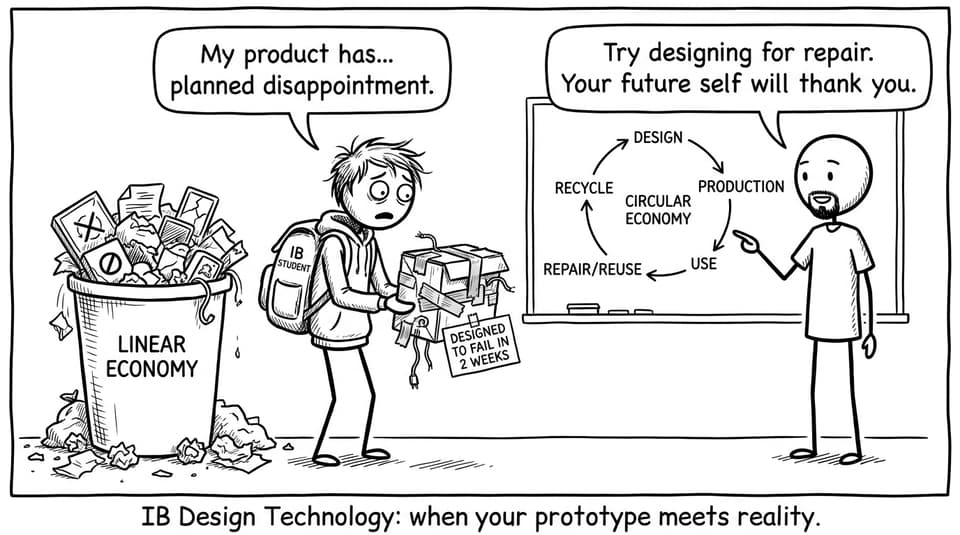
A circular economy aims to keep products, components, and materials in use for as long as possible, while reducing waste and avoiding unnecessary extraction of new resources. The opposite is the linear model: take, make, dispose.
In IB Design Technology, the key is application. You are not rewarded for repeating a definition alone. You are rewarded for showing how design decisions change:
-
Materials (what you choose and why)
-
Construction (how parts connect)
-
Use phase (how long it lasts and how it’s maintained)
-
End-of-life (what happens when it’s no longer wanted)
If you want clean comparison language for essays and evaluation questions, use Linear vs Circular Economy Notes.
Circular economy design strategies (and how to phrase them)
Circular thinking becomes exam-ready when you translate it into design moves. These are the strategies that appear again and again in IB Design Technology questions.
Design for durability (longevity)
Durability is the simplest circular strategy: a product that lasts longer needs fewer replacements. But you must justify it using context.
In IB Design Technology, strong evaluation sounds like:
-
“A more robust material increases lifespan in a high-wear environment, reducing replacement frequency.”
-
“However, increased mass may raise transport emissions, so the gain depends on expected use time.”
RevisionDojo’s C2.2.2 Designing for a Circular Economy Notes helps you collect the right vocabulary (longevity, upgradability, disassembly) without drowning in paragraphs.
Design for repair and maintenance (anti-waste by default)
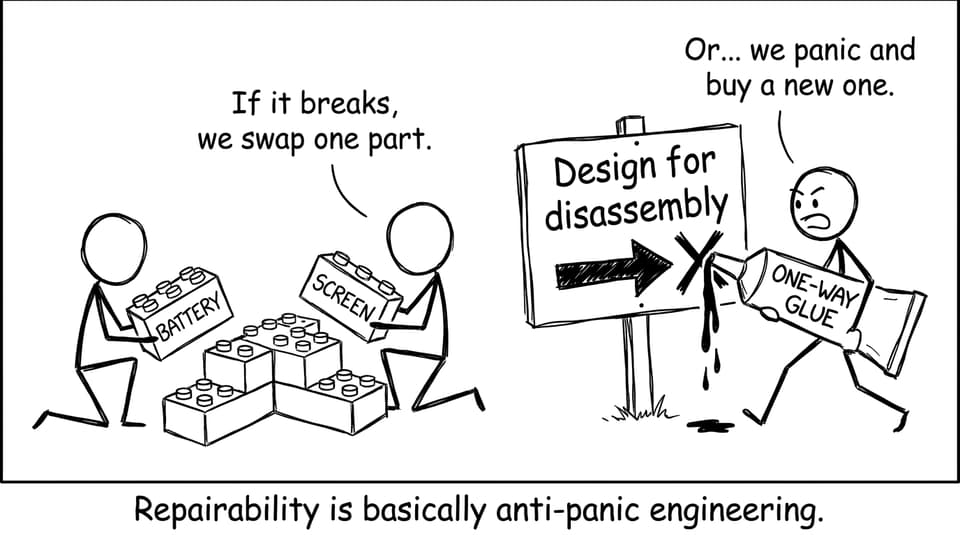
Repairability is circular economy design with a practical edge. It forces you to think about screws vs adhesives, modular parts, and access to components.
Try framing repair as a user-centered feature:
-
“A modular battery compartment allows replacement without discarding the full product.”
-
“Clear disassembly steps reduce time cost and increase the likelihood of repair.”
To drill this as exam technique, practice questions from Design for a Circular Economy Questionbank and review your explanations using markscheme-style feedback.
Design for reuse (extend function, not just lifespan)
Reuse is about keeping value in the system. Sometimes that’s a second life for the whole product. Sometimes it’s a new role for components.
In IB Design Technology, reuse earns marks when it is specific:
-
Multi-function products that reduce the need for separate purchases
-
Packaging intentionally designed for secondary use
-
Components sized and standardized so they can be repurposed
If your teacher warns you about “copying,” this is where nuance matters. Reuse can be ethical and high-scoring when you clearly document improvements and cite sources. See IB Design Technology: Can You Reuse Products or Ideas? for a safe, exam-friendly approach.
Design for recycling (realistic, not magical)
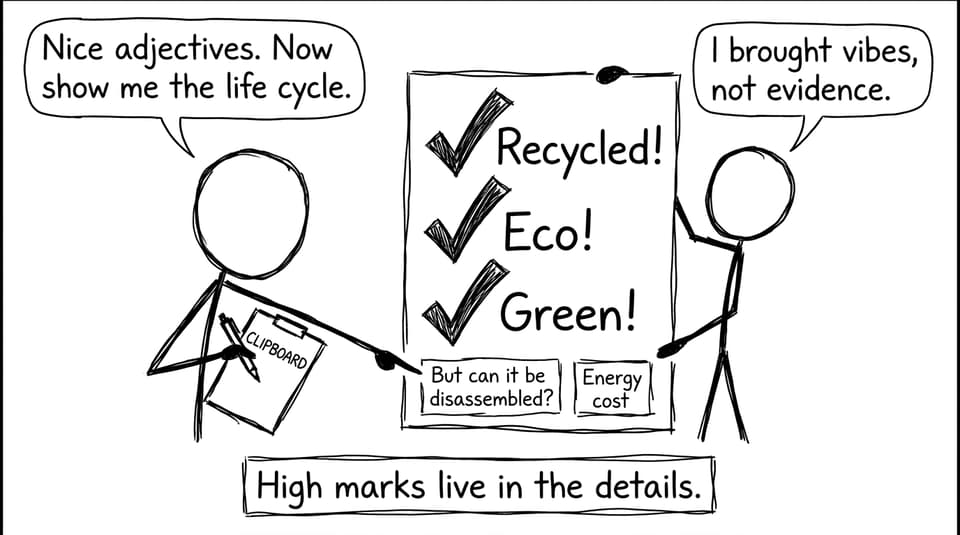
Recycling is part of circular economy design, but it’s not the whole story. And it has constraints: mixed materials, contamination, energy cost, sorting infrastructure.
High-quality IB Design Technology evaluation includes lines like:
-
“Material separation is simplified through standardized fasteners, improving recyclability.”
-
“However, recycling still requires energy input, so reducing material use may have higher overall impact.”
How circular economy design shows up in IB Design Technology exams
Most circular economy prompts are not asking, “Do you know the definition?” They’re asking you to evaluate a product in context.
A reliable structure:
-
State where in the lifecycle the biggest waste occurs.
-
Propose a circular economy design improvement.
-
Evaluate benefits and limitations.
-
Link back to user needs and feasibility.
To train that structure under time pressure, pair concept revision with practice loops: Study Notes for clarity, Flashcards for recall, then targeted questions. You can start from IB Design Technology Resources (new syllabus) if your cohort is on the updated course.
Using circular economy design in the design project (without tacking it on)
Examiners can tell when circular economy design is a late add-on. The stronger approach is to make it a thread that runs through decisions:
-
Early research: identify environmental issues in existing products.
-
Specification: include measurable sustainability constraints (repair time, part replacement, material choice).
-
Development: prototype modularity or disassembly, not just shape.
-
Testing: evaluate longevity and maintenance, not only aesthetics.
When you need examples of how students integrate evaluation and iteration, RevisionDojo’s Coursework Library and Tutors are the fastest way to turn a good idea into a documented, mark-ready project narrative.
Common mistakes IB students make with circular economy design
Students lose marks in IB Design Technology when they:
-
Treat “recycled” as a full argument.
-
List strategies without linking to user needs.
-
Ignore trade-offs (cost, safety, manufacturing complexity).
-
Propose unrealistic solutions (perfect recycling, infinite reuse, no downsides).
If you want a broader revision system that prevents this kind of fuzzy writing, use Best Study Strategies for IB Design Technology Students and build a definition-plus-application routine.
Conclusion: circular economy design is a scoring skill
Circular economy design in IB Design Technology is less about sounding ethical and more about thinking structurally: what happens before, during, and after a product’s use. When you can propose circular improvements and evaluate their trade-offs, your answers stop being generic and start becoming high-mark.
If you want to make that progress fast, use RevisionDojo as a single system: Study Notes and Lessons to learn, Flashcards to lock in terminology, Questionbank to practise under exam conditions, AI Chat to fix weak phrasing, Grading tools to understand markbands, plus Predicted Papers, Mock Exams, the Coursework Library, and Tutors to tie everything together. Circular economy design is not an extra topic. In IB Design Technology, it’s a way of thinking that keeps paying you back.