


A recession is a word you feel before you define
In IB Economics, “recession” can sound like a tidy term you memorise. But in real life it behaves more like a mood: shops get quieter, hiring freezes spread, and everyone suddenly becomes an “expert” on what the government should do next.
For your exam, though, the mood has to become a model. IB Economics wants you to define a recession clearly, connect it to the business cycle, and explain causes, effects, and policy responses using the AD-AS framework. If you can do that calmly under time pressure, you turn a scary headline into predictable marks.
If you want a syllabus-first home base while you revise, start here: IB Economics on RevisionDojo.
Recession definition (what you actually write in IB Economics)
A recession is typically defined as negative economic growth for at least two consecutive quarters, measured by a fall in real GDP. In IB Economics, the definition matters because it gives you a clean opening sentence for Paper 1 and a precise anchor for data-response.
But examiners also reward what comes next: the idea that a recession is a contraction in economic activity across the economy, often linked to rising unemployment, weaker spending, and falling confidence.
To tighten your definitions (and stop losing marks to vague wording), use IB Economics Key Definitions.
Quick checklist: what to mention for full marks
When a question asks “What is a recession?” or gives recession-like data, your IB Economics checklist is:
-
Define recession (two consecutive quarters of falling real GDP)
-
Link to the business cycle (contraction phase)
-
Mention typical indicators (unemployment, confidence, investment)
-
Explain causes using AD fall and/or AS shock
-
Explain effects (macro objectives: growth, unemployment, inflation, equity)
-
Evaluate policy responses (effectiveness + trade-offs)
For practice that feels like the real papers, use the Macroeconomics Questionbank or the topic hub: IB Economics 3. Macroeconomics.
Recessions and the business cycle (what the diagram is really saying)
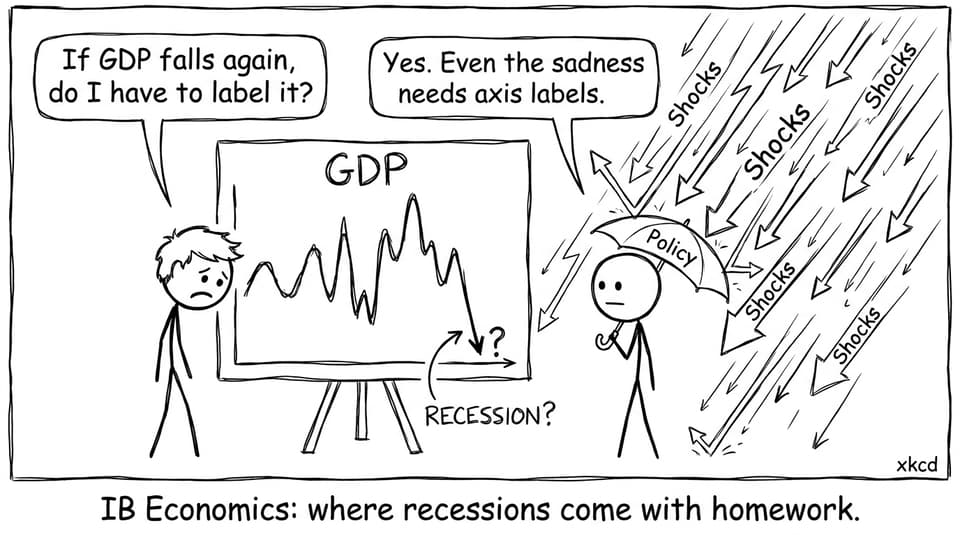
In IB Economics, the business cycle is a story of expansions and contractions. A recession sits in the downswing: output falls, firms cut production, and unemployment rises.
You do not need a perfect art piece in the exam. You need a labelled diagram and a sentence that interprets it: recession as a period of falling real output below potential, with weakening demand and/or disrupted supply.
If your diagram explanations feel fuzzy, build them from the equilibrium idea in: How Macroeconomic Equilibrium Is Determined.
Causes of a recession in IB Economics (AD fall vs AS shock)
Most recession explanations boil down to two routes:
Demand-side recession (AD shifts left)
Aggregate demand can fall if:
-
Consumers cut spending because confidence drops
-
Firms delay investment due to uncertainty
-
Interest rates rise (contractionary monetary policy)
-
Exports fall because trading partners slow down
To strengthen your AD explanations, revise the components and determinants with Determinants of AD Components Notes.
Supply-side recession (AS shifts left)
A recession can also come from higher costs or lower productive capacity:
-
Oil or energy price shocks
-
Wage-cost pressures
-
Supply chain disruption
This route matters because it can create a nasty combination: lower output and higher prices, which changes how effective demand-side policy will be.
Effects of a recession (link to macro objectives)
In IB Economics, effects are best organised by macro objectives:
-
Economic growth: real GDP falls; living standards may stagnate
-
Unemployment: cyclical unemployment rises as firms reduce output
-
Inflation: demand-side recessions often reduce inflationary pressure; supply shocks can raise it
-
Equity: lower incomes and job losses often worsen inequality
-
Fiscal position: tax revenue falls, welfare spending may rise, deficits can widen
To reinforce the full Topic 3 toolkit (notes, videos, practice), use: Macroeconomics Notes and Macroeconomics Flashcards.
Policy responses (and how to evaluate them)
A recession invites policy action, but IB Economics rewards students who explain the mechanism and then question the limits.
-
Fiscal policy: higher government spending or lower taxes can raise AD, but may increase debt and faces time lags. For an exam-ready framework, see Fiscal Policy Guide for IB Economics.
-
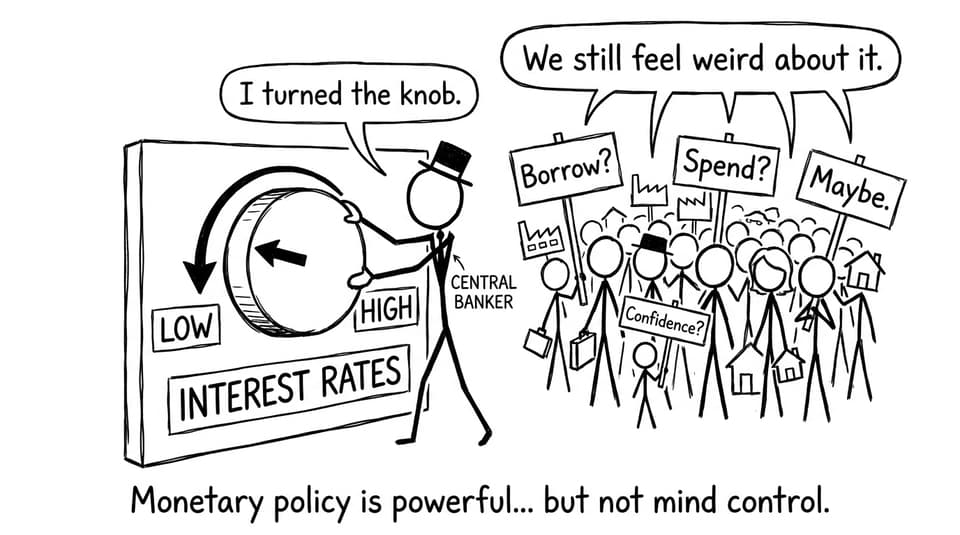
Monetary policy: lower interest rates can stimulate borrowing and spending, but confidence might be too weak for households and firms to respond strongly.
-
Supply-side policies: training, competition reforms, and productivity policies support long-run growth, but are slow to work.
For realistic rehearsal, RevisionDojo also connects your revision loop: Study Notes, Flashcards, AI Chat, the Questionbank, Grading tools, Mock Exams, Predicted Papers, the Coursework Library, and Tutors when you want feedback that doesn’t take a week.
The exam takeaway (and what to do next)
A recession is not just a definition in IB Economics. It’s a predictable bundle of diagrams, indicators, and policy trade-offs that keeps returning in different outfits.
If you want the fastest path to confidence, build a small routine: revise the core notes, drill targeted questions, and get feedback quickly. Start with IB Economics 3. Macroeconomics, then use the Questionbank feature to practise until your recession explanation becomes automatic, even when the headline feels loud.