


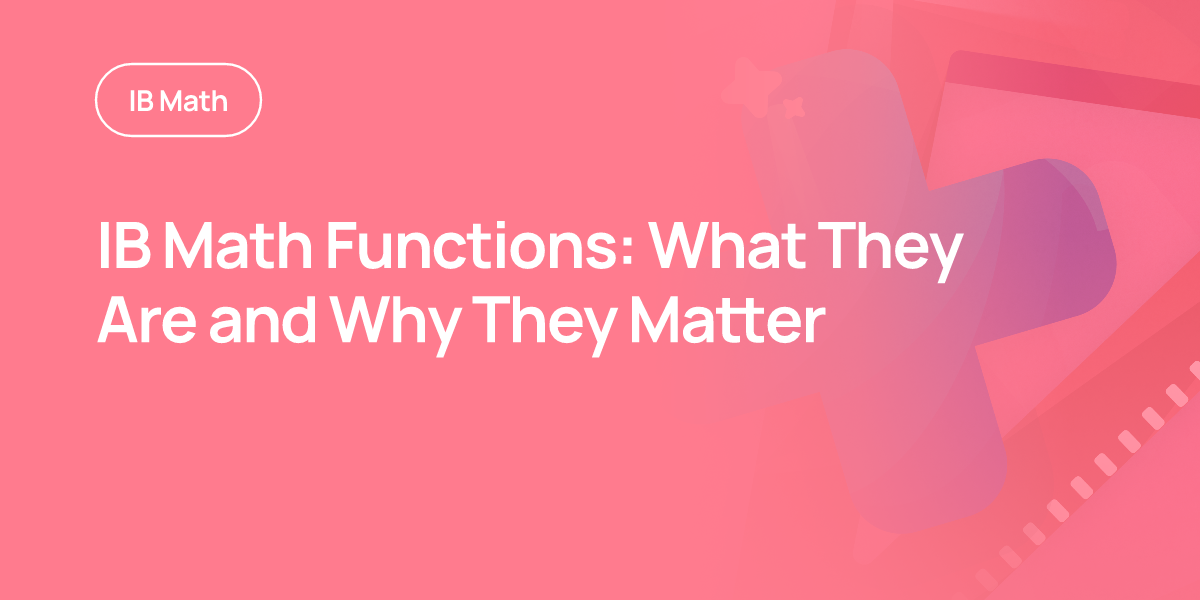
If you’ve ever stared at IB Math notation like f(x) and felt it was more “mystery novel” than mathematics, you’re not alone. Most students don’t actually struggle with the calculations first, they struggle with the idea. They can substitute numbers into a formula, but they’re not sure what a function really is. And in IB Math, that tiny gap quietly grows until it shows up everywhere: algebra, graphing, modelling, calculus, even the wording of exam questions.
A function is simple. But it’s also the language the course is written in.
What is a function in IB Math?
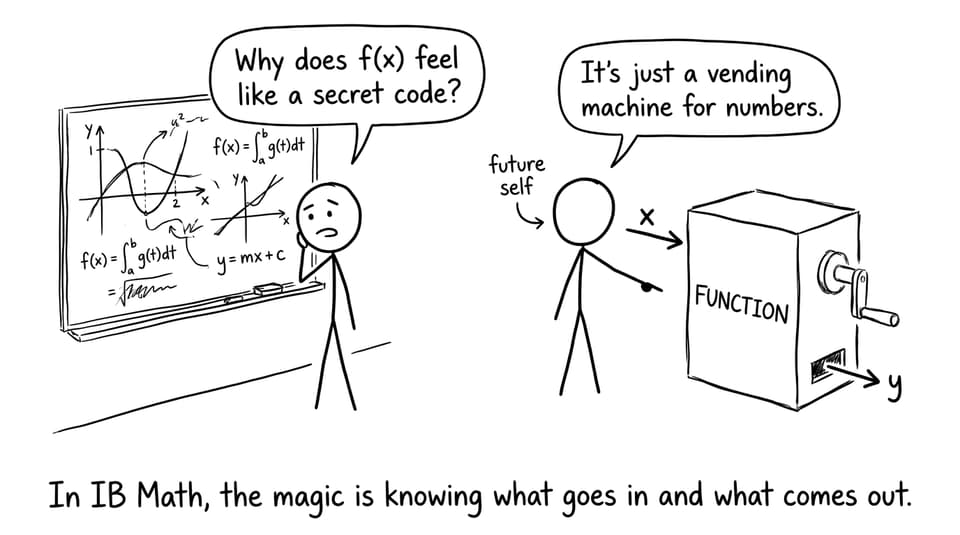
In IB Math, a function is a rule that connects each input to exactly one output. That’s it. It’s not “an equation.” It’s not “a graph.” It’s a relationship where every allowed x-value produces one y-value.
A helpful way to think about it is a mapping or machine: put in x, the function does its process, and you get out y. When you write y = f(x), you’re naming the process.
If you want the syllabus-aligned version (with questions, notes, and videos in one place), the best hub to anchor your understanding is IB Mathematics AA Functions.
A quick checklist before you answer any function question
When exams get fast, your brain wants shortcuts. In IB Math, functions reward calm routines. Before you do anything else, ask:
-
What is the input and what is the output?
-
What is the domain (allowed x-values)?
-
What is the range (possible y-values)?
-
Which representation is given: formula, table, graph, or context?
-
Does it pass the “one input, one output” rule?
For domain-focused practice (where marks are often lost quietly), read Why Is Finding the Domain of a Function So Tricky in IB Maths?.
Why functions feel confusing at first in IB Math
Most students meet functions through symbols: f(x), g(x), f(2). If no one pauses to translate, it feels like learning grammar without learning meaning.
Then IB Math adds a second twist: you’re expected to move between representations. The same function can be shown as a graph, a formula, a table, or a real-world story. The exam doesn’t just ask “calculate”, it asks “connect.”
If graphing and transformations are the part that makes things feel slippery, keep this nearby: How to Master Functions and Transformations (Graphing Toolkit).
What makes something a function (and what doesn’t)
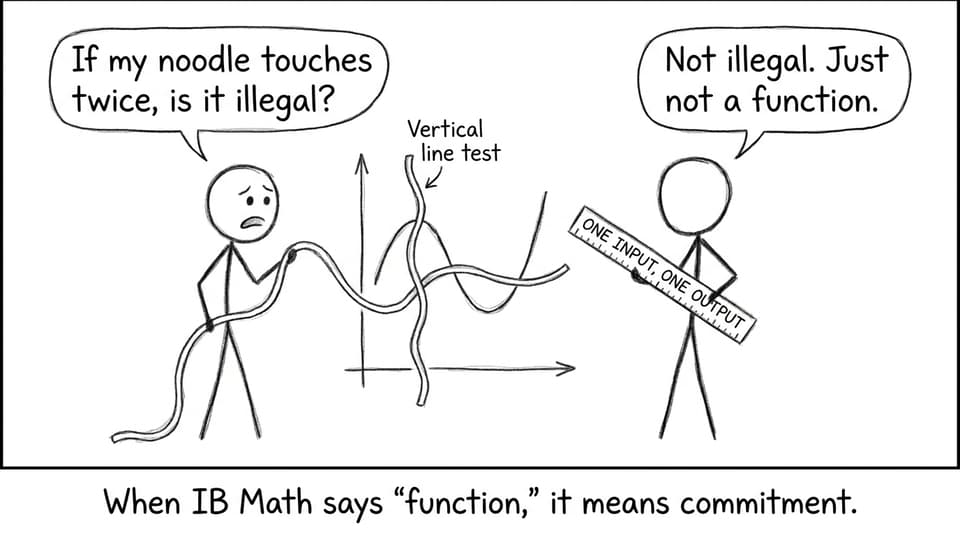
The defining test is the rule: each input has exactly one output.
That’s why a circle fails when you view it as y in terms of x: one x-value can produce two y-values. In graph terms, this becomes the vertical line test: if a vertical line hits the graph more than once, it’s not a function.
This matters in IB Math because later topics assume you’re working with valid functions when discussing inverses, transformations, and calculus. If the “function-ness” isn’t secure, everything built on top wobbles.
For targeted practice on notation, domain/range, and inverse-as-reflection skills, use SL 2.2 Functions, Notation, Domain, Range and Inverse as Reflection Questionbank.
Why functions are everywhere in IB Math
Functions are the course’s unifying concept. They let IB Math describe change in a single framework:
-
Modelling: turning a situation into something you can analyze.
-
Graph features: intercepts, turning points, asymptotes, behavior.
-
Transformations: shifting, stretching, reflecting a base relationship.
-
Calculus: derivatives and integrals are operations on functions.
-
Composite and inverse ideas: functions acting on functions.
When composite functions start feeling like you’re doing “math on math,” that’s normal. The fix is to think in processes, not symbols. This breakdown helps: Why Do Composite Functions Feel So Unintuitive in IB Maths?.
And if you learn best by watching a concept unfold step-by-step, use Functions Videos alongside practice.
Common IB Math mistakes with functions
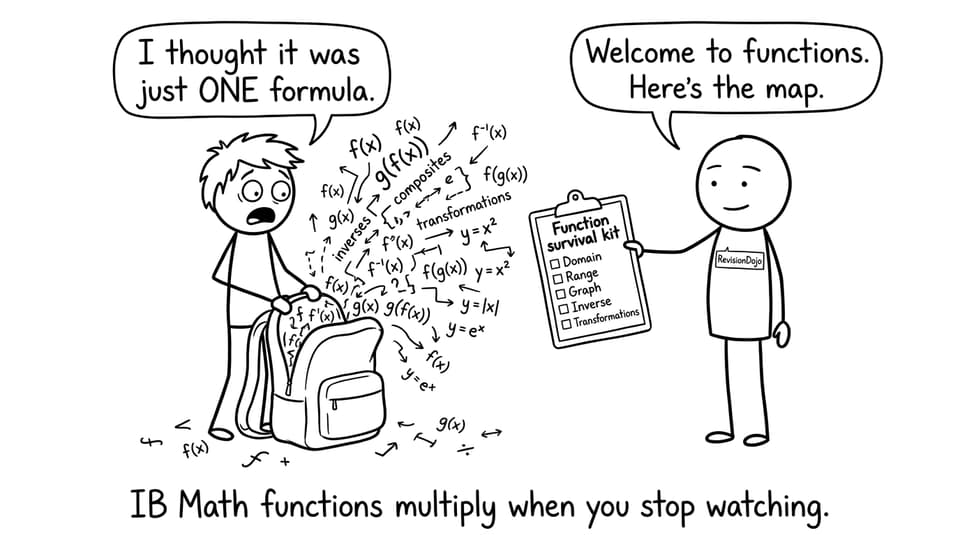
A few errors show up repeatedly in IB Math exams:
-
Treating every equation as a function (some are only relations).
-
Mixing up the function f with the value f(x).
-
Ignoring domain restrictions (especially with fractions, roots, and logs).
-
Doing transformations in random order rather than inside-to-outside.
-
Assuming composites commute: f(g(x)) is usually not g(f(x)).
For transformation confusion specifically, this article is a strong reset: Why Do Function Transformations Feel So Confusing in IB Maths?.
A final word: make functions your advantage in IB Math
The students who do best in IB Math aren’t the ones who memorize the most formulas. They’re the ones who treat a function like an object they can describe, test, and reshape.
RevisionDojo is built for that kind of understanding: a syllabus-aligned Questionbank, clear Study Notes, quick Flashcards, step-by-step Videos, and an AI Chat that helps you debug your thinking without judgment. Add Mock Exams, Predicted Papers, Grading tools, a Coursework Library, and Tutors, and you get a full system for turning “I can do the steps” into “I understand the structure.”
If you want to make functions feel automatic before exam day, start with IB Mathematics AA Functions and then practise daily until IB Math function questions feel like familiar territory, not a surprise.