
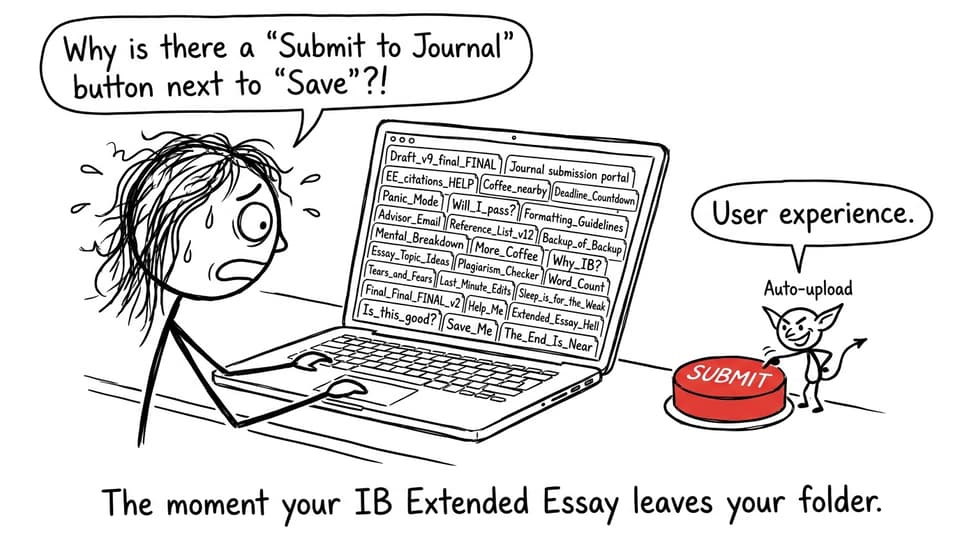
If you have ever clicked “share link” while half-asleep, you already understand how accidents happen in the IB.
One minute you are polishing your IB Extended Essay draft, juggling exam revision and caffeine. The next minute you realize it is live on a student journal page, a school site, or some submission portal you barely remember creating. It feels surreal because the work is yours. But it is also public. And the IB cares about public copies in a very particular way.
This article explains what “accidental publication” can trigger, how the IB tends to look at authorship and fairness, and the practical steps that protect you. You will also see how to keep your IB Extended Essay safe while you prepare for exams, using a system that does not rely on perfect memory.
Quick crisis checklist (save this)
If your IB Extended Essay gets published accidentally, do these in order:
-
Pause and take screenshots: the URL, date, journal page, and any submission confirmations.
-
Tell your IB coordinator immediately (before the similarity report surprises them).
-
Collect proof of authorship: drafts, version history, supervisor feedback, research notes.
-
Request takedown: email the journal/site administrator with a clear, polite request.
-
Write a short timeline: what happened, when, and what you did to fix it.
-
Keep revising for exams: do not let panic steal a week of preparation.
That is the backbone. Now let us walk through why it matters.
Why the IB Extended Essay is treated differently from “normal” school writing
The IB Extended Essay is not just a long assignment. It is an externally assessed piece of academic work that is supposed to be original, traceable, and submitted through your school for IB assessment.
That matters because the IB tries to protect two things at once:
-
Authenticity: the essay must clearly be your own work, created through a documented process.
-
Assessment fairness: examiners should assess what you submitted as a candidate, not something that has been circulating publicly.
If you want a broader refresher on how to run the EE process without burning out, RevisionDojo’s hub is a good starting point: IB Extended Essay Guides. And if you are still choosing or adjusting a question, these two guides are quietly life-saving during exam season: IB Extended Essay Research Question: 8 Proven Tips and How to Survive the IB Extended Essay Research Process.
What “published accidentally” usually means in practice
Students imagine “published” as a glossy academic journal. In reality, accidental publication of an IB Extended Essay can look like any of these:
-
You submitted a draft to a student journal, research showcase, or competition.
-
A teacher uploaded examples to a public class page.
-
You posted the PDF in a forum for feedback.
-
You used a tool or website that stores submissions (including some free checkers).
-
Your Google Doc permissions were set to public, and someone indexed it.
The common thread is not prestige. It is public availability and discoverability.
Will the IB treat it as plagiarism if it is your own IB Extended Essay?
This is where the story gets counterintuitive.
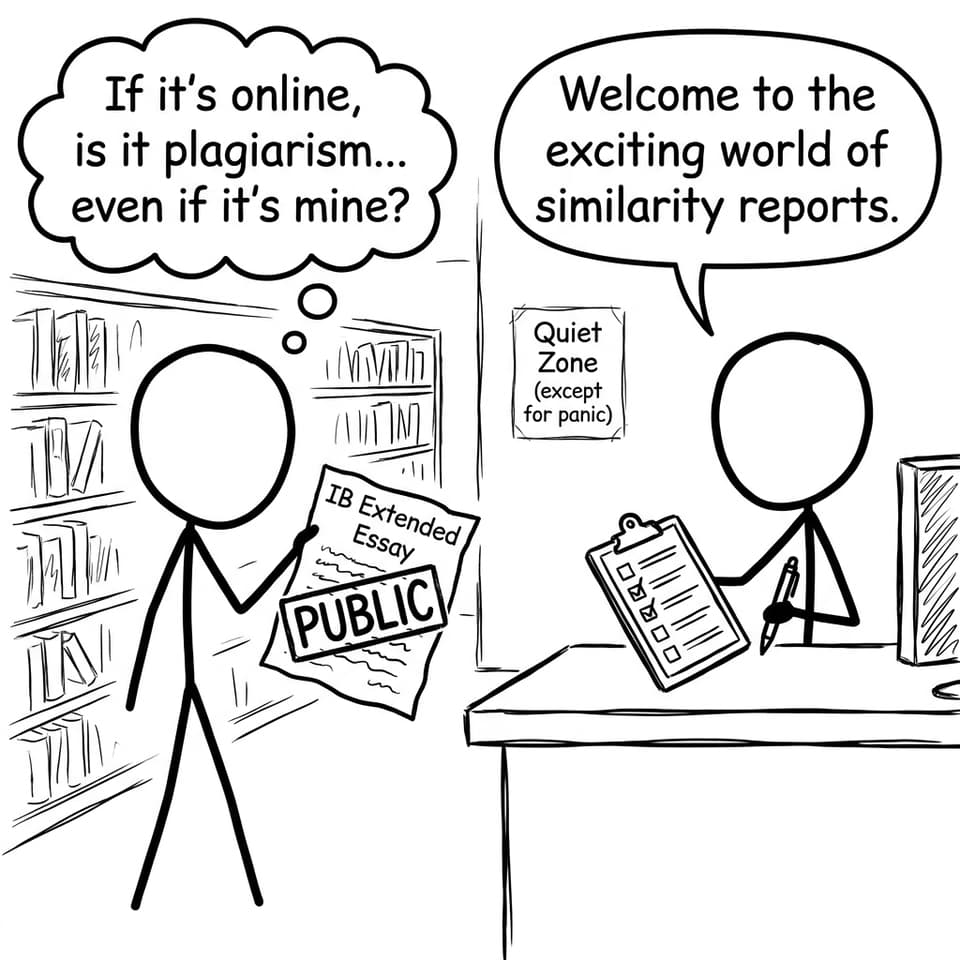
Similarity detection does not “know” intention. It matches strings of text. If your IB Extended Essay is online, a similarity report may flag large overlaps because the system is doing exactly what it was built to do: find matching text.
That does not automatically mean you will be accused of stealing from someone else. But it can trigger a review, and the burden shifts toward proving authorship and process.
For a deeper overview of how integrity is framed across the programme, these RevisionDojo reads are worth your time:
-
What Are IB's Expectations for Academic Honesty in the Extended Essay (EE)
-
IB Academic Misconduct Explained: How to Avoid Plagiarism and Collusion
-
What Happens if You're Accused of Academic Misconduct in the IB
How cases like this are typically evaluated (and what evidence matters)
Schools and the IB look for something simple: can you show that the IB Extended Essay online is yours, and that your submission is authentic?
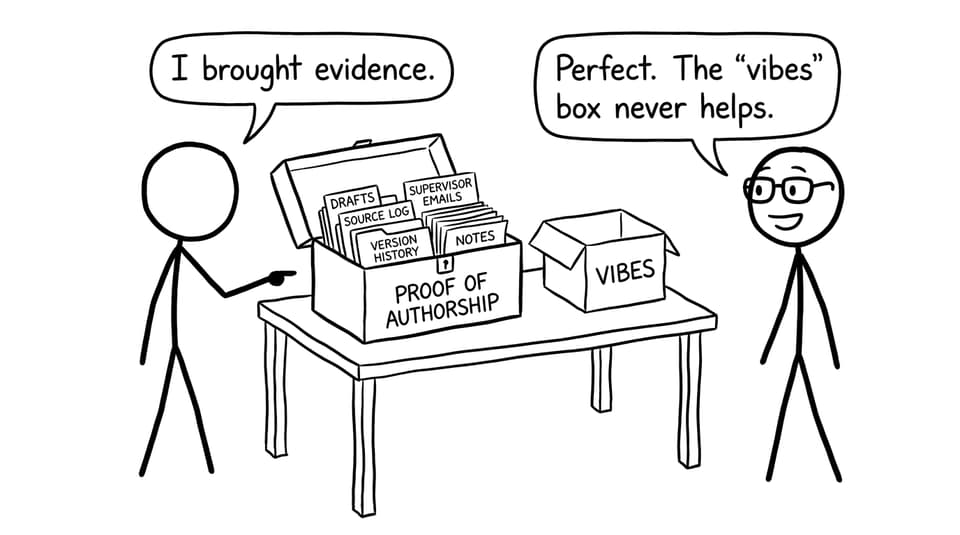
The strongest evidence usually includes:
-
Dated drafts (multiple versions, not just one “final”).
-
Version history (Google Docs history is extremely persuasive when it is clean and continuous).
-
Supervisor comments (annotations, meeting notes, feedback emails).
-
Research notes and a source log (showing reading, extraction, and synthesis).
-
Your planning artifacts (outline iterations, paragraph plans, argument maps).
Weak evidence looks like this:
-
A single PDF titled “final.”
-
A vague explanation without timestamps.
-
A story that does not match your document trail.
The calm truth is that an accidental publication is survivable when your process is visible.
What to do immediately if your IB Extended Essay is already in a journal
Time matters here, not because the IB is trying to punish you, but because fast action looks like good faith.
Contact your IB coordinator first
Tell them before they discover it through a report. Send:
-
the link,
-
screenshots,
-
a short timeline,
-
and what you are doing to remove it.
You are not “confessing” to wrongdoing. You are protecting yourself by being transparent.
Request takedown (politely, but clearly)
Email the journal editor or site admin. Ask for:
-
removal of the PDF,
-
removal of cached copies if possible,
-
and no further distribution.
Even if it cannot be fully erased from the internet, demonstrating that you tried matters.
Assemble an authorship packet
Treat it like you are building a case file.
Create one folder containing:
-
Drafts (named by date)
-
Supervisor feedback and meeting notes
-
Your bibliography development (early and late versions)
-
Research notebook or annotated sources
-
A short “process narrative” (half a page is enough)
This packet is also useful later if you are stressed and cannot remember what you did in October.
How to prevent accidental publication (without becoming paranoid)
Most students do not need stricter discipline. They need fewer points of failure.
Here is a prevention routine that keeps your IB Extended Essay private without making you feel like you are guarding a state secret.
Use private storage and check permissions weekly
Once a week, open your doc settings and confirm:
-
Sharing: restricted
-
Link access: off
-
Download/print/copy: limited when possible
This is the kind of boring habit that quietly saves diplomas.
Avoid “free” upload tools that store text
Many free services keep submissions in databases. That is not evil; it is their business model. But it is a bad match for an IB Extended Essay.
If you want to check your integrity habits and understand what is allowed, read: How RevisionDojo Helps You Maintain Academic Integrity While Studying and IB Coursework Plagiarism Check: Ensure Academic Integrity.
Build version control like a calm person
Use a simple naming convention:
-
EE_Draft_2026-09-14
-
EE_Draft_2026-10-02
-
EE_Final_2026-11-15
And keep a short changelog in a separate file. The goal is not perfection. It is traceability.
What if you actually want to publish your IB Extended Essay later?
Wanting to publish is not a problem. Timing is the issue.
After your diploma is awarded, you can adapt your IB Extended Essay into something public: a student journal piece, a blog essay, or even a research showcase. Many students also rework the argument for university writing samples.
If you are not sure whether your draft is strong enough to represent you publicly, calibrate first. RevisionDojo’s IB Coursework Examples: IA, EE and TOK Exemplars can help you see what high-scoring structure and voice look like without turning into a template.
Keeping exam prep steady while the EE situation is handled
The biggest hidden cost of a publication scare is not the investigation. It is the week of revision you lose to doom-scrolling.
This is where having one reliable system matters.
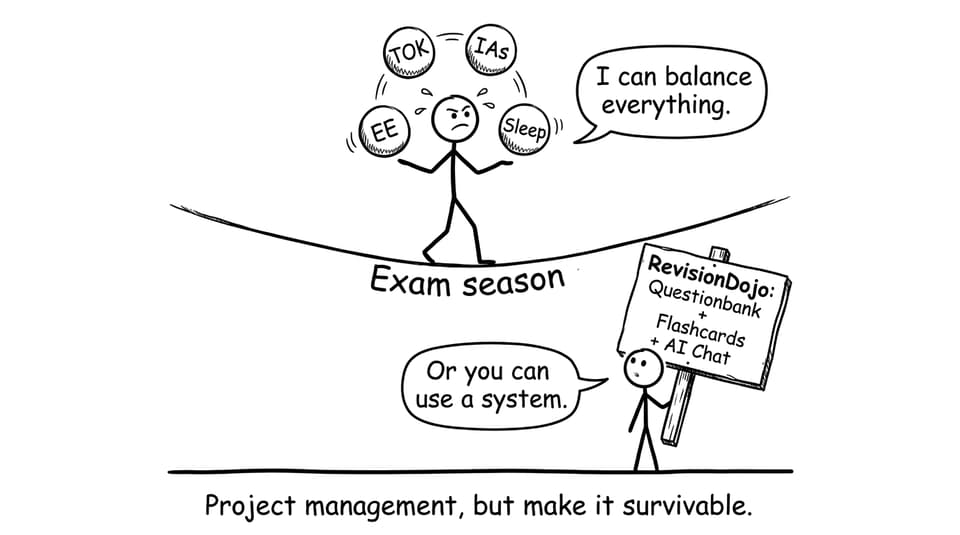
On RevisionDojo, you can keep your exam loop running while the IB Extended Essay issue is being resolved:
-
Use Questionbank to practice exam-style questions in short sets.
-
Use Flashcards for daily recall when your brain is fried.
-
Use AI Chat to clarify command terms and fix recurring mistakes without burning an hour.
-
Use Grading tools to get criterion-based feedback on coursework drafts when you are back in writing mode.
-
Use Predicted Papers and Mock Exams for timed pressure practice.
-
Use the Coursework Library and Tutors when you need human reassurance and direction.
If you want the bigger picture of how to stitch those pieces into a routine, this guide is a helpful map: Comprehensive IB Revision Made Easy: How RevisionDojo's All-in-One Platform Can Simplify Your Study Routine.
Closing: treat this like a process problem, not a character flaw
Accidents do not mean you are dishonest. They mean you are human, working inside systems that were not designed for stressed teenagers balancing exams and coursework.
If your IB Extended Essay gets published accidentally in a journal, your job is simple: act fast, document everything, and show a clear authorship trail. Then return to what actually protects your final results: steady, repeatable exam revision.
If you want a calmer way to do both, use RevisionDojo as your home base. Keep daily momentum with Questionbank and Flashcards, get unstuck with AI Chat, refine coursework with Grading tools and the Coursework Library, and add structure with Predicted Papers, Mock Exams, and Tutors. Your IB Extended Essay can still be yours, still be assessed fairly, and still become something you are proud to share later, just at the right time.