



The moment most IB Design Technology students misunderstand the marking
The night before a deadline, you can feel it: that quiet panic that says, What if this doesn’t look impressive enough? You add another sketch. Another render. Another paragraph describing what you “would test if you had time.”
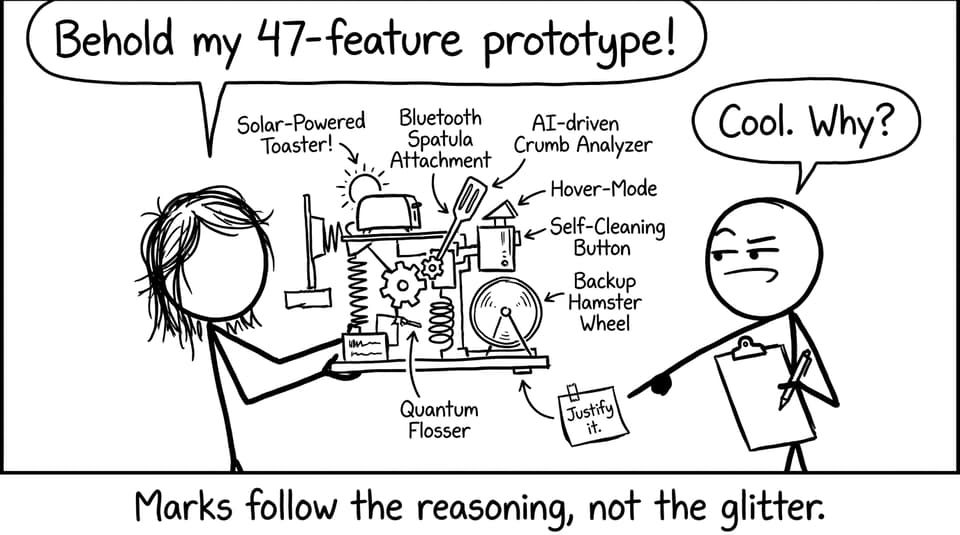
But IB Design Technology doesn’t work like an art show. And examiners don’t mark like they’re shopping for the prettiest prototype.
They mark what they can see. Thinking. Evidence. Justification. Evaluation that isn’t trying to hide.
If you remember one line, make it this: in IB Design Technology, marks follow the reasoning, not the glitter.
Quick checklist: the examiner’s “yes, I can award marks” signals
Use this short checklist before you submit an IA section or plan an exam answer in IB Design Technology:
-
A specific user and a real, evidence-based problem
-
Design requirements that are measurable and testable
-
Decisions explained with trade-offs (not vibes)
-
Testing that produces usable evidence (data, observations, feedback)
-
Iteration shown clearly: what changed, why it changed, and what improved
-
Evaluation that judges against requirements and admits limitations
If you’re building your revision system, the fastest place to anchor everything is the IB Design Technology Resources hub on RevisionDojo.
What IB Design Technology examiners reward most: visible thinking
The big secret is also the simplest: IB Design Technology examiners can’t give marks for what you meant to do.
They award marks for what you make explicit on the page.
That means you must write like your examiner has never met your user, never watched you prototype, and doesn’t know why your “obvious” decision was obvious. Your job is to turn design work into a readable chain of reasoning: evidence leads to decision leads to test leads to change leads to judgement.
When that chain is clear, even a simple project can score extremely well.
What examiners look for in the IB Design Technology IA
A narrow problem with a real user
A high-scoring IB Design Technology IA usually begins with restraint. Not “design a better chair,” but “design a seat support for this user, in this context, with these constraints.”
Examiners look for:
-
A user who is specific enough to interview or observe
-
Evidence the problem exists (not just a claim)
-
A problem statement that does not quietly jump to the solution
If you’re still choosing, the framing in How Do You Choose a Good IB Design Technology IA Topic? helps you avoid the common trap: ambitious product, weak problem.
Requirements that control your project (not decorate it)
Design requirements are where IB Design Technology projects quietly win or lose marks.
Top work uses requirements like guardrails:
-
Each requirement links to research or user evidence
-
Each requirement is testable (numbers, criteria, pass/fail conditions)
-
The evaluation later points directly back to these requirements
Students who want models can compare how strong projects do this in IB Design Technology IA Examples: What Top Projects Look Like.
Development that shows decisions, not just activity
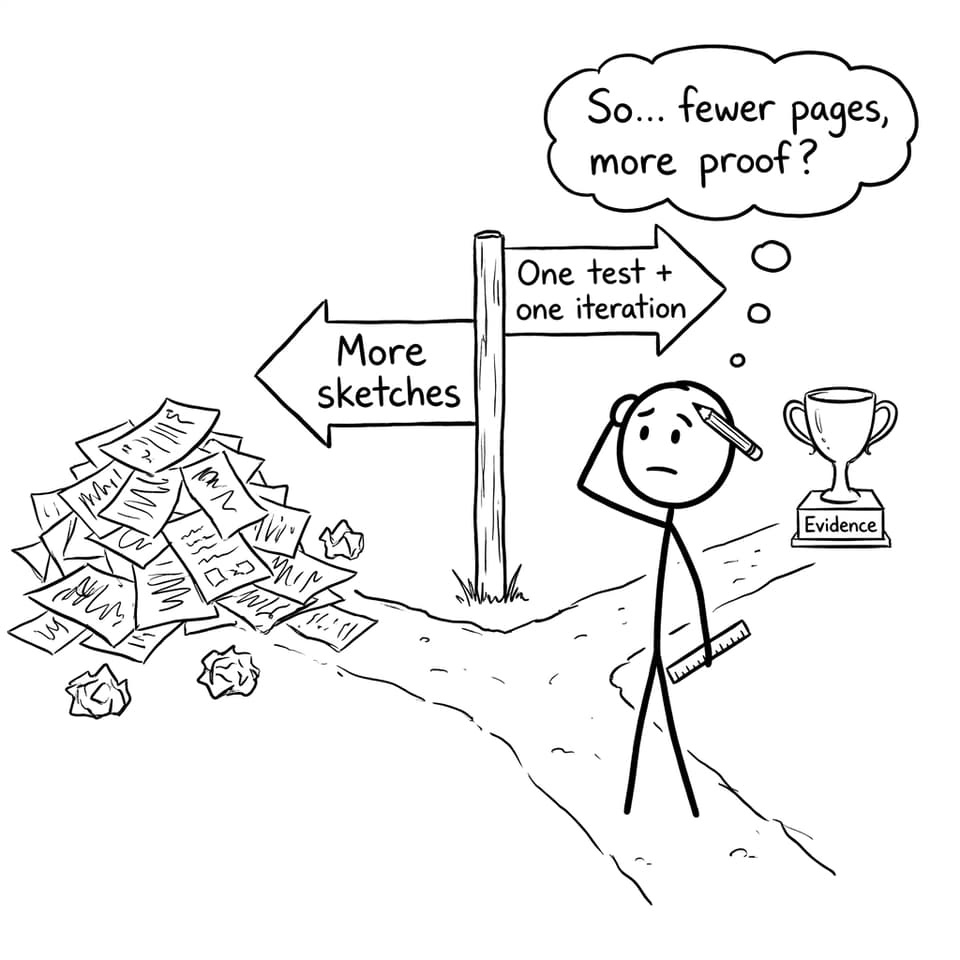
Examiners don’t award marks for “lots of pages.” They award marks for development that proves thinking.
So instead of adding more sketches, show:
-
Alternatives that solve the same problem differently
-
A comparison method (pros/cons, weighted matrix, constraints)
-
A clear, justified selection based on requirements
When you practise this skill in small pieces, it transfers to exams too. That’s why RevisionDojo’s IB Design Technology Questionbank is useful: it forces explanation under constraints.
Iteration that is proven, not promised
In IB Design Technology, “I iterated” is not evidence. It’s a sentence.
Examiners look for iteration that behaves like a lab report:
-
What you tested (method)
-
What failed or underperformed (result)
-
What you changed (specific variable)
-
Why that change should help (reasoning)
-
What improved after (new evidence)
If you want a clean framework for this section, How Do You Show Iteration in the IB Design Technology IA? lays out what “visible learning” actually looks like.
Evaluation that judges, admits, and concludes
Strong evaluation is calm. It doesn’t try to win an argument. It tries to tell the truth.
Examiners reward students who:
-
Evaluate directly against design requirements
-
Use test evidence and user feedback, not general opinion
-
Explain trade-offs (what got better, what got worse)
-
State limitations clearly and propose realistic improvements
To self-check your alignment, you can also compare your draft against the logic explained in How Is the IB Design Technology IA Graded?.
What examiners look for in IB Design Technology exams
Application beats memorisation
In exams, IB Design Technology rewards students who apply theory to a scenario: user needs, constraints, sustainability, materials, manufacturing, and consequences.
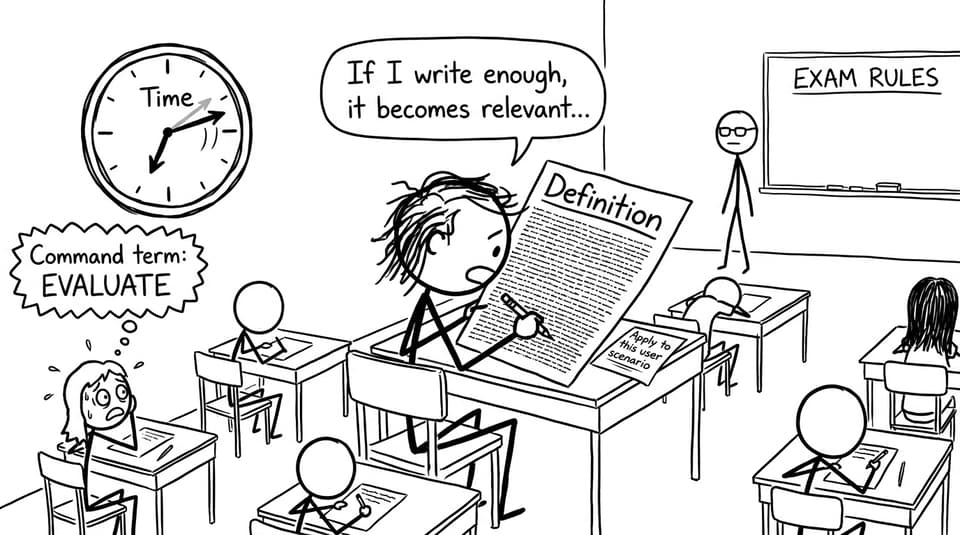
A definition without application is often a low-mark answer wearing a long coat.
RevisionDojo’s Best Study Strategies for IB Design Technology Students is a good reminder that the best revision loop is: understand it, recall it, apply it.
Command terms decide your ceiling
Command terms are not polite suggestions. They are markband instructions.
If the question says evaluate, you need a judgement, supported by strengths, weaknesses, and a conclusion. If it says analyse, you need relationships and cause-effect, not a list.
You can practise this quickly by doing timed sets and then using RevisionDojo’s AI Chat to ask, “What did I do that makes this analysis vs description?” That feedback loop is where students start writing like examiners mark.
Structure and relevance beat length
Examiners don’t reward long answers. They reward answers that stay on the rails.
A practical template for many IB Design Technology questions is:
-
Context sentence (user + scenario)
-
2-3 developed points (each linked to the scenario)
-
Evidence/examples (materials, processes, sustainability, ergonomics)
-
A judgement or conclusion if required
To build real exam stamina, pair the Questionbank with timed practice using IB Predicted Papers by IB Examiners (Free) and review your weak topics immediately afterward.
What IB Design Technology examiners do not care about (as much as you do)
Many students stress about the wrong things in IB Design Technology.
Examiners are usually not prioritising:
-
How expensive your solution is
-
How “futuristic” the concept sounds
-
How complex the final artifact looks
-
How many hours you spent
Effort only becomes marks when it creates assessable evidence: justification, testing, iteration, evaluation.
Closing: design work that reads like evidence
The most reassuring part of IB Design Technology is that the rules are fair once you see them. Examiners aren’t hunting for genius. They’re looking for a readable trail: problem, requirements, decisions, tests, iterations, evaluation.
If you want your preparation to match that reality, build a repeatable loop inside RevisionDojo: learn with Study Notes, retain with Flashcards, apply with the Questionbank, unblock confusion with AI Chat, and rehearse with Predicted Papers and Mock Exams. Then use Grading tools to check whether your “good idea” is also a mark-winning explanation.
Because in IB Design Technology, the strongest project isn’t the one that looks perfect. It’s the one that makes its thinking impossible to miss.