
A hook you can test in 30 seconds
The easiest way to spot weak research in IB Design Technology is also the fairest: does it change anything?
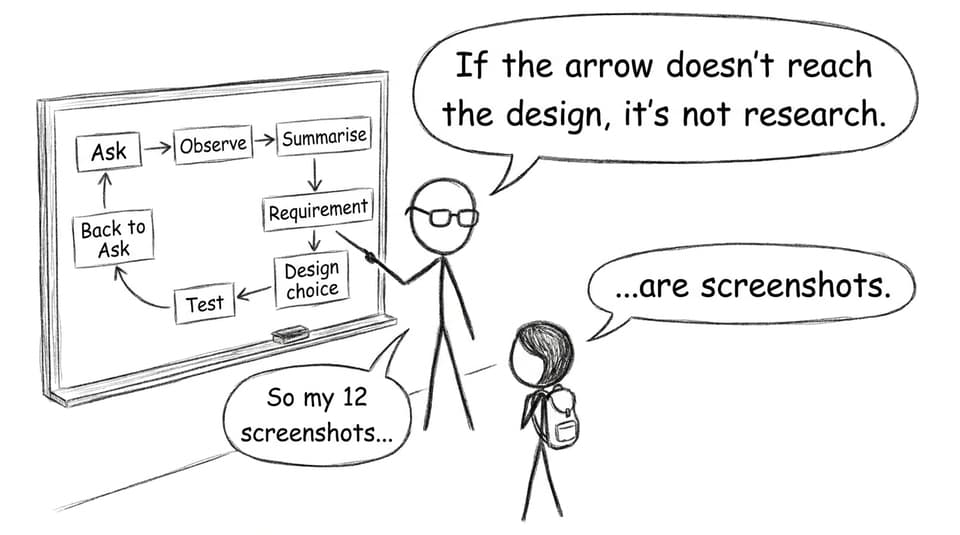
Most students don’t struggle because they “didn’t research enough.” They struggle because the research sits in the document like a museum display--nice to look at, impossible to use. Examiners aren’t rewarding how long you spent searching. They’re rewarding the chain of reasoning: user evidence --> design requirements --> design decisions --> testing --> improvements. That chain is what effective user research looks like in IB Design Technology.
The quick checklist: what “effective” must do
Use this as a pre-submission filter for IB Design Technology user research:
-
It focuses on a real, specific user (not “teenagers” in general).
-
It answers a design question you genuinely need answered.
-
It turns raw data into 2--5 clear insights.
-
It becomes measurable design requirements (specs you can test).
-
It reappears later: in development, iteration, and evaluation.
If one bullet is missing, your research may be “true” but not “useful.”
What counts as user research in IB Design Technology?
In IB Design Technology, user research is the process of finding out what a user needs, what limits them, and what context they live in--then using that evidence to make better design choices.
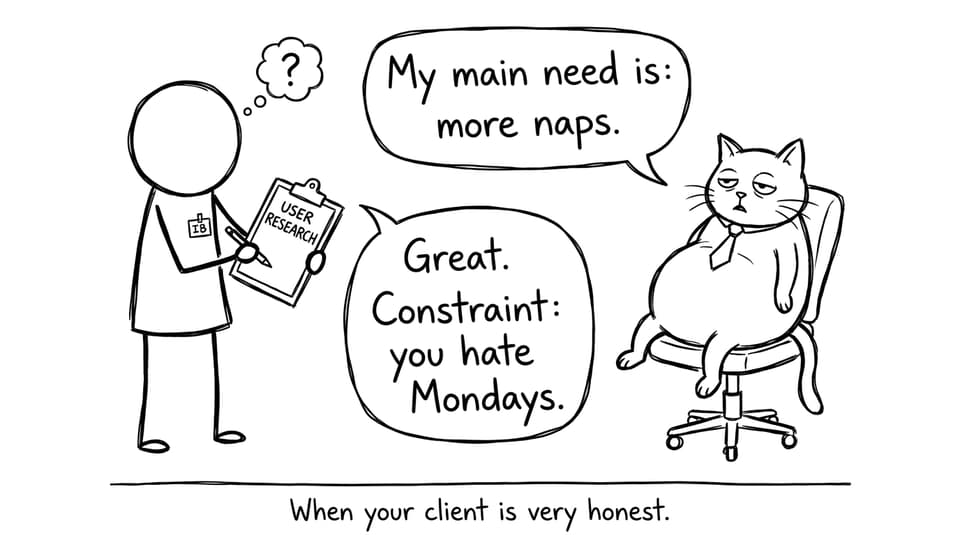
That includes needs (what they want), constraints (what they can’t do), preferences (what they’re likely to accept), and environment (where the product lives). It also includes contradictions, because real users are often inconsistent. Your job is to turn that mess into something design can work with.
If you want the syllabus language behind this, anchor your understanding in the IB Design Technology resources hub and the notes on strategies for user research.
Why effective user research earns marks (and weak research leaks them)
Effective user research in IB Design Technology doesn’t just “support” the project; it strengthens multiple assessment moments at once:
-
Problem justification becomes evidence-based, not opinion-based.
-
Design requirements become testable and traceable to the user.
-
Design development becomes a response to insights, not guesswork.
-
Testing and evaluation becomes fair, because you’re measuring against real needs.
If you’re unsure how examiners read the work, it helps to understand the criteria logic in How is the IB Design Technology IA graded? and tighten your focus using What makes a strong problem statement in IB Design Technology?.
The three qualities of effective user research in IB Design Technology
It is close to the client, not close to Google
The highest-value research is usually the most ordinary: you speak to the user, watch them, and ask better follow-up questions.
In IB Design Technology, this matters because it proves your design is user-centred rather than trend-centred. Secondary research (articles, product listings, general statistics) can support you, but it rarely replaces direct client input.
A simple upgrade: instead of “I found that many people experience discomfort,” write “My client reported discomfort after 12 minutes of use, especially at X point.” One is a fact. The other is a design lever.
It is targeted: every method answers a specific design question
Good research is shaped like a key, not a net. Before you collect anything, write the question it’s meant to answer.
Examples of questions that lead to marks in IB Design Technology:
-
What causes the current solution to fail in the user’s context?
-
Which features are non-negotiable vs. “nice to have”?
-
What physical constraints matter (size, reach, grip, strength, posture)?
-
What environmental constraints matter (noise, lighting, storage, cleaning)?
This is also how you avoid the classic mistake: researching after you’ve already chosen a solution. If you need help sequencing the process, follow the structure in Step-by-step guide to writing a winning IB Design Technology IA and the early-stage guidance in What is the best way to start the IB Design Technology IA?.
It produces insights, not transcripts
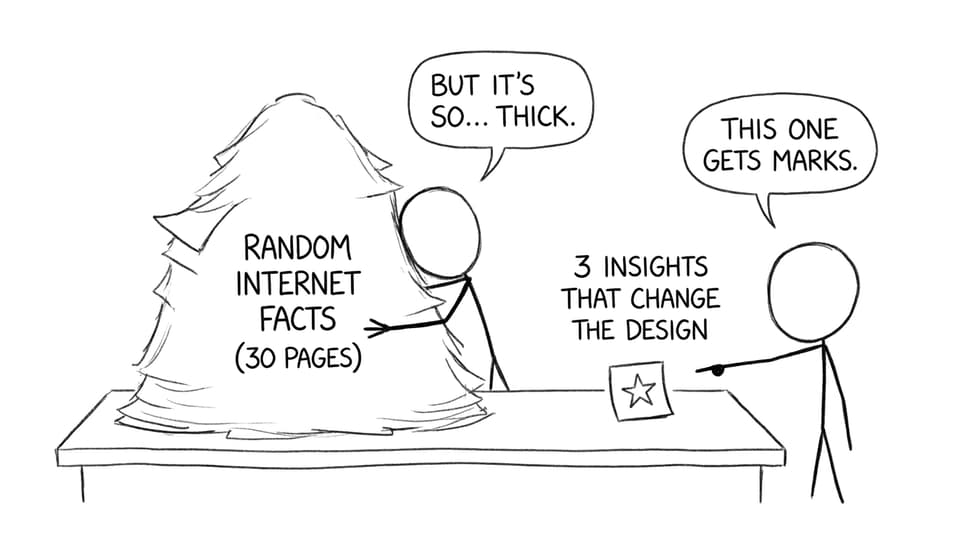
Examiners don’t award marks for raw material. They award marks for interpretation.
So after an interview, don’t paste a long Q&A. Summarise. Pull patterns. Name tensions. Then translate them into requirements.
Example translation:
-
Finding: “User forgets to charge devices and hates cables.”
-
Insight: Power access must be frictionless and visible.
-
Requirement: “Charging status must be visible from 2m; product must function while charging; cable management must prevent snagging.”
Methods that usually count as effective (when used properly)
Interviews and short conversations
In IB Design Technology, interviews work because they let you ask “why?” until the real need shows up. Keep them short, specific, and tied to your design questions. Use follow-ups like “when does that happen?” and “show me what you mean.”
Observation in context
Observation catches what people don’t think to mention. Watch the user using an existing product in the real environment, then annotate what you saw: awkward movements, workarounds, repeated steps, hesitation.
Combine it with a quick debrief: “I noticed you adjusted your grip three times. What were you trying to fix?” That single line can produce a requirement that improves ergonomics and usability.
Surveys (carefully)
Surveys can help when you need broader preferences, but only if you analyse them. In IB Design Technology, a survey with 40 responses and zero interpretation is just noise.
If you use surveys, keep the questions tight, avoid leading wording, and end with: “What’s the one change that would matter most?” Then quantify results and convert them into ranked requirements.
What does NOT count as effective user research?
In IB Design Technology, the following often looks busy but scores poorly:
-
Long blocks of copied secondary content.
-
Generic product reviews with no link to your user.
-
“Interesting facts” that never become requirements.
-
Research that appears once, then disappears during development.
If you want a ruthless standard for “how much is enough,” the logic in How much research do you need in the IB Design Technology IA? helps you cut what doesn’t move the design.
How to show user research in a way examiners can reward
A practical format that works in IB Design Technology:
-
Method (what you did, briefly)
-
Key evidence (quote, photo annotation, small table)
-
Insight (one sentence)
-
Design requirement (testable)
-
Design decision (what changed because of it)
This turns research into a visible decision trail. If you’re polishing your final document, pair this with the clarity-first mindset in Finalise and submit your IB Design Technology IA.
Closing: turn research into a scoring advantage
Effective user research in IB Design Technology is calm, focused, and slightly ruthless: keep what changes the design, cut what doesn’t. When your research leads to requirements, your requirements lead to decisions, and your testing points back to the user, the whole project reads like good thinking.
If you want a system that keeps that chain intact, RevisionDojo is built for it: use the Study Notes to lock in user-centred design theory, drill definitions with Flashcards, practise exam-style application in the Questionbank, and pressure-test your reasoning with AI Chat. When you’re drafting your IA, RevisionDojo’s Grading tools, Coursework Library, Mock Exams, Predicted Papers, and on-demand Tutors help you turn “research” into marks you can actually defend.
Your next step: pick one research finding today and write the requirement and design decision it forces. In IB Design Technology, that is what effective research looks like.


