

Metals don’t just look tough. They behave tough in a very specific way: you can hit them, press them, roll them, and they turn into sheets instead of snapping. In IB Chemistry, that simple observation is a quiet doorway into bigger ideas--bonding models, structure, and how to write explanations that earn marks.
If you’ve ever found yourself saying “metals are malleable because of metallic bonding” and then freezing, you’re not alone. The examiner wants the mechanism: what moves, what stays connected, and why the structure doesn’t collapse.
IB Chemistry quick checklist: the 5-point explanation
Use this when you need a fast, markscheme-friendly answer in IB Chemistry:
-
Metals form a giant lattice of positive metal ions.
-
Outer electrons are delocalized (a “sea” of electrons).
-
The attraction between ions and electrons is electrostatic.
-
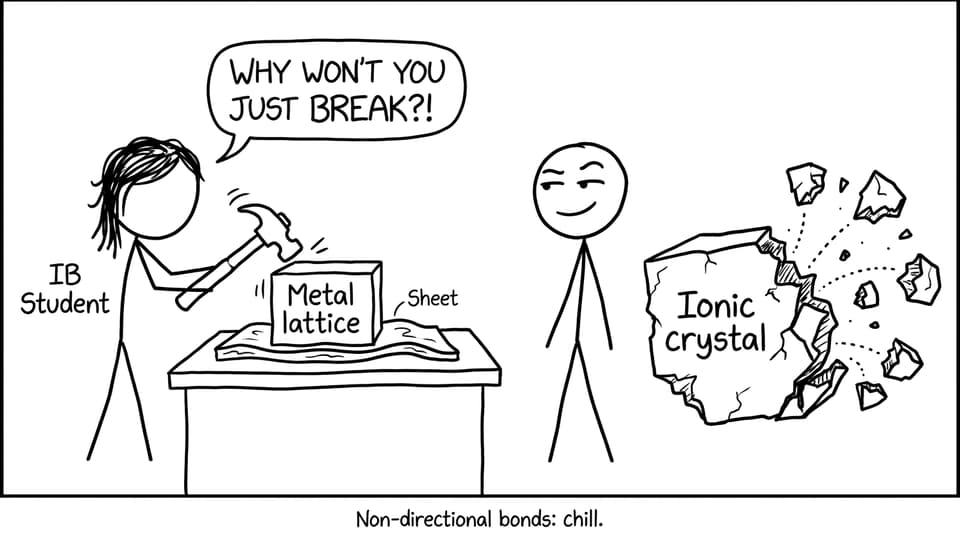
Metallic bonding is non-directional (works in all directions, not in fixed pairs).
-
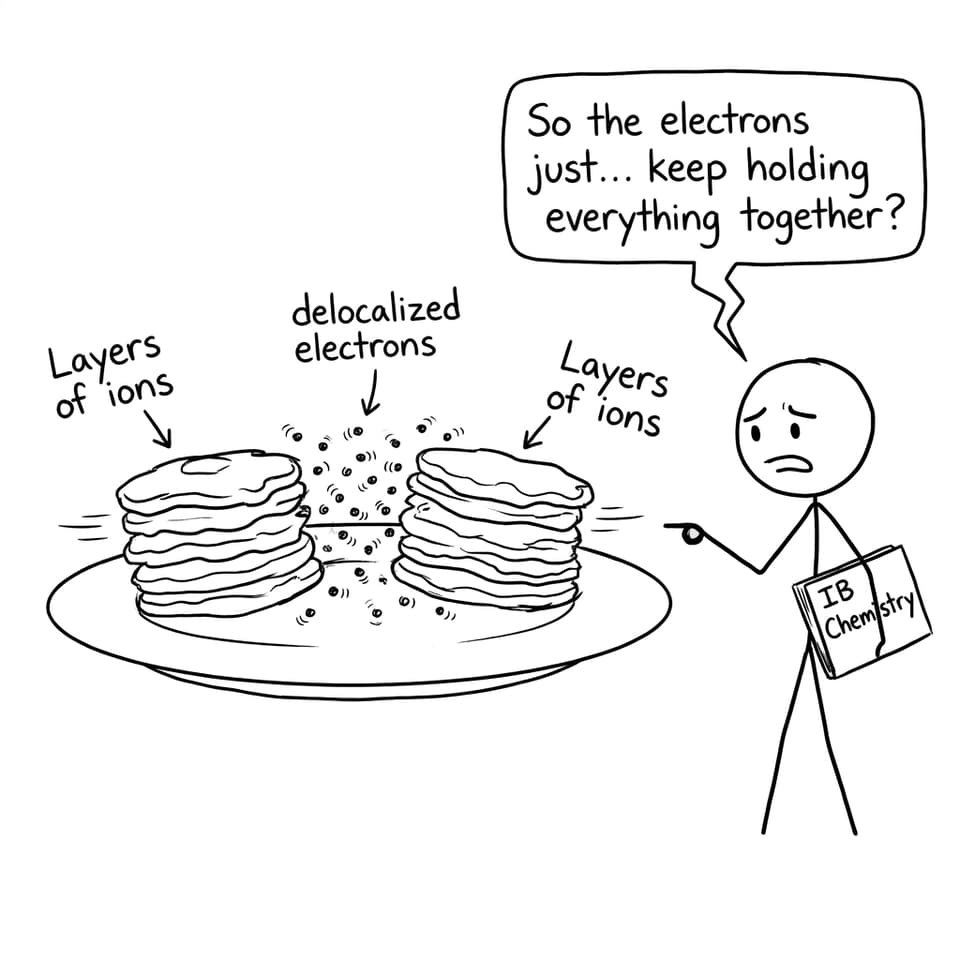
When force is applied, layers of ions slide, but electrons keep the ions held together.
To strengthen the broader bonding story, it helps to connect metallic bonding to the bigger unit: Chemical bonding and structure (IB) overview.
The metallic bonding model (what you’re actually picturing)
In IB Chemistry, metallic bonding is described as the electrostatic attraction between:
-
a lattice of positive metal ions (cations), and
-
a sea of delocalized electrons moving throughout the structure.
The key detail students often skip is that those electrons are not “shared between two atoms” (that’s covalent). They are shared by the whole lattice. That’s why metallic bonding scales up into a structure that’s both strong and flexible.
If you want a fuller walk-through with properties like conductivity and melting point, use: Metallic Bonding Explained for IB Chemistry.
What causes metals to be malleable? (the IB Chemistry version)
Layers can move without “snapping” the bonding
Metals are arranged as regular layers of ions. When you hammer or bend a metal, you force those layers to shift position. In a covalent network, shifting would mean breaking specific bonds. But in a metal, the bonding isn’t locked between fixed neighbors.
Because metallic bonding is non-directional, ions can slide and still remain attracted to the electron sea around them.
The electron sea “re-sticks” the structure instantly
As ions shift, the delocalized electrons redistribute. The attraction between ions and electrons continues in the new positions, so the lattice doesn’t fall apart.
This is the heart of the explanation in IB Chemistry: malleability happens because deformation does not destroy the electrostatic attractions holding the metal together.
If you’re also revising why metals conduct (often asked alongside malleability), this pairs perfectly: Why Metallic Bonds Allow Electrical Conductivity.
Why ionic and giant covalent solids are not malleable
Ionic solids: sliding layers creates repulsion
In an ionic crystal, if layers shift, you can force like charges next to each other (positive-positive or negative-negative). That creates strong repulsion, so the crystal fractures. In IB Chemistry, “brittle” is the property word, but “repulsion when layers shift” is the scoring reason.
Giant covalent: bonds are directional and expensive to break
In diamond or silicon dioxide, every atom is held by strong, directional covalent bonds. Try to deform it and you must break bonds throughout the network. That requires too much energy, so the structure resists bending and tends to crack.
If you want a broader way to describe how bonding sits on a spectrum (helpful for tricky data questions), see: Bonding as a continuum (S2.4.1) notes.
Exam tip: write it like a markscheme, not like a poem
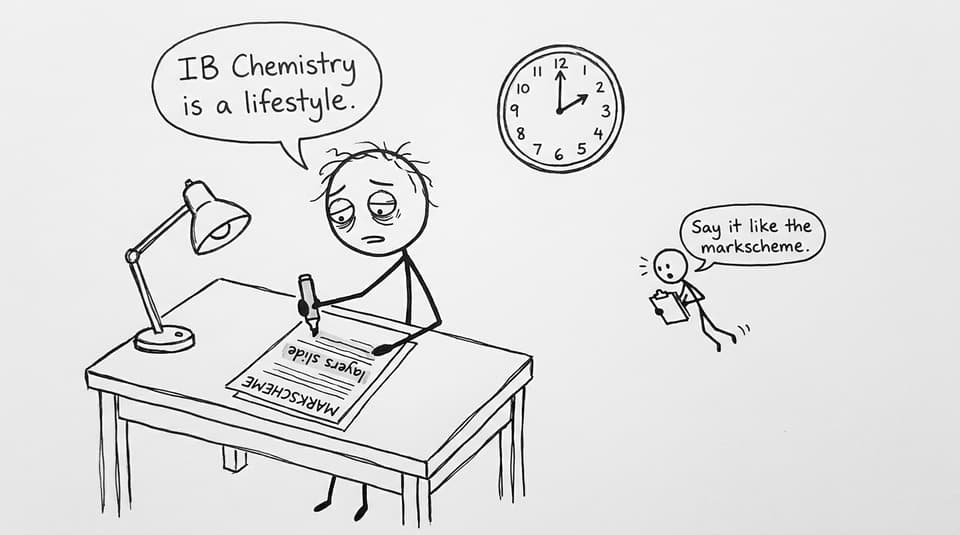
A high-scoring IB Chemistry explanation usually includes these exact pieces of language: layers slide, delocalized electrons, electrostatic attraction, non-directional bonding.
If you want targeted practice that trains those phrases under time pressure, use the S2.3 the Metallic Model Questionbank and the companion notes: S2.3.1 Metallic bonding and properties of metals.
Conclusion: the one-sentence IB Chemistry answer
Metals are malleable in IB Chemistry because their positive ions are arranged in layers that can slide, while a sea of delocalized electrons maintains non-directional electrostatic attraction and keeps the lattice intact.
When you’re ready to turn that explanation into marks, RevisionDojo is built for it: the Study Notes clarify the model, the Flashcards lock in the key phrases, the Questionbank and Mock Exams make the wording automatic, and AI Chat plus Grading tools help you polish explanations until they sound like an examiner wrote them. For a strong foundation beyond bonding, you can also sharpen your practical reasoning with Tips to improve your lab skills for IB Chemistry.